What Is a Space Maintainer? a Fair Lawn, NJ Guide
Wondering what is a space maintainer and if your child needs one? Our Fair Lawn pediatric dental experts explain why they're used and how they work. Call us.
Wondering what is a space maintainer and if your child needs one? Our Fair Lawn pediatric dental experts explain why they're used and how they work. Call us.
Your child is eating dinner, laughs, then suddenly shows you a baby tooth that should not have come out yet. Maybe there was a fall at school. Maybe a cavity led to an extraction. Maybe the tooth seemed fine a week ago, and now there is an empty space you were not expecting. For many parents in Fair Lawn, that moment brings the same questions. Is this a problem, do we need to act now, and will this affect the adult tooth later?
A space maintainer is a custom dental appliance that keeps an early empty space open until the permanent tooth is ready to come in. It works like a placeholder on a crowded shelf. If the spot closes too soon, the tooth meant for that space may not have a clear path.
That sounds stressful, but it is manageable.
The most helpful next step is having your child examined before nearby teeth have time to drift. Some children need a space maintainer, and some do not. The answer depends on your child's age, which tooth was lost, and how soon the adult tooth is expected. A local visit can give you a clear plan and some peace of mind, especially if you want guidance from a team focused on pediatric dental care in Fair Lawn.
Parents often worry that losing a baby tooth early automatically means braces later. Sometimes the mouth does fine on its own. Sometimes a small appliance prevents a bigger orthodontic problem. The goal is simple. Protect the space now so your child has the best chance of a healthy, orderly smile later.
If you are also unsure what timing is normal for baby teeth, Toothfairy's advice on baby teeth offers a helpful overview for parents.
A common scene looks like this. Your child comes into the kitchen holding a tooth in their hand, but instead of the usual excitement, there's confusion. Maybe the tooth wasn't loose for long. Maybe it came out after an injury. Maybe your child had a painful tooth removed and now you're staring at the empty space wondering if you've just traded one problem for another.
That next step depends on why the tooth was lost and when the adult tooth is expected to come in. A space maintainer is a fixed or removable dental appliance used after premature loss of a primary tooth to prevent arch length deficiency and preserve the eruption path for the permanent successor. It may be unilateral for one side or bilateral for both sides in the same arch, as outlined in this dental policy overview of space maintainers.

Many parents assume a baby tooth doesn't matter because it's going to fall out anyway. That's understandable, but baby teeth do important work while they are there. They help guide the permanent teeth into place.
A helpful parent resource on normal timing and healthy development is Toothfairy's advice on baby teeth. When the timing seems off, it's smart to have a dentist look at the space rather than guess.
A lost baby tooth isn't always an emergency, but it is always worth evaluating if it came out earlier than expected.
For families who want a closer look at children's preventive care, our pediatric dental care blog covers the kinds of issues we monitor as kids grow. In Fair Lawn, many parents also come from Ridgewood and Glen Rock for this kind of check because they want to know one simple thing. Is the space safe to watch, or does it need help staying open?
That answer is different for every child. The location of the missing tooth, the child's age, and how the adult tooth is developing all matter.
A baby tooth does more than help your child chew and smile. It also helps hold the right amount of room for the adult tooth developing underneath.
When that baby tooth is lost too soon, the teeth next to the space can start to lean or slide. Parents are often surprised by this part because the change is usually quiet. It does not always hurt, and you may not notice anything different at home right away. But inside the mouth, even a small shift can change the path the permanent tooth needs to follow.

A space maintainer protects room for the tooth that has not come in yet. That is the whole job.
You can picture it like keeping a doorway clear before someone walks through it. If furniture slowly gets pushed into that opening, getting through becomes harder. In the same way, if nearby teeth drift into an empty spot, the adult tooth may have less room to erupt normally.
That can lead to problems such as:
For a parent, this is usually about peace of mind as much as prevention. You want to know whether your child can be watched or whether a small appliance now could prevent a bigger issue later.
Waiting is sometimes reasonable. In other cases, waiting lets the space shrink little by little. That is why an exam in Fair Lawn can be so helpful. We look at your child's age, which tooth was lost, and how close the adult tooth is to coming in before recommending anything.
Families who are already thinking ahead about alignment often also read our page on why teeth shift after braces. The same basic principle applies here. Teeth respond to the space around them.
Practical rule: If your child loses a back baby tooth earlier than expected, have the area checked instead of assuming it will stay the same.
For many Fair Lawn parents, that is the primary value of a space maintainer. It is a simple step that protects space now, makes day to day monitoring easier, and can reduce surprises when the permanent tooth is ready to come in.
A lot of parent worry starts to settle once they see that a space maintainer is not one generic device. We choose the style based on a few practical questions. Which baby tooth was lost? Is it on the top or bottom? Is your child likely to do better with something that stays in place, or something that can be taken out and cleaned?
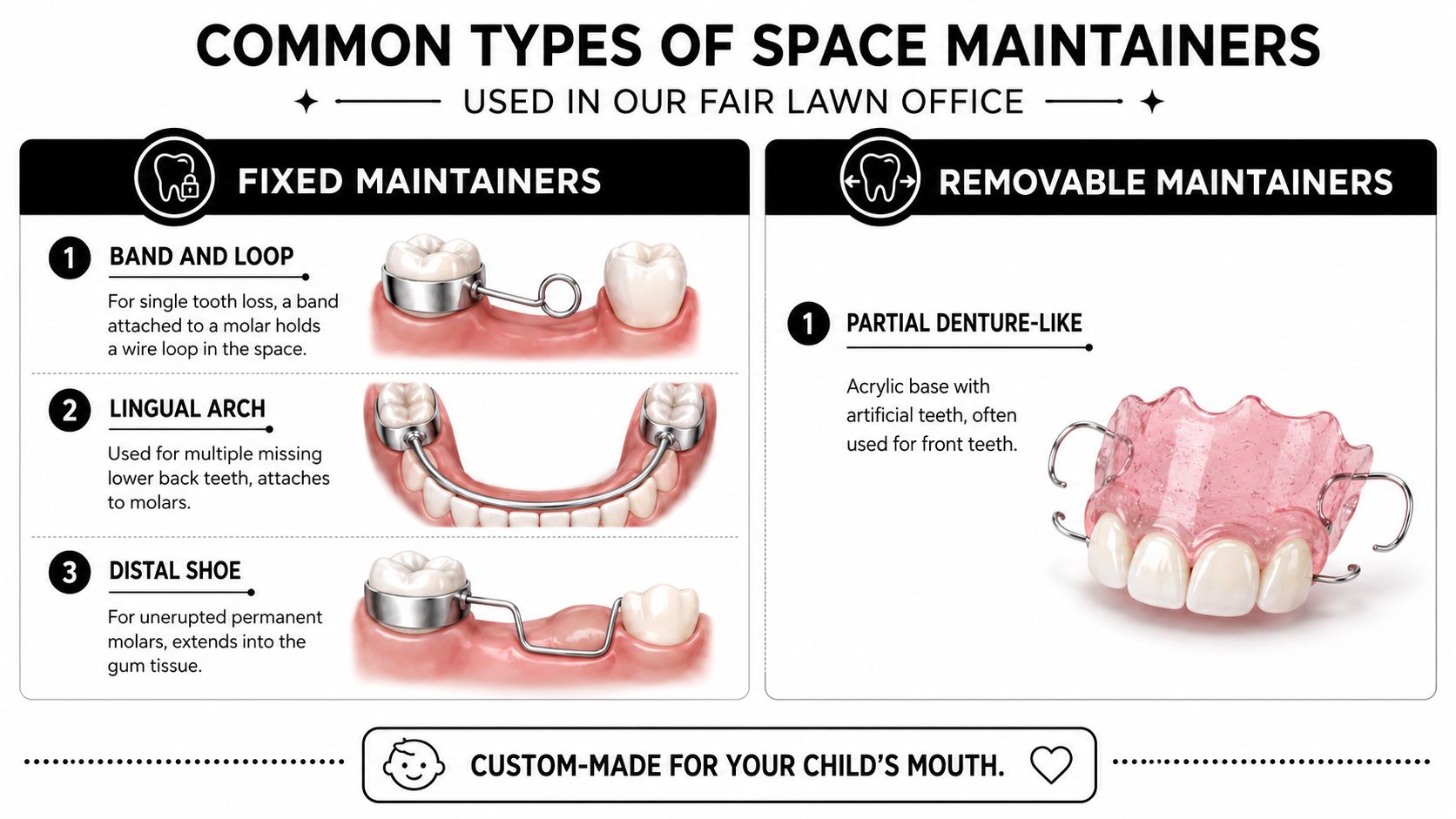
For many children in Fair Lawn, the first big decision is fixed versus removable.
A fixed space maintainer is cemented onto a tooth, so it stays put. Parents often feel more relaxed with this option for younger children because there is nothing to remember before school, sports, or bedtime.
A removable appliance can be a good choice in selected cases, usually for children who are old enough to follow directions well. It can be cleaned outside the mouth, which some families like, but it only works if it is worn consistently.
Here is a simple guide to the appliances parents ask about most often in our office:
| Type | Best known use | What a parent should picture |
|---|---|---|
| Band-and-loop | Usually for a single missing tooth | A small band attached to one tooth with a wire loop holding the space open |
| Lingual arch | Often used when more than one lower tooth is involved | A wire resting along the inside of the lower teeth to help preserve space across the arch |
| Distal shoe | A more specialized option in selected cases | An appliance that extends slightly under the gums to guide the tooth behind the missing space |
| Removable appliance | Selected children who can cooperate well | Similar to a retainer, with an added role of holding space |
If your child lost one back baby tooth early, a band-and-loop is often the easiest appliance for parents to understand. It works like a placeholder in a parking spot. It keeps neighboring teeth from drifting into an area the adult tooth will need later.
A lingual arch is used more often when we need to preserve space in the lower back teeth on both sides. Instead of guarding one gap, it helps hold the shape of the lower arch more broadly.
A distal shoe is less common and more specialized. We use it only in the right clinical situation, because it is designed to guide the eruption of the tooth behind the missing baby tooth. Parents usually have more questions about this one, and that is completely normal.
Space maintainers are temporary. Their job is to hold space until the permanent tooth is ready, not to stay in forever.
One commonly cited review of appliance longevity reported a median survival time of 7 months. In that report, band-and-loop maintainers lasted the longest at a 13-month median survival, while the lower lingual holding arch had the shortest median survival at 4 months, according to the American Dental Association's MouthHealthy page on space maintainers.
For parents, the practical takeaway is simple. A space maintainer needs checkups. It may loosen, bend, trap food, or need to come out once the adult tooth starts coming in. A shorter lifespan does not mean the treatment was a mistake. It usually means the appliance did its job during a specific window of time.
The best space maintainer is the one that matches your child's missing tooth, stage of development, and day-to-day ability to keep it clean.
That is why two children in Fair Lawn who both lost baby teeth early may leave with different recommendations. The appliance is custom selected for the mouth in front of us, not chosen from a one-size-fits-all checklist.
Your child loses a baby tooth earlier than expected, and one of the first questions parents ask is, "What will the appointment be like?" In most cases, the process is simpler and gentler than families expect. The hardest part is usually the worry before the visit, especially when your child is nervous and you are trying to picture every step ahead of time.

The first appointment is usually focused on checking the area and deciding whether a space maintainer is the right next step. We examine the gap, look at the neighboring teeth, and consider how the adult tooth underneath is developing. Parents often feel relieved here, because the situation starts to feel more concrete once someone walks them through what is happening in plain language.
If your child does need a space maintainer, we then gather the details needed to make it fit properly. That may mean taking an impression or using a digital scan. A digital scan can be especially helpful for children who dislike gooey materials, but often, the greatest difference comes from a calm approach, simple explanations, and giving your child time to get comfortable.
At the placement visit, we try the appliance in first and make small adjustments if needed. If your child is getting a fixed space maintainer, we secure it in place with dental cement so it stays where it should.
The appointment is usually short.
Afterward, many children notice the appliance with their tongue and talk a little differently for a day or two. That is a normal adjustment, much like getting used to a new pair of shoes. The mouth learns quickly, and most children settle in faster than parents expect.
A short video can also make the idea feel less intimidating for parents and kids.
How the visit is presented matters. In our Fair Lawn office, we often pair this kind of treatment planning with preventive care, and we may use digital scanning when it fits the child and the case. For children who feel especially anxious about dental treatment, sedation options may also be discussed if appropriate.
Parents also want to know the same practical thing. Will it hurt? Placement is usually well tolerated because it is generally a fitting procedure, not a surgical one. What helps most is preparing your child with a simple explanation: the space maintainer is there to hold the spot open, like saving a seat, until the grown-up tooth is ready to come in. For many Fair Lawn families, that understanding brings real peace of mind before the appointment even begins.
Home care is where parents make the biggest difference. A space maintainer can do its job well, but it still needs daily attention.
Clinical guidance emphasizes cleaning around bands and wires and avoiding sticky or hard foods that can dislodge or deform the appliance, as explained in this overview of space maintainer care.

Some foods place extra stress on a fixed appliance.
Watch for changes your child may not mention clearly. A child might say, "It feels weird," when what they really mean is that something is loose.
If the appliance starts to wiggle, pokes the cheek, traps a lot more food than before, or suddenly feels different, call your dentist rather than waiting for the next routine visit.
A space maintainer is helpful, but it isn't maintenance-free. Parents deserve the full picture.
A retrospective analysis of 100 children ages 1 to 5 treated between 2017 and 2022 found that early tooth loss leading to a space maintainer was caused by caries in 38% of cases and trauma in 62%. The same study reported complications including resin tooth fracture in 41%, appliance detachments in 28%, and gingivitis in 26% on this PMC article about children with space maintainers. That doesn't mean problems are guaranteed. It means follow-up matters.
Most issues aren't dramatic. A band may loosen. The area may be harder to brush well. Gums can get irritated if plaque builds around the appliance.
The same study also reported other complications, which is another reason younger children need close supervision and regular checks. If something changes, we want to catch it early while the fix is simple.
Sometimes, yes. Depending on the child, the tooth involved, and the eruption stage, a dentist may recommend monitoring instead of placing an appliance right away. In other situations, another type of appliance or later orthodontic guidance may make more sense.
Call your Fair Lawn dentist if you notice any of these:
The best parent mindset is simple. Don't panic, but don't ignore changes.
If your child lost a baby tooth early and you're not sure whether the space needs protection, schedule an evaluation with Dental Professionals of Fair Lawn. Families in Fair Lawn, Ridgewood, and Glen Rock can get a clear, practical assessment, guidance on whether a space maintainer is needed, and support with follow-up care so your child's smile stays on track.