What Are Dental Bridges: Types, Benefits & Cost
Discover what are dental bridges. Our Fair Lawn experts explain types, costs, and benefits. Find out if they're right for you. Schedule your consultation!
Discover what are dental bridges. Our Fair Lawn experts explain types, costs, and benefits. Find out if they're right for you. Schedule your consultation!
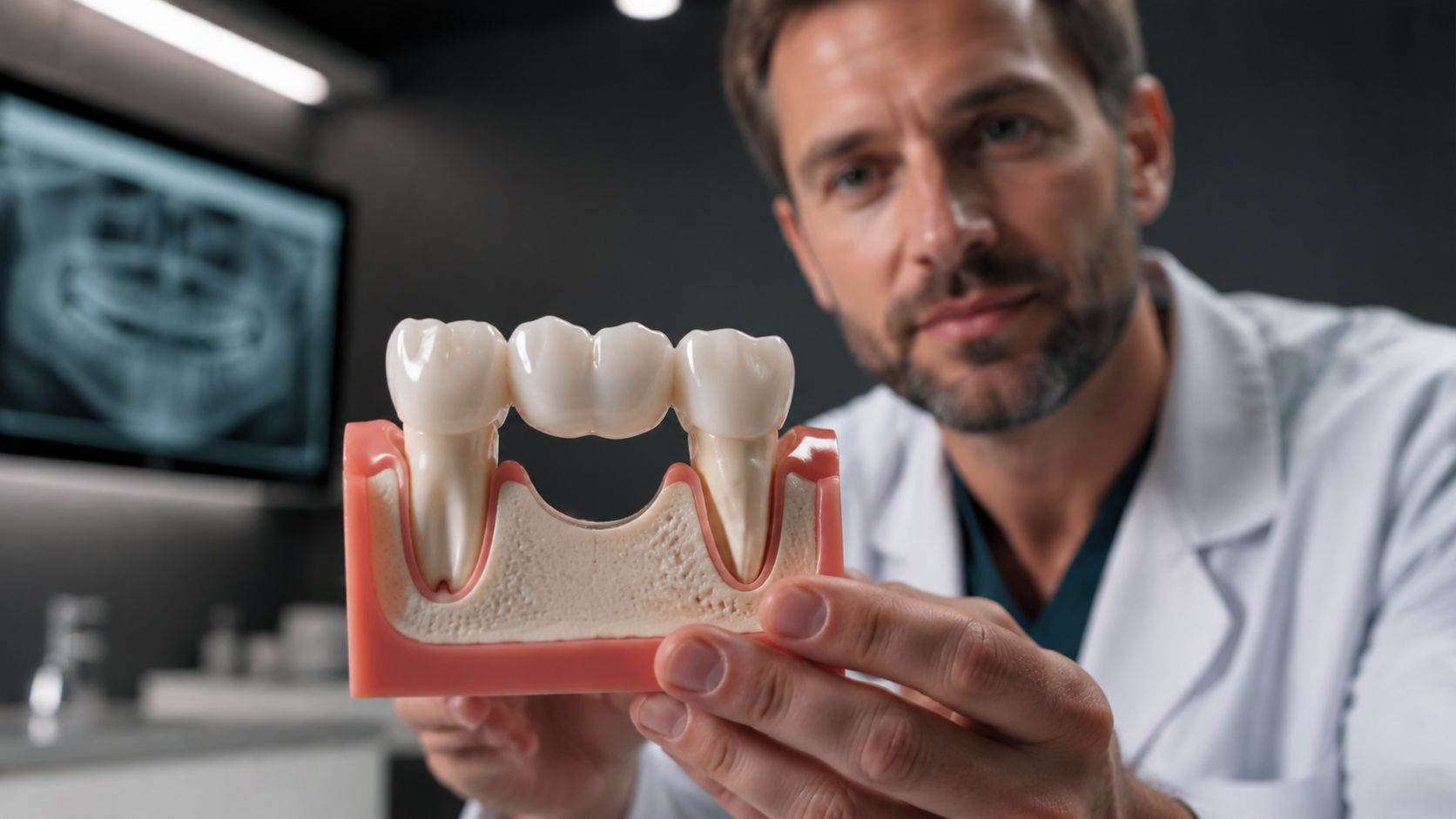
If you're reading this because you've been hiding one side of your smile, chewing on the other side of your mouth, or wondering whether that gap is going to cause bigger problems, you're not alone. Losing a tooth changes more than appearance. It can affect how you eat, how you speak, and how confident you feel in everyday moments.
Patients around Fair Lawn often ask a simple question with a lot behind it: What are dental bridges, and are they the right fix for me? The answer depends on where the missing tooth is, what the nearby teeth look like, and whether you're also considering options like dental implants, crowns, or a removable partial denture.
A missing tooth usually doesn't start as a dental topic. It starts as a real-life moment. You smile in a photo and notice the gap. You bite into something and stop because it doesn't feel right. You start wondering if people can tell when you talk.
That's often when people begin searching for a dentist near me or a dentist in Fair Lawn, NJ who can explain their options clearly and without pressure. Families in Fair Lawn, Ridgewood, and Glen Rock want more than a quick fix. They want a plan that makes sense for their health, comfort, and budget.
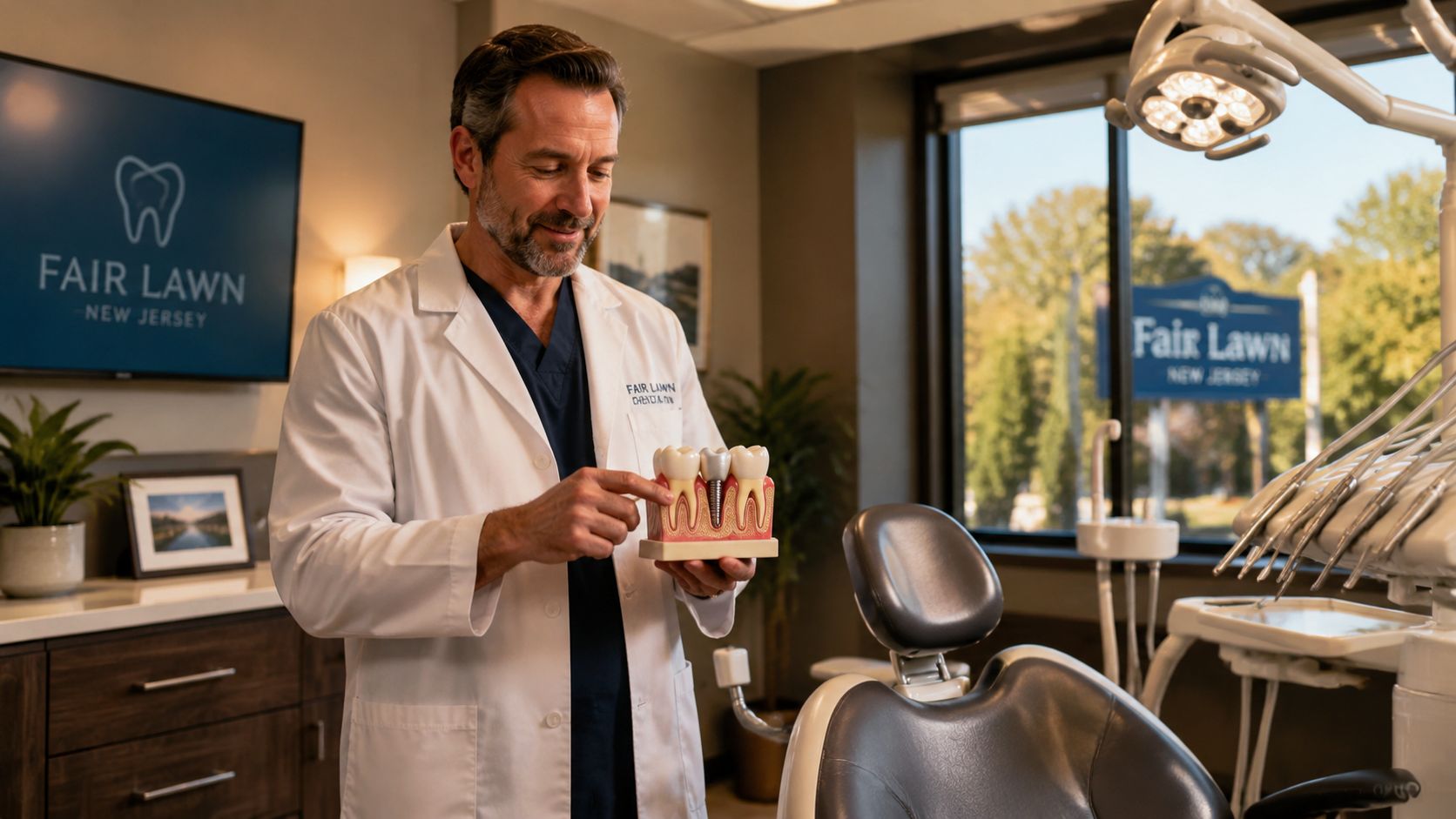
Some patients come in because a front tooth is missing and they feel self-conscious. Others are missing a back tooth and think it isn't urgent because it doesn't show. In both cases, the concern is valid. Teeth work as a team, and when one is gone, the rest of the bite can start compensating.
A bridge is one of several restorative dentistry options that may help rebuild that missing section of your smile. It can also be part of a bigger treatment conversation that includes dental implants near me, cosmetic dentistry, tooth extraction, or even urgent care if the tooth was lost suddenly.
Local perspective: The best treatment isn't always the newest one. It's the one that fits your mouth, your goals, and the condition of the teeth supporting it.
Some people want the fastest fixed solution. Some want to avoid removing a partial denture. Some want to compare a bridge with an implant because their neighboring teeth are still healthy. Those are exactly the kinds of questions a good consultation should answer.
If you're looking for an emergency dentist, a long-term restorative plan, or a new office for cleaning and exams, it helps to work with a team that can look at the full picture instead of treating the gap in isolation.
A dental bridge does what its name suggests. It bridges the space left by a missing tooth. Think of a small span crossing a gap. The replacement tooth sits in the open space, and the support comes from teeth or implants beside it.
In simple terms, the artificial replacement tooth is called a pontic. The supports are called abutments. If the bridge is tooth-supported, the teeth next to the gap are usually fitted with crowns that hold the bridge in place.
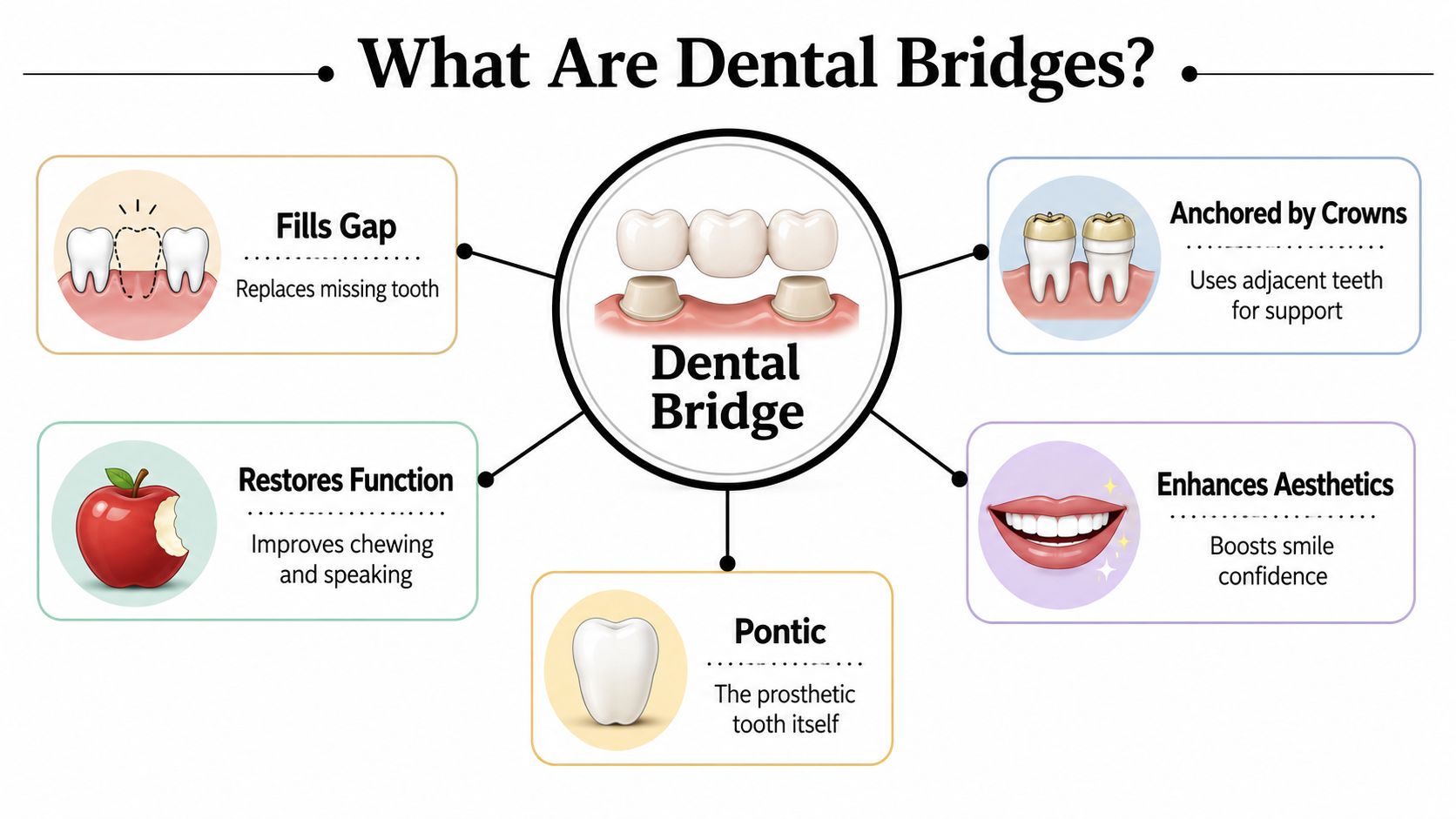
If you're missing one tooth between two teeth, the bridge can use those neighboring teeth as anchors. The middle tooth fills the empty space so your smile looks complete again and your bite has support where it's been missing.
That sounds straightforward, but patients often get confused about one point. A bridge doesn't “grow” into place. It's a carefully made restoration designed to fit your bite and sit securely on its supports.
Dental bridges aren't new or experimental. Historical accounts show tooth replacement devices were used as early as 700 BC, and one U.S.-based source estimates that about 15 million Americans have chosen a bridge or crown to replace a missing tooth, as noted in this dental bridge history overview.
A short visual can make that easier to understand in real time:
A bridge can help with more than appearance. It may improve:
Many people ask, “What are dental bridges really for?” The practical answer is simple. They replace a missing tooth in a fixed way so your mouth can work and look more normal again.
For many adults, that combination of function and appearance is exactly why bridges remain such a common treatment in modern dental care.
Not every bridge is built the same way. The right type depends on where the gap is, how many teeth are missing, the condition of the surrounding teeth, and whether implants are part of the plan.
A traditional fixed dental bridge is the most common type and is typically used to replace 1 to 3 consecutive missing teeth, supported by crowned teeth on each side, according to Cleveland Clinic's dental bridge overview.
Some bridge types are common. Some are more selective. What matters is not memorizing the names. What matters is understanding why your dentist might recommend one over another.
| Dental Bridge Types at a Glance | Best For | How It Works |
|---|---|---|
| Traditional bridge | One to a few missing teeth with support on both sides | Uses crowns on the neighboring teeth with a replacement tooth between them |
| Cantilever bridge | A gap with support available on only one side | Anchors from a single neighboring tooth |
| Maryland bridge | Selected front-tooth cases where a more conservative design may work | Uses framework or wings attached to the backs of nearby teeth |
| Implant-supported bridge | Areas needing stronger support, especially over a longer span | The bridge attaches to implants instead of relying only on natural teeth |
A traditional bridge often works well when the teeth beside the gap already need crowns or large restorations. In that situation, using those teeth as supports may make practical sense.
A Maryland bridge is often discussed for front teeth because appearance matters and biting force may be lighter than in the back. It isn't the right choice for every bite, but it can be a useful option in selected cases.
Cantilever bridges are less common because all the load comes from one side. They can work in limited situations, but they need careful case selection.
Implant-supported bridges are often worth discussing if the gap is longer or if you want support that doesn't depend only on neighboring teeth. If you want a deeper look at the most common design, this page on a traditional fixed bridge gives a helpful overview.
When patients come in for a new patient exam, these are often the most useful questions:
Those details matter more than the name of the bridge itself.
A lot of Fair Lawn patients feel better once they know what will happen at each visit. A dental bridge is usually done in stages, and each stage has a simple job. The goal is not to rush you through treatment. The goal is to make sure the bridge fits well, feels natural, and makes sense for your mouth.
The first visit is the planning visit. Your dentist examines the space, checks the teeth and gums around it, and looks at how your bite comes together. X-rays help us see what is happening below the gumline, because a bridge only works well when the supporting teeth and surrounding bone can handle the job.
For some patients, that exam also turns into a decision visit. If you are comparing a bridge with an implant, we talk through both in plain language so you can weigh timing, cost, surgery, and what happens to the nearby teeth. If you want to review those tradeoffs in more detail, our guide to crown vs bridge vs implant treatment options can help before or after your appointment.

If a tooth-supported bridge is the right choice, the next step is preparing the support teeth. Those teeth are reshaped so crowns can sit over them securely, like placing stable posts at each end of a span. Patients sometimes worry when they hear that part, but it is a routine part of restorative dentistry and it is done with precision and local anesthesia.
A procedural description of bridge preparation notes that the supporting teeth are shaped with a slight taper and enough room for the restoration, including at least 2 mm of occlusal clearance, to help prevent seating problems and fractures, as described in this bridge preparation demonstration.
After the preparation, we take impressions or digital scans. That record acts like a blueprint for the lab, so the final bridge is made to match your bite, the space between your teeth, and the look of your smile. Digital scanning can also make this part easier for patients who dislike traditional impression material.
Most patients leave the preparation visit with a temporary bridge. It protects the treated teeth, helps you chew more normally, and keeps the space from feeling so exposed while the final bridge is being made.
At the delivery visit, we place the new bridge, check the fit, and adjust the bite carefully. Small adjustments matter. A bridge should not feel high, loose, or awkward when you talk and chew.
A well-made bridge should start to feel like part of your mouth after a short adjustment period. Stable is the word most patients use.
If dental visits make you nervous, tell us early. That gives us time to explain each step, keep the appointment paced comfortably, and make the experience easier to handle. Clear communication helps as much as the numbing medicine for many anxious patients.
At Dental Professionals of Fair Lawn, bridge treatment is often one part of a larger care plan. Some patients also need a cleaning, gum treatment, implant consultation, or help deciding whether saving the neighboring teeth with another option makes more sense. That local, start-to-finish approach is important, especially when the main question is not only "Can I get a bridge?" but "What is the right way to replace this tooth for my mouth and my goals?"
A bridge can be an excellent solution for the right patient, but it's still important to understand the trade-offs. Good dental decisions come from comparing the benefits with the long-term implications, not from choosing the first option that sounds familiar.
For many patients, the appeal is clear. A bridge is fixed in place, fills the visible space, and can help restore chewing and speech more quickly than doing nothing.
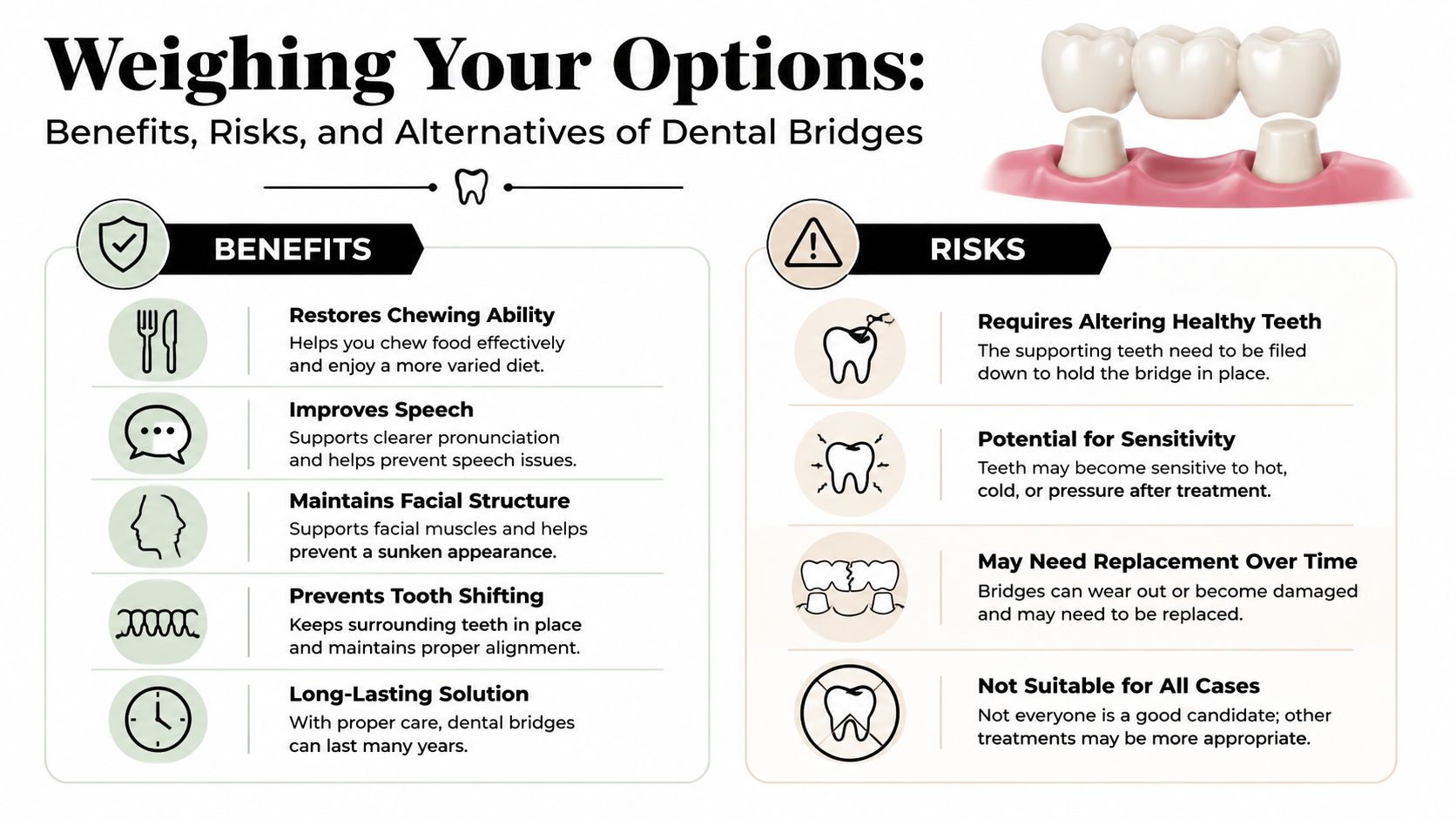
A bridge may be a strong choice if:
For a lot of adults, that's enough reason to move forward. It can restore confidence quickly and make daily eating feel more normal again.
The biggest question usually isn't what a bridge is. It's whether it makes sense compared with an implant.
A key long-term trade-off is that a traditional bridge requires reshaping neighboring teeth, while a dental implant can replace a missing tooth without altering adjacent healthy teeth, as explained in Delta Dental's comparison of bridges and implants.
That doesn't mean implants are always the better choice. Sometimes the neighboring teeth already need crowns, which changes the decision. Sometimes health history, time, healing preferences, or cost considerations make a bridge more practical. If you're comparing several restorations side by side, this guide to crown vs bridge vs implant can help frame the conversation.
If the teeth beside the gap are completely healthy, it's reasonable to ask whether preserving them should push the decision toward an implant.
A partial denture is removable. Some patients like that it can replace missing teeth without the same type of preparation on neighboring teeth. Others dislike taking it in and out.
A dental implant is fixed and independent. It often appeals to patients who want to avoid altering adjacent teeth, but it requires enough bone and a treatment process that differs from a traditional bridge.
A bridge sits in the middle for many people. It's fixed, familiar, and often very effective when the case is well selected.
Once your bridge is in place, daily care becomes a big part of how well it performs over time. Bridges are durable, but they still depend on the health of the teeth and gums supporting them.
A clinical evidence review reported an overall 96.4% survival rate per year for dental bridges and an estimated 10-year survival rate around 82%, while also noting an overall 3.6% annual failure rate across primary studies. Patient-facing guidance commonly describes a practical lifespan of 5 to 15 years, depending on hygiene and related factors, as summarized in the NCBI review of dental bridge evidence.
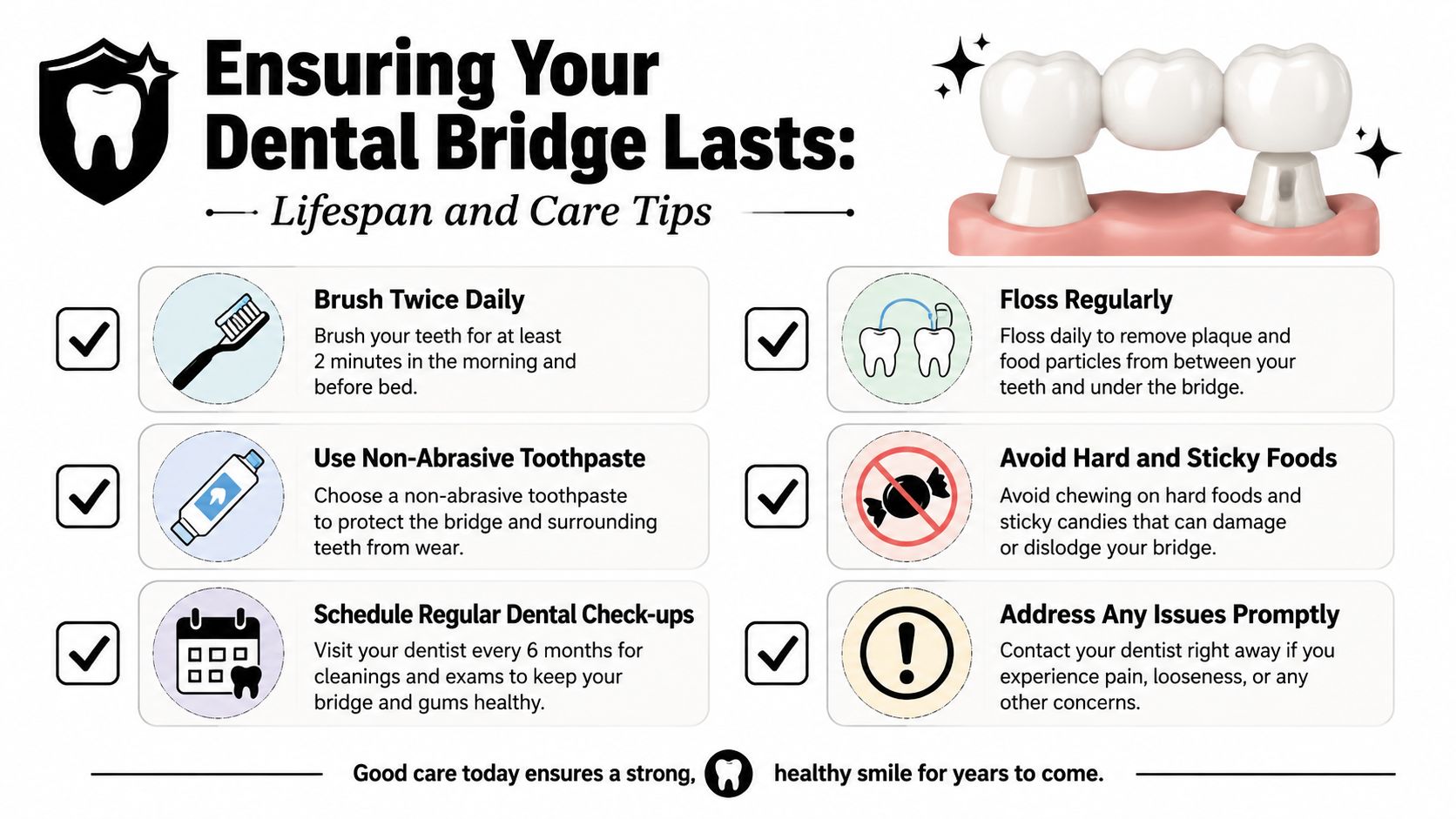
The weak point usually isn't the idea of the bridge itself. The weak point is often plaque buildup around the margins of the crowns or trouble cleaning under the replacement tooth. If decay or gum disease affects the supporting teeth, the whole restoration can be put at risk.
That's why home care matters so much.
Daily brushing alone isn't enough for a bridge. The area underneath needs attention too.
Don't wait if the bridge feels loose, food traps more than usual, your bite feels off, or the gums around it start bleeding. Those changes don't always mean the bridge has failed, but they do mean it needs to be checked.
A bridge can be a solid long-term restoration when the design is appropriate and the home care is consistent. That's the part many people underestimate. The bridge is fixed in your mouth, but it still needs active maintenance from both you and your dental team.
If you're missing a tooth and want straightforward guidance on whether a bridge, implant, or another restorative option makes the most sense, schedule a consultation with Dental Professionals of Fair Lawn. We help patients in Fair Lawn, Ridgewood, and Glen Rock understand their choices, relieve discomfort, and rebuild healthy, confident smiles with care that fits their needs.