Crown vs Bridge vs Implant: Which Is Right for You?
Explore crown vs bridge vs implant options. Fair Lawn, NJ experts detail pros, cons, costs, and longevity to help you decide. Schedule a consult today!
Explore crown vs bridge vs implant options. Fair Lawn, NJ experts detail pros, cons, costs, and longevity to help you decide. Schedule a consult today!
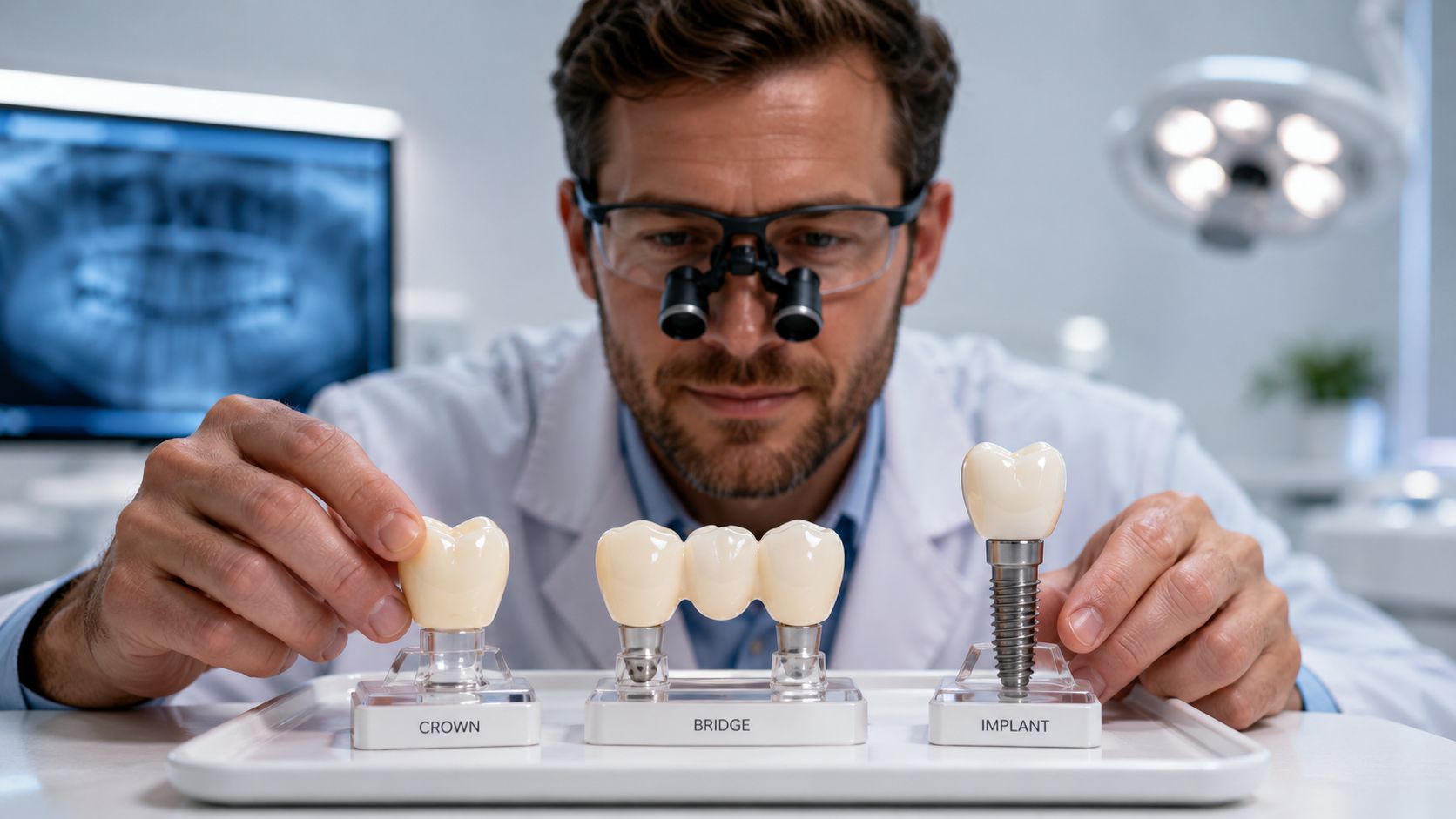
A tooth rarely fails at a convenient time. It's often a cracked molar you notice while chewing dinner, or a missing tooth that suddenly becomes impossible to ignore when you smile in a photo. Then the questions start. Can this tooth be saved? Do I need a crown? If it's missing, should I get a bridge or an implant?
For many patients in Fair Lawn, Glen Rock, and Ridgewood, the hardest part isn't the treatment itself. It's figuring out which option fits their real situation. Most online guides compare ideal cases. Real mouths are different. Nearby teeth may already have large fillings, old crowns, or signs of wear. That's where the decision becomes more nuanced.
When a tooth breaks down, the problem usually goes beyond appearance. A damaged tooth can make chewing feel uneven. A missing tooth can change how you bite, how food traps in the area, and how confident you feel talking or laughing. Some patients come in focused on the cosmetic issue. Others are more worried about pain, sensitivity, or avoiding a bigger problem later.
In practice, the most common question isn't just, “What's the best treatment?” It's, “What makes sense for my mouth right now?” That's the right question.
A crown is used to protect and rebuild a tooth that's still there. A bridge replaces a missing tooth by connecting to neighboring teeth. An implant replaces a missing tooth from the root level up. Those are simple definitions, but the right choice depends on details such as:
A healthy-looking smile and a healthy bite aren't always the same thing. The best plan has to support both.
If a tooth is badly damaged but still salvageable, a crown may be the most conservative path. If the tooth is gone, the conversation shifts to bridge versus implant. That sounds straightforward until the neighboring teeth already need work themselves.
That's where a real evaluation matters. In a mouth with old dentistry, wear, fractures, or large fillings, the answer often isn't as simple as “implants are always better” or “bridges are always faster.” The right treatment is the one that solves the current problem without creating a new one.
Patients often hear these terms together, but they do different jobs. If you're comparing crown vs Bridge vs Implant, start with one basic question. Are we trying to save a damaged tooth or replace a missing one?
A dental crown is a custom cap that covers a damaged tooth. It functions as a fitted helmet for a tooth that has cracked, worn down, or weakened after a large filling or root canal. The tooth stays in place. The crown reinforces it and restores shape, function, and appearance.
Crowns are usually the conversation when the root is still healthy enough to keep the tooth.
A fixed bridge fills the space left by a missing tooth. It works like a span supported by teeth on either side of the gap. Those neighboring teeth act as anchors, and the replacement tooth sits between them.
That means a bridge can restore the space without placing a replacement root into the jaw. It also means the supporting teeth matter a great deal.
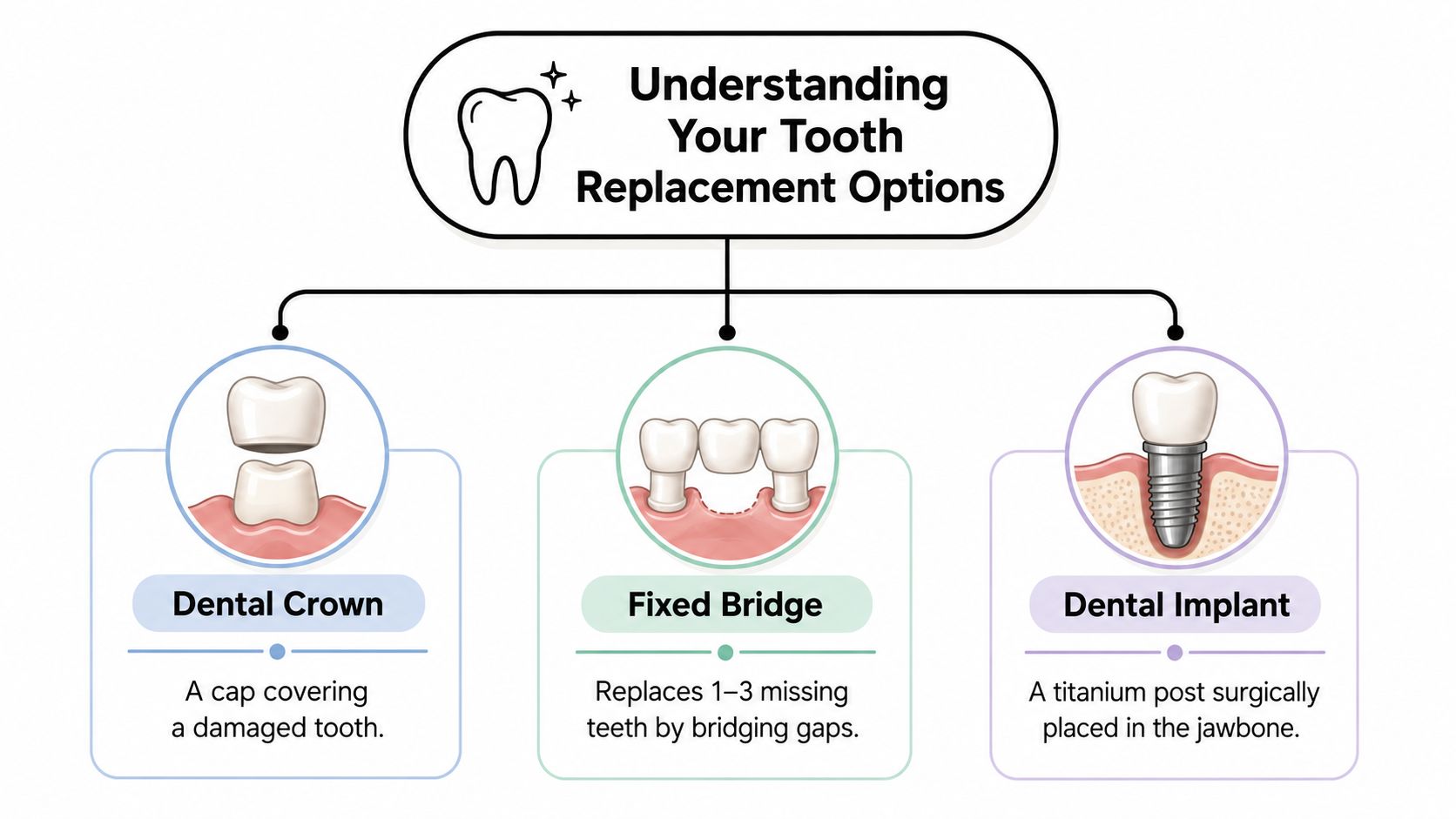
A dental implant replaces the missing tooth root first. A small post is placed in the jawbone, and after healing, a crown is attached on top. Instead of borrowing support from the neighboring teeth, the implant supports itself through the bone.
That difference matters mechanically. Cleveland Clinic's explanation of bridge vs implant load transfer notes that an implant transfers biting forces directly to the jawbone through osseointegration, while a bridge places functional stress on the adjacent abutment teeth.
Here's the practical version:
Practical rule: If the tooth can be predictably saved, a crown enters the conversation. If the tooth is gone, the comparison usually becomes bridge versus implant.
That's the foundation. The more useful question is how these options compare over time, especially when you're thinking beyond the next appointment.
Real treatment decisions rarely happen in a perfect textbook situation. In our Fair Lawn office, the harder conversations usually involve patients who are missing one tooth and also have a filling, crack, or older dental work on the teeth next to that space. That is where the choice between a crown, bridge, and implant becomes more personal.
The key question is not only what replaces the tooth. It is what each option asks of the rest of your mouth.
| Feature | Dental Crown | Dental Bridge | Dental Implant |
|---|---|---|---|
| Main purpose | Restores and protects a damaged tooth | Replaces a missing tooth by connecting to adjacent teeth | Replaces a missing tooth from the root up |
| Depends on neighboring teeth | No | Yes | No |
| Tooth preparation needed on adjacent teeth | No | Yes | No |
| Effect on jawbone at missing tooth site | Limited because the root is not replaced | Limited because the root is not replaced | Supports the jaw through a root replacement |
| Typical role in treatment | Save a tooth that can still be kept | Replace a missing tooth when support teeth are suitable | Replace a missing tooth with a stand-alone restoration |
| Long-term maintenance focus | Protecting the underlying tooth | Monitoring bridge fit and support teeth | Monitoring implant health and crown wear |
A crown is usually the most conservative choice if the tooth is still present and can be saved predictably. The goal is to protect what remains, restore strength, and keep your own root in function. For patients considering porcelain crowns in Fair Lawn, that distinction matters. A crown preserves an existing tooth. It does not replace a missing one.
A bridge replaces a missing tooth without surgery, but it asks more from the teeth on either side. Those teeth need to be shaped to hold the restoration, and they become long-term support teeth. If those neighboring teeth already have large fillings, cracks, root canal treatment, or gum loss, a bridge can still be a reasonable option, but the margin for error gets smaller.
An implant stands on its own. It replaces the root as well as the visible tooth, which means the neighboring teeth usually stay untouched. In borderline cases, that independence is often the deciding factor, especially if the adjacent teeth are healthy or only mildly restored and worth preserving.
Short-term convenience and long-term stability are not always the same thing.
A bridge is often faster to complete than an implant, and some patients prefer that. Others want to avoid surgery. Those are valid reasons. The trade-off is that the bridge joins the future of three teeth together instead of one. If one support tooth develops decay, fracture, or gum problems later, the entire bridge may be affected.
An implant usually takes more time and healing, but it separates the replacement tooth from its neighbors. That can simplify future care. If the crown on top wears or chips years later, the implant itself may still be sound.
This is the part many comparison guides skip. If the teeth next to the gap already need crowns, a bridge may make practical sense because those teeth were likely heading toward full coverage anyway. In that setting, using them as bridge supports may solve several problems at once.
If those adjacent teeth are healthy, cutting them down for a bridge deserves careful thought. Many patients are surprised to learn that the missing tooth is not always the only issue under consideration. Protecting the teeth beside the space can be just as important as replacing the one that is gone.
All three options can be made to look natural. The day-to-day difference is usually maintenance and feel.
A crown on your natural tooth often feels the most familiar because you are still biting on your own root. A bridge can look excellent, but cleaning underneath it takes more effort and consistency. An implant can feel very natural in function because it stands alone, though it still requires healthy gums and regular professional monitoring.
The best choice is usually the one that solves today's problem without creating a larger one for the teeth next to it.
Many patients feel calmer once they know what the process looks like. The steps differ quite a bit depending on whether we're saving a tooth with a crown, spanning a space with a bridge, or replacing a root with an implant.
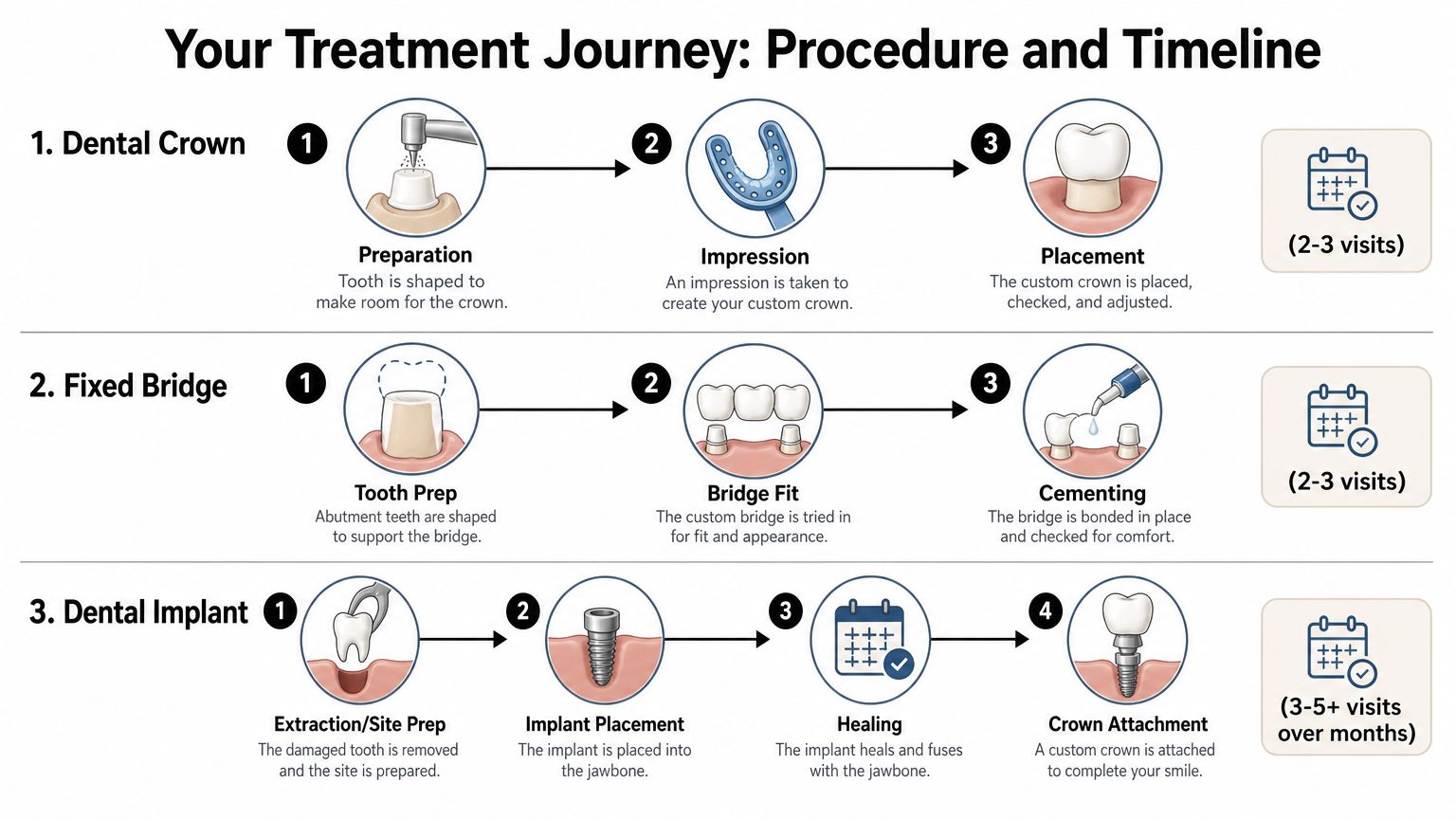
A crown often starts with removing weakened tooth structure and shaping the tooth so the restoration can fit securely. Records are taken, a temporary may be placed, and the final crown is seated once it's ready.
A bridge follows a similar rhythm, except the neighboring support teeth are prepared to receive the restoration. The bridge is then fitted and cemented once the design, bite, and appearance are confirmed.
For many patients, these options feel more familiar because they don't involve healing around a surgically placed root. They're often the path people picture when they think of restorative dentistry.
An implant is usually a staged process. First, the site is evaluated carefully. If the tooth is already missing, the next step may be implant placement. If the tooth still needs to be removed, the sequence depends on the condition of the site and surrounding bone.
After placement, the implant needs time to integrate with the bone. Once that healing phase is complete, the final crown is attached. The number of visits and the spacing between them can vary from patient to patient. If you want a more detailed overview, this guide to the dental implant timeline walks through the stages in more detail.
Some patients want the fastest fixed solution. Others care more about preserving adjacent teeth or creating a stand-alone replacement. Neither priority is wrong. The timeline is one of the trade-offs.
A treatment that takes longer isn't necessarily harder. It's often just working on a different biological timeline.
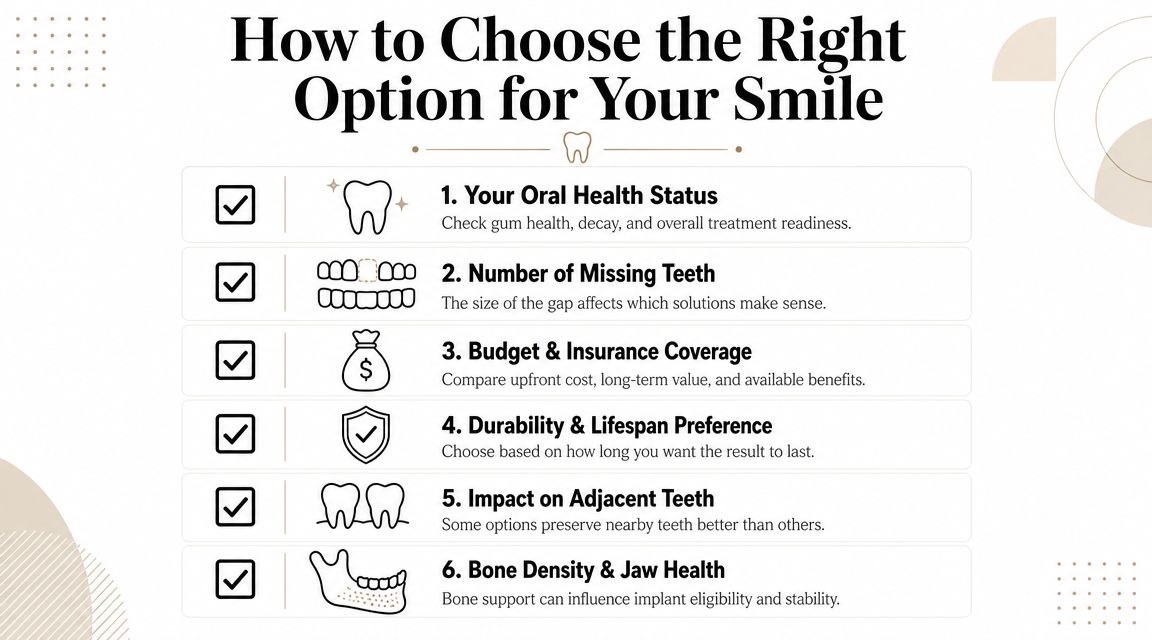
The most helpful way to choose is to stop asking which restoration is “best” in general and ask which one fits your mouth, your neighboring teeth, and your long-term goals. That's especially true in borderline cases.
If the tooth is damaged but still restorable, a crown is usually the first option to consider. If the tooth is missing, the conversation moves to a bridge or an implant.
That part is straightforward. The harder part is evaluating the teeth beside the space.
This is the nuance many articles skip. Cleveland Clinic's overview of dental bridges notes that traditional bridges depend on healthy teeth on both sides of the gap, but it also points to a more practical reality. If the adjacent teeth are already compromised, already crowned, or already need full-coverage restorations, a conventional bridge may be a reasonable choice because it can solve multiple problems at once.
That doesn't mean a bridge is automatically better in those cases. It means the decision is no longer a simple “never touch the neighboring teeth” rule. If those teeth already need crowns, using them as bridge supports may be entirely rational.
Instead of focusing only on the name of the treatment, think through these real-world factors:
If the neighboring teeth are healthy, an implant often makes the most mechanical sense because it stands alone. If those teeth are already heavily restored, a bridge may be more efficient and more practical than patients first assume. If the damaged tooth can still be saved predictably, preserving it with a crown is often the most conservative move.
That's why the crown vs Bridge vs Implant decision shouldn't be made from a checklist alone. It should be made from an exam, imaging, bite evaluation, and a candid discussion about what you want this restoration to do for you over time.
The right answer isn't the most advanced treatment. It's the option that fits the biology, the bite, and the condition of the surrounding teeth.
Choosing between a crown, bridge, or implant gets easier once someone has examined the tooth, the neighboring teeth, and the way you bite. Online information helps you ask better questions, but it can't tell you whether a crack extends deeper than expected, whether a support tooth is strong enough for a bridge, or whether an implant site is ready.
At your visit, the goal is to make the decision clear, not overwhelming. That means reviewing what can be saved, what should be replaced, and which option gives you the healthiest long-term result for your specific situation. In a practice that offers restorative dentistry, implant dentistry, emergency treatment, and sedation options, the conversation can stay focused on what fits the patient rather than forcing a one-size-fits-all plan.

A restorative consultation usually includes a close clinical exam, digital imaging, and a discussion of the condition of the surrounding teeth and gums. If you're comparing options for a missing tooth, the health of the teeth next to the space is often just as important as the space itself.
Patients who feel nervous about treatment often benefit from knowing there's a plan for comfort. Sedation dentistry can be part of that conversation when anxiety has kept needed care on hold.
Modern planning tools can improve fit and predictability. The practice information for Dental Professionals of Fair Lawn notes the use of tools such as iTero digital scanning and facial scanning as part of treatment planning. For crowns, bridges, and implant restorations, digital records help support a more precise process and more informed decision-making.
For patients searching for a dentist near me in Fair Lawn, NJ, or comparing dental implants near me with other restorative options, the most useful next step is a consultation that looks at the whole picture, not just the missing tooth.

During the procedure, the area is numbed thoroughly with local anesthesia, and many patients are surprised by how manageable the appointment feels. The more common challenge is soreness in the first few days afterward, not sharp pain during treatment.
Comfort planning matters. In our Fair Lawn practice, that discussion includes medical history, anxiety level, and how extensive the procedure will be.
Crowns and bridges are commonly made from porcelain, zirconia, metal-based materials, or combinations of those materials. The right choice depends on the location in the mouth, the strength needed, and how visible the tooth is when you smile.
A front tooth usually calls for a material that blends naturally with nearby teeth. A back tooth often needs more fracture resistance because it handles heavier chewing forces.
Gum health needs to be under control first. Active periodontal disease can weaken the support around teeth and bone, which affects both bridges and implants.
This question comes up often in borderline cases. If the teeth next to a missing space already have bone loss, large fillings, or looseness, that history changes the decision. In some patients, a bridge places too much demand on teeth that are already compromised. In others, implant treatment has to wait until the gums are stable enough to support it safely.
Implants usually have the longer service life, while bridges often need replacement sooner because they depend on the condition of the supporting teeth. The key question is not only which one lasts longer on paper. It is which option gives your mouth the better long-term outlook.
For a patient with two strong neighboring teeth and no interest in surgery, a bridge can still be a reasonable choice. For a patient whose adjacent teeth already have crowns, cracks, or large fillings, an implant may protect the rest of the mouth better because it does not rely on those teeth for support.
A crown is not automatically the better treatment. If a tooth still has enough healthy structure, a filling can be the more conservative option.
A crown makes more sense when the tooth is heavily restored, cracked, worn down, or likely to break under pressure. The goal is to keep the tooth functioning comfortably and predictably, not to place the biggest restoration possible.
That is common, especially if you have older dental work or have been told different things over the years. The right answer depends on what can still be saved, what the neighboring teeth look like, how your bite functions, and what kind of maintenance you are prepared for over time.
A careful exam usually brings clarity. At Dental Professionals of Fair Lawn, patients from Fair Lawn, Glen Rock, and Ridgewood can get a personalized restorative plan built around comfort, function, and long-term oral health.