What to Do When a Filling Falls Out: Don't Panic
Don't panic! Learn exactly what to do when a filling falls out. Our Fair Lawn emergency dentists explain how to manage pain & when to call for immediate steps.
Don't panic! Learn exactly what to do when a filling falls out. Our Fair Lawn emergency dentists explain how to manage pain & when to call for immediate steps.

You bite into a sandwich at lunch, or your child says something feels “scratchy” while getting ready for school, and suddenly a tooth feels rough, hollow, or sharp. That moment rattles people. Adults usually want to know if they can safely wait. Parents are often trying to judge the tooth, calm a nervous child, and make sure a small filling piece was not swallowed.
A lost filling is common, and in most cases it can be handled without panic if you protect the tooth and arrange care soon. Fillings do fail over time. Teeth flex under pressure, old dental work wears down, and decay can form around the edges. The immediate priority is protecting the tooth and having it evaluated before a straightforward repair turns into a larger problem.
For families in Fair Lawn, Ridgewood, and Glen Rock, the situation often feels harder than generic dental advice suggests. Children may struggle to describe what they feel. Anxious patients may focus on the fear of the appointment more than the tooth itself. Practical, calm steps at home can help both. If you are unsure what to do in a dental emergency, start by keeping the area clean, avoiding chewing on that side, and calling for guidance.
A lost filling rarely happens at a convenient time. It might happen during dinner, while brushing before bed, or in the car on the way to school. The first thing most patients notice is a rough edge or a small hole where the filling used to be. Some feel nothing at first. Others get an immediate zing from cold air or water.
That difference in symptoms can be misleading. A missing filling may not feel dramatic right away, but the tooth has lost its seal and support. Food packs into the space, the exposed area becomes sensitive, and the risk of deeper damage starts to rise.

For adults, the immediate challenge is usually pain control and protecting the tooth until they can be seen. For parents, the situation can feel more chaotic. Guidance for families with pediatric patients is often overlooked, but a child's needs differ from an adult's. Risks like swallowing a small filling piece, managing pain with correct child dosing, and handling dental anxiety are unique challenges, as noted in this discussion of lost fillings in children and families. That’s especially relevant for children and teens in Fair Lawn who wear Invisalign or Damon appliances, since orthodontic hardware can make a repair plan more nuanced.
Practical rule: If a filling falls out, treat it as urgent even if the tooth doesn’t hurt yet.
If you’re trying to decide what counts as urgent care versus true emergency care, a clear overview of what to do in a dental emergency can help you sort through the next step without guessing.
The key message is simple. Don’t panic, but don’t ignore it. Most lost fillings can be handled smoothly when the tooth is protected early and examined promptly.
A filling often comes out at the worst time. Dinner is half-finished, your child says their tooth feels “weird,” or you notice a sharp edge late at night. The good news is that the first steps are usually simple, and they can protect the tooth until you get in for care.
If you find the filling, place it in a small clean container or resealable bag. I do not usually reuse the old material, but seeing it can help identify whether the restoration broke, wore down, or came loose because the tooth changed underneath it.
Keep fingers and tools out of the space in the tooth. Household glue and over-the-counter craft adhesives can irritate the tissue and make the repair harder.
Use warm salt water to rinse away food and plaque. A common home recipe is 1/2 teaspoon of salt in 8 ounces of warm water, which matches routine oral rinse instructions from the American Dental Association’s guidance on salt water rinses after dental care.
Swish gently for several seconds, then spit. Skip vigorous rinsing, scrubbing with a toothbrush, or probing the opening with a toothpick.
If food keeps packing into the area, that can be a clue that the opening is larger than it looks.
If the tooth feels open, sensitive, or rough, a temporary filling material from the pharmacy can cover it for a short time. Orthodontic wax can help if a broken edge is rubbing your cheek. Sugar-free gum is a last-resort option for a brief period, but a dental repair product is a better choice.
The goal is simple. Cover the area, keep debris out, and avoid making the tooth easier to crack.
In some cases, a lost filling exposes decay that was hidden at the edges. If you want to understand how that happens, our page on hidden tooth decay around existing restorations explains what we look for.
Chewing on the affected side raises the chance of breaking off more tooth structure, especially if the lost filling was large or the tooth already had a crack. The Cleveland Clinic’s patient guidance on lost fillings advises avoiding chewing on that side until a dentist can examine and repair the tooth.
Choose soft foods. Cut food into smaller pieces. If the filling came from a front tooth, avoid biting into firm foods like bagels, apples, or crusty bread.
Ibuprofen or acetaminophen can help if you normally take those medications safely. If cold air or cold drinks trigger pain, cover the tooth and avoid temperature extremes until you are seen.
For children, use only age-appropriate medication and dosing. For anxious patients, keep the explanation calm and concrete. Tell them the tooth needs a repair and that the visit is meant to keep it comfortable. That approach usually works better than dramatic language, especially with younger children.
A lost filling leaves the tooth less protected from bacteria, pressure, and temperature changes. The longer it stays open, the greater the chance that a simple repair turns into a larger filling, a crown, or root canal treatment. The National Health Service advice on lost fillings and crowns recommends seeing a dentist as soon as possible.
A short delay happens sometimes. A long delay allows a manageable problem to become more expensive and more uncomfortable.
| Do | Don't |
|---|---|
| Save the loose filling if you can find it | Don’t glue it back in with household adhesive |
| Rinse with warm salt water to clear debris | Don’t scrub or pick at the cavity |
| Use temporary filling material from a pharmacy if needed | Don’t pack random materials into the tooth |
| Chew on the other side and choose soft foods | Don’t keep biting normally on the affected tooth |
| Take approved pain relief if needed | Don’t ignore the problem because it isn’t hurting yet |
| Arrange a dental visit promptly | Don’t wait past a couple of days if you can avoid it |
Fillings usually come loose because something changed in the tooth, the bite, or the restoration itself. The missing piece matters, but the reason it came out matters just as much. That is the part families in Fair Lawn often need explained clearly, especially when a child, teen, or anxious adult wants to know whether this will keep happening.
According to the National Institute of Dental and Craniofacial Research overview of tooth decay, cavities are one of the most common oral health problems in the United States. In practice, that means fillings are common, and replacement dentistry is common too. A lost filling is often a sign that the tooth needs another close look, not just a quick patch.
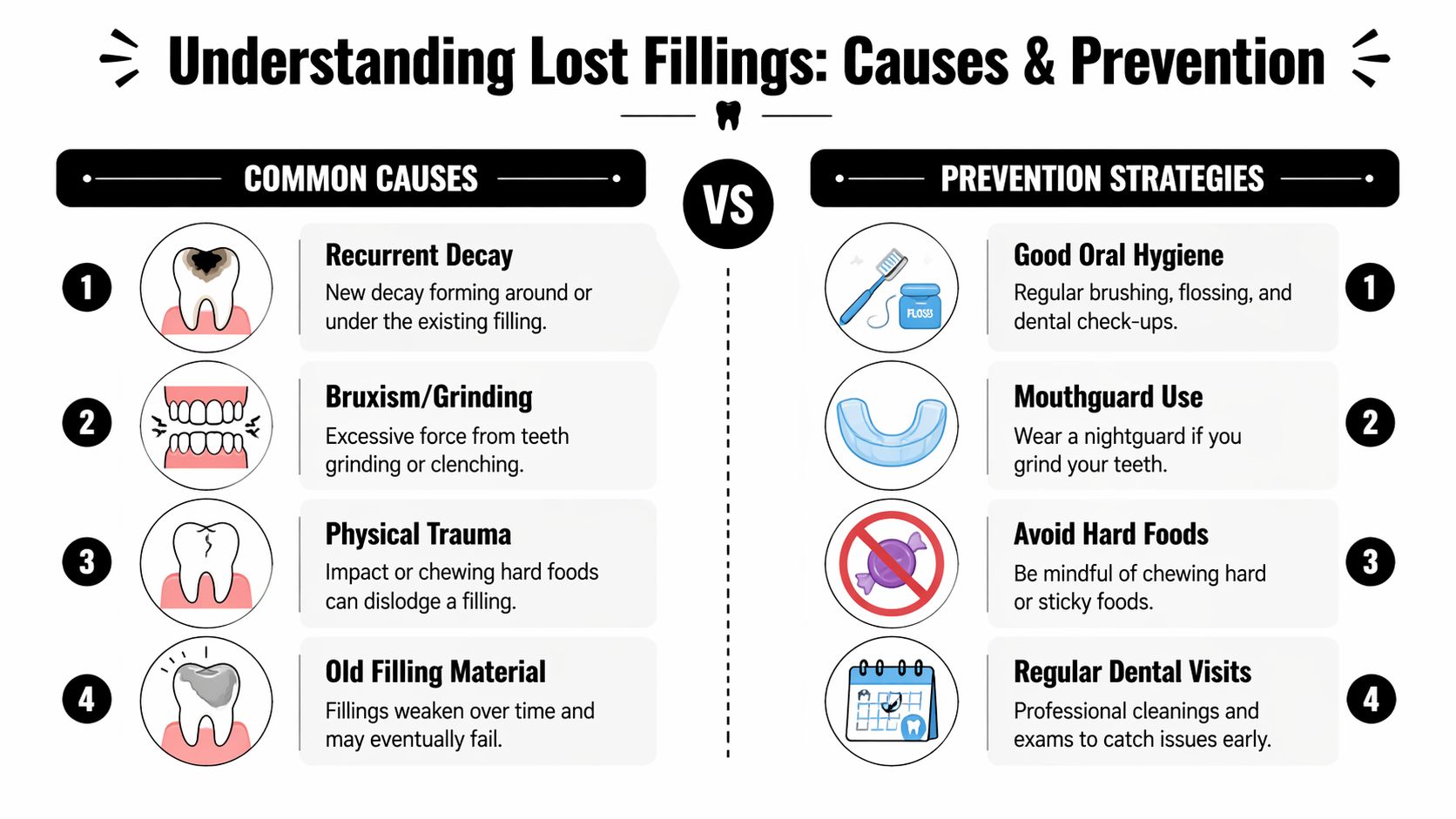
A filling can fail because new decay starts at the edge where the restoration meets the tooth. The bond weakens, the enamel softens, and the filling no longer has solid support.
This is one of the reasons routine exams still matter when nothing hurts. Small changes around an old filling are often easier to treat before the area opens up. If you want to understand how a tooth can look fine on the surface while decay develops underneath, this article on hidden tooth decay under the surface explains what we look for.
Clenching and grinding put repeated stress on both the filling and the tooth. The problem is not only wear on the material. Strong bite forces can flex the tooth enough to loosen the seal over time.
The American Dental Association guidance on bruxism notes that grinding can damage teeth and restorations. For many patients, prevention is less about choosing a tougher filling and more about reducing the force that keeps breaking it. A night guard often helps. So does catching daytime clenching early.
Sometimes the cause is simple. Ice, hard candy, popcorn kernels, or a hit to the mouth during sports can dislodge a filling, especially if the restoration is already large.
Children and teens run into this more often because sports, rough play, and uneven eating habits all add risk. A properly fitted mouthguard helps protect teeth during athletics. At home, avoiding hard chewing habits gives older fillings a better chance to last.
Even a well-done filling has a service life. Chewing, temperature changes, moisture, and normal wear all affect the bond between the filling and the tooth.
Older restorations often fail gradually. A margin opens. A corner chips. The surface gets rougher and traps more plaque. These changes may not cause pain right away, which is why people are often surprised when a filling comes out during an ordinary meal.
A lost filling does not always mean the tooth can take another filling. If decay is deep, the tooth is cracked, or too much structure has already been lost, a crown may protect the tooth better. If the tooth cannot be saved, replacement options may need to be part of the discussion.
The American Academy of Implant Dentistry explanation of missing tooth replacement options describes dental implants as one way to restore function after tooth loss. That is not the usual outcome after a single lost filling, and I make that clear to worried patients. Early care keeps the repair smaller in many cases, which is better for comfort, cost, and long-term tooth preservation.
By the time you get to our office, the question is no longer just, “Can we put the filling back?” The primary question is what the tooth can safely support now. A lost filling may leave behind a small, clean space, or it may expose decay, a crack, or irritation close to the nerve that was not obvious at home.

The exam starts with a close look at the tooth, the filling site, and your bite. X-rays are often part of that visit because they show what the eye cannot. Decay between teeth, infection around the root, and changes near the nerve can all change the treatment plan.
Research published in the Journal of the American Dental Association found that recurrent decay is a leading reason restorations need replacement, especially at the margins where breakdown can be hard to spot early (JADA review on why restorations are replaced61580-0/fulltext)). That is why I do not rush to “just refill it” before checking the health of the remaining tooth.
For families in Fair Lawn, this step is especially helpful. Children may have trouble describing what they feel, and anxious adults often assume the worst. A careful exam gives us a clear answer and usually lowers the stress level right away.
If the remaining tooth structure is sound, a new tooth-colored filling is often the most conservative repair. We clean the area, remove any weakened material, place the composite, shape it carefully, and adjust the bite so the tooth is not taking extra force.
Composite fillings perform well when the case is selected properly. A large systematic review in Clinical Oral Investigations reported good long-term survival for posterior composite restorations, with outcomes influenced by cavity size, moisture control, and biting forces (systematic review of posterior composite survival). In plain terms, smaller repairs on solid tooth structure tend to last better than trying to stretch filling material over a tooth that really needs more support.
A typical visit in this situation includes:
Some teeth need more than another filling. If a cusp is undermined, if too much tooth has broken away, or if the old restoration was already very large, an onlay or crown often protects the tooth better.
The American College of Prosthodontists notes that crowns are used to restore teeth that are broken down or weakened beyond what a filling can predictably handle, and they can serve patients well for many years with proper care (American College of Prosthodontists guide to dental crowns). The trade-off is straightforward. A filling preserves more natural tooth when the tooth is strong enough. A crown covers more of the tooth and usually offers better protection when the remaining walls are thin or fragile.
For some patients, an inlay or onlay is the middle ground. It covers more than a standard filling without going as far as a full crown.
Here’s a short video that helps patients understand how dentists evaluate and restore a damaged tooth:
A practical treatment plan has to work for the person in the chair. Children need clear explanations. Teens often do better when we tell them exactly what to expect. Adults with dental anxiety usually want two things: less uncertainty and more control.
We take that seriously. Sedation options can help anxious patients tolerate care more comfortably, and digital tools can make diagnosis and planning more precise. If you are dealing with pain, swelling, or a rapidly worsening tooth, our emergency dental care in Fair Lawn gives families a direct path to prompt treatment.
Sometimes the best part of the visit is getting a firm answer.
If the tooth has deep decay, a fracture that extends below the visible surface, or signs that the nerve has been affected, treatment may go beyond a filling. In those cases, the plan might include root canal therapy followed by a crown, or, if the tooth cannot be saved, a discussion about replacement.
Laser-assisted cavity treatment may be an option in selected cases. The American Dental Association notes that dental lasers are used in certain hard- and soft-tissue procedures, though whether they are the right choice depends on the diagnosis, the location of the problem, and the goals of treatment (American Dental Association overview of dental lasers). That is the kind of decision that should be made tooth by tooth, not by trend.
The goal is simple. Save as much healthy tooth as possible, keep the repair comfortable, and choose a solution that will serve you well at your next meal, next season, and next year.
Not every lost filling is a middle-of-the-night emergency, but some absolutely need same-day attention. The mistake patients make is waiting for the situation to declare itself. If the tooth is worsening quickly, it’s already declaring itself.

A filling that falls out without major pain is still urgent. The tooth is exposed, more vulnerable, and easier to fracture. You should arrange prompt care even if you can still function normally.
A true dental emergency is different. That usually means the problem has moved beyond a missing restoration and into active infection, severe inflammation, or structural damage that can’t safely wait.
Call for emergency evaluation if you notice any of these:
If you need help quickly, emergency treatment information is available through dental emergencies.
Pain that wakes you up, swelling that spreads, or pressure that builds is not a wait-and-see situation.
Parents often wait because a child says the tooth “only feels weird.” That’s understandable, but kids don’t always describe symptoms clearly. If a child stops chewing on one side, avoids cold drinks, or becomes suddenly irritable with brushing, that’s enough reason to call.
For anxious adults, the barrier is often fear rather than uncertainty. They know something is wrong but keep hoping it will settle down. That delay can turn a refill into a more involved repair. Sedation dentistry can remove a lot of that friction by helping patients get through care calmly and safely.
If the tooth is missing a filling but symptoms are mild, it’s urgent and should be booked promptly. If pain is strong, swelling is present, or the tooth appears to be breaking, treat it as an emergency.
That distinction helps, but if you’re unsure, it’s better to call and describe what’s happening than to guess at home.
A lost filling is one of those problems that feels bigger in the moment because it happens suddenly. The reassuring part is that many cases are very treatable when you protect the tooth, avoid chewing on it, and get it evaluated promptly.
The biggest mistake is delay. A filling doesn’t usually fall out in isolation. Sometimes there’s hidden decay. Sometimes there’s grinding, a crack, or a weakened cusp that needs stronger protection. The sooner that’s identified, the more conservative the repair tends to be.
For families in Fair Lawn, Ridgewood, and Glen Rock, this matters for more than convenience. It matters for comfort, school schedules, workdays, and peace of mind. Children may need extra reassurance. Teens with Invisalign or Damon appliances may need a repair plan that works around orthodontic treatment. Adults with dental anxiety may need a gentler path into care. All of those situations deserve thoughtful attention, not rushed advice.
If you’re looking for an emergency dentist, a dentist near me, or a dentist in Fair Lawn, NJ who can evaluate a lost filling and explain the next step clearly, the right move is to schedule the visit before the tooth becomes more painful or more fragile.
A prompt exam, dental X-rays when needed, and the right restoration can protect your bite, relieve sensitivity, and help you avoid more extensive treatment later.
If you need help with a lost filling, book a visit with Dental Professionals of Fair Lawn. The team provides family, restorative, cosmetic, and emergency dental care for patients in Fair Lawn, Ridgewood, Glen Rock, and nearby New Jersey communities. If your tooth feels rough, sensitive, or suddenly unprotected, contact the office and schedule an evaluation as soon as possible.