Tongue Tie Pediatric Dentist: Fair Lawn NJ Guide
Our Fair Lawn tongue tie pediatric dentist provides expert diagnosis & laser frenectomy in 2026. Learn signs, find local support. Call us today!
Our Fair Lawn tongue tie pediatric dentist provides expert diagnosis & laser frenectomy in 2026. Learn signs, find local support. Call us today!

For those seeking a tongue tie pediatric dentist in Fair Lawn, there's likely a prior concern about something that doesn't feel quite right. Maybe your baby takes a long time to feed, makes clicking sounds while nursing, or still seems hungry after a full feeding. Maybe your toddler speaks unclearly, struggles with certain foods, or can't stick their tongue out very far. Parents usually notice the pattern before they know the name for it.
That uncertainty can be exhausting. Online advice often jumps straight from symptoms to treatment, without helping you understand what matters most. In real life, families need something simpler. They need a careful exam, a clear explanation, and a plan that doesn't stop at the procedure itself.
A parent in Fair Lawn might start with a simple question. Why does feeding feel this hard? A baby may latch, pull away, cry, and try again. An older child may seem bright and healthy, but certain sounds stay hard to say, or food always takes longer to chew and swallow.
Those moments don't always point to a tongue tie. But they do deserve attention from someone who looks at the whole picture.
Most families don't walk into an office saying, "My child has ankyloglossia." They say things like:
That mix of symptoms and uncertainty is common. Tongue function affects more than many parents realize. It can influence feeding, oral comfort, speech clarity, and even how well the mouth clears food.
Practical rule: If you're repeatedly wondering whether your child is struggling more than they should, it's time for a functional evaluation.
Families in Fair Lawn, Ridgewood, and Glen Rock often want local care that feels steady and personal, not rushed. That's especially important when the patient is a baby or young child. A parent needs time to explain what they've seen at home, and a clinician needs time to watch how the tongue moves.
At Dental Professionals of Fair Lawn pediatric and family dental care, the focus isn't just on identifying a restriction. The visit centers on how your child is functioning now and what support may help next. Sometimes that means monitoring. Sometimes it means treatment. Sometimes it means coordinating with other professionals involved in feeding or speech.
That long-view approach matters because tongue tie care isn't a one-visit topic. Parents usually need guidance before diagnosis, during treatment decisions, and after any procedure. When a family feels heard at each step, the process becomes much less intimidating.
Tongue tie, also called ankyloglossia, happens when the tissue connecting the tongue to the floor of the mouth is too tight, short, or restrictive for comfortable movement. A simple way to picture it is this: the tongue has a small tether under it, and if that tether is too tight, the tongue can't lift, extend, or move side to side as freely as it should.
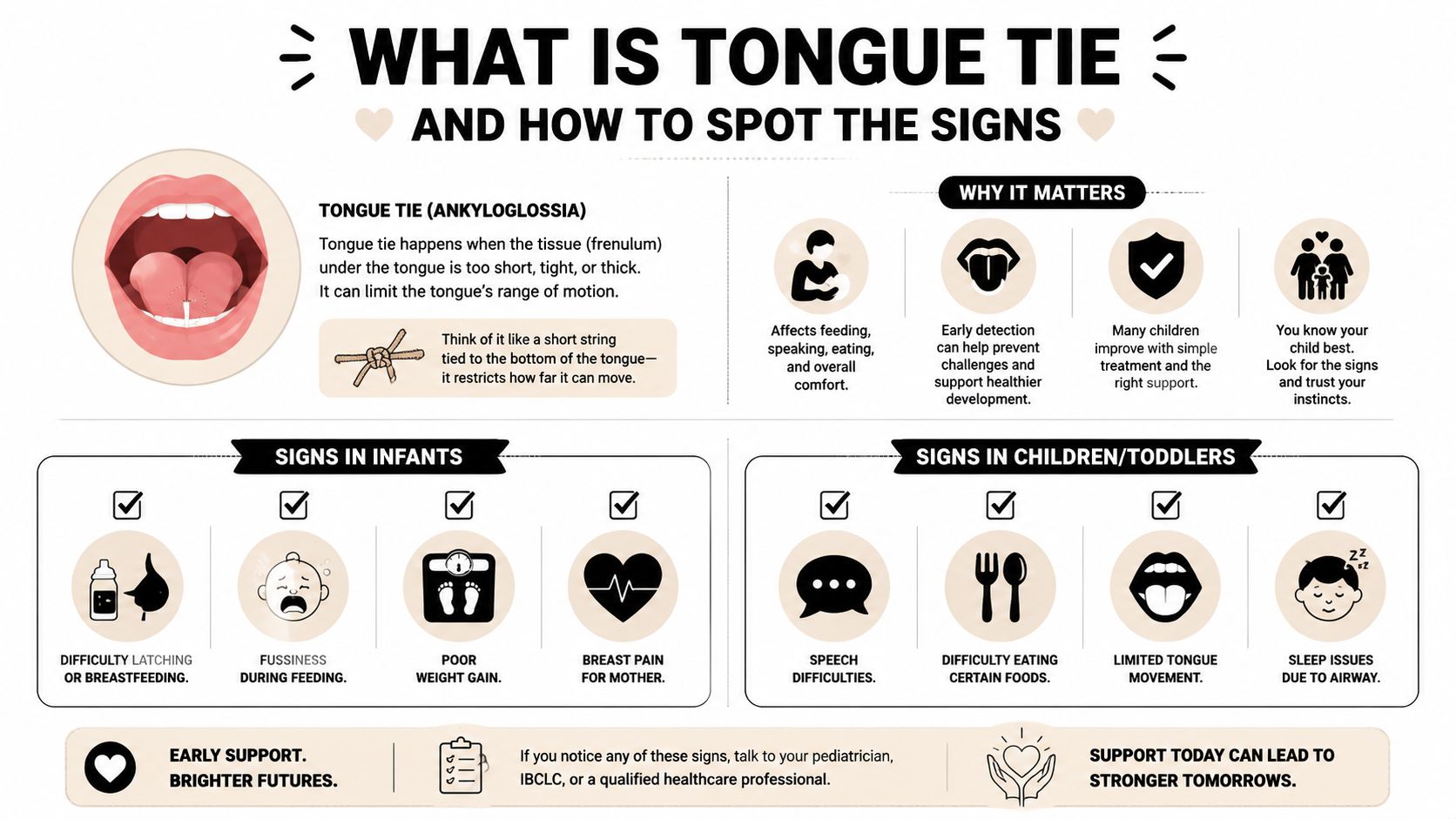
This isn't a rare curiosity. StatPearls notes that reported prevalence ranges from 0.1% to 10.7%, and some older studies cited about 4%, while modern practice identifies and treats it more often. That wide range is one reason parents hear conflicting things. Different studies look at different age groups and use different definitions.
In babies, tongue tie often shows up as a feeding problem before anything else. Watch for patterns like these:
In older children, the clues can be different. The issue may shift from feeding to everyday oral function.
A tongue tie isn't defined by one sign alone. It's the pattern that matters.
Parents often get confused when they can clearly see a short frenulum in one child, but another child with a less obvious appearance has bigger symptoms. That's why looking only at what the tissue looks like can be misleading. Function tells you much more than appearance.
A careful diagnosis starts with one principle. A tongue tie should be judged by function, not appearance alone.

The American Academy of Pediatric Dentistry says a restrictive frenulum should be evaluated based on tongue mobility and its impact on feeding or speech, rather than how it looks by itself. That's a helpful standard for parents because it keeps the conversation focused on whether the tongue can do its job.
A functional exam is more detailed than a quick glance under the tongue. The goal is to understand how the tongue performs during real tasks.
A pediatric evaluation may include:
Parents often expect the answer to be immediate. Sometimes it is. But in many cases, the most accurate diagnosis comes from combining the exam with the story you bring from home. How feeds go. What speech sounds are difficult. Whether oral hygiene is challenging. Whether you notice strain, frustration, or compensation.
A visible frenulum doesn't always require a frenectomy. Some children have tissue that looks tight but function well. Others have less obvious anatomy and clear functional problems.
This short video helps illustrate why tongue mobility matters during a real assessment.
That distinction protects families from unnecessary treatment and also prevents delayed care when symptoms are being dismissed too casually. When parents search for a tongue tie pediatric dentist in Fair Lawn, they usually aren't just looking for someone who can do a procedure. They're looking for someone who can tell them whether the procedure is needed.
The right diagnosis answers two questions at once. Is the tissue restrictive, and is that restriction affecting daily function?
When a tongue tie is functionally significant, the usual treatment is a frenotomy or frenectomy, which releases the restrictive tissue so the tongue can move more freely. For many families, the next question is simple. How is that done, and what will my child experience?
A common modern approach is the laser frenectomy.
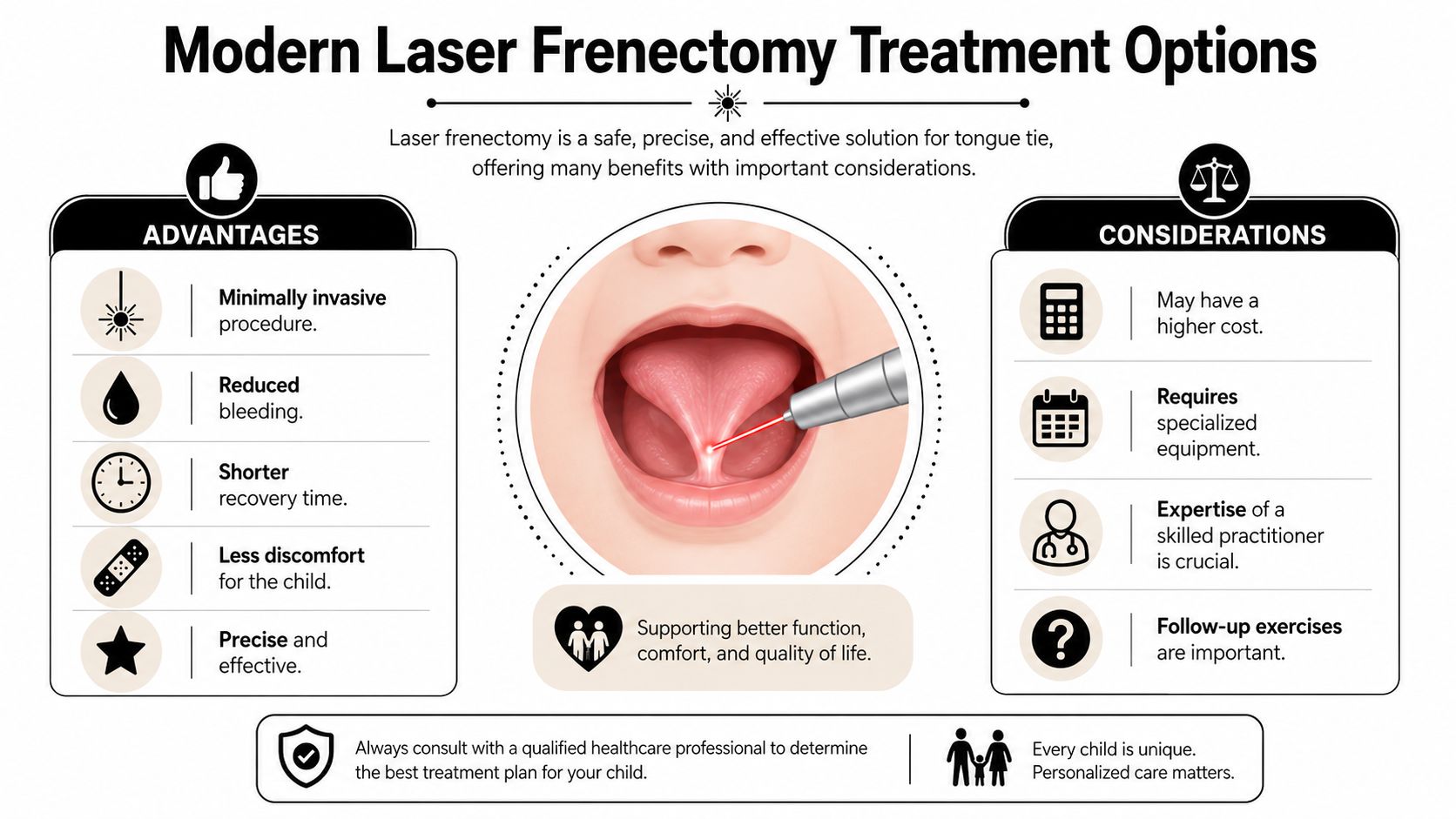
According to Montgomery Pediatric Dentistry, a laser frenectomy is typically brief, causes minimal bleeding, often doesn't require stitches, and is associated with faster healing. That usually makes the process feel less intimidating for parents than they expected.
Both methods aim to release restrictive tissue. The main differences involve precision, bleeding, and post-operative experience.
| Feature | Laser Frenectomy (Our Method) | Traditional Frenectomy |
|---|---|---|
| Tissue release | Uses laser energy to release the frenulum | Uses conventional surgical instruments |
| Bleeding | Typically minimal | May involve more bleeding |
| Stitches | Often unnecessary | May be more likely depending on technique |
| Healing experience | Commonly described as faster | May feel more involved for some families |
| Precision | High precision in experienced hands | Depends on method and visibility |
| Aftercare needs | Still requires exercises and follow-up | Still requires exercises and follow-up |
Parents sometimes assume the laser alone guarantees success. It doesn't. The procedure releases the tissue, but your child still has to learn how to use that new range of motion.
That point is easy to miss. Families often focus on the procedure because it's the part that sounds most serious. In practice, the bigger question is whether the child will receive the follow-up support needed for function to improve.
Some children also need comfort-focused planning. If your child is very anxious during dental care, a practice that offers sedation dentistry and child-centered treatment planning can help make the visit more manageable. Families looking for more background on related oral restriction care can also review lip tie treatment information from the Fair Lawn practice blog.
A laser frenectomy is a treatment step, not the whole treatment plan.
Many parents first think about tongue tie in terms of breastfeeding or speech. Those are important reasons to seek care, but they're not the only reasons. Tongue posture and mobility can influence how the mouth, face, and airway develop over time.
That doesn't mean every child with a restriction will develop larger problems. It does mean an early evaluation can be worthwhile, especially when symptoms don't fit neatly into one category.
The tongue helps shape everyday patterns. It plays a role in swallowing, oral rest posture, and how the mouth functions during sleep. When the tongue can't rest where it should or move normally, children may compensate in ways that affect comfort and development.
Potential concerns can include:
A careful pediatric dental evaluation doesn't treat every one of these issues directly. It helps identify whether restricted tongue movement could be one contributor.
Not every child with tongue tie struggles as a newborn. Some children seem to do fine in infancy, then show concerns later with solids, speech, oral hygiene, or sleep quality. That's one reason older kids should still be evaluated when symptoms persist.
Emerging research referenced by Sweet Smiles Orlando describes a 30% higher prevalence of obstructive sleep events in children with untreated ankyloglossia and discusses links between oral posture, craniofacial development, and airway volume. For families, the key takeaway isn't fear. It's perspective. A tongue tie evaluation can be about long-term function, not just an immediate feeding problem.
Sometimes the most important reason to evaluate a tongue tie is not what you see during the day, but what the body may be compensating for over time.
In a well-rounded office, that broader lens also matters because related services may be relevant later. A family may first come in for pediatric concerns, then learn more about airway-focused care, TMJ or TMD support, or other dental services that help oral function stay on track through childhood and beyond.
For many parents, the biggest surprise isn't the procedure. It's the aftercare. A frenectomy may be brief, but recovery is an active phase, and your role at home matters a great deal.

The released tissue wants to heal. That part is normal. The challenge is making sure it heals in a way that preserves the new mobility rather than tightening back down.
Parents often receive guidance on gentle stretching or mobility exercises after the procedure. The exact routine depends on the child's age and needs, but the purpose is consistent. It helps reduce the chance of reattachment and supports better use of the tongue's new movement.
Common aftercare goals include:
Some children also benefit from lactation support, speech therapy, or structured oral exercises. That's not a sign that treatment failed. It means the tongue is learning a new movement pattern after being restricted.
Families deserve honesty here. Skipping stretches or doing them inconsistently can affect the result. Summit Kids Dental reports that when post-operative stretching exercises aren't followed, there can be a 15% to 20% recurrence rate of functional restriction.
That doesn't mean every child who struggles with aftercare will need another procedure. It does mean the rehabilitation phase matters.
A few practical reminders help parents stay grounded:
Healing is not passive after a frenectomy. The best outcome comes from release plus retraining.
Parents often feel calmer once they know what the first visit will be like. A consultation for tongue tie concerns should feel organized, unhurried, and centered on your child, not on a preset treatment script.
At a visit in Fair Lawn, the conversation usually starts with your observations. You may talk about feeding, speech, sleep habits, oral hygiene struggles, or concerns raised by a lactation consultant, pediatrician, or speech professional. From there, the exam focuses on function and comfort.
A child-friendly dental setting matters because anxious children don't show their best function when they feel overwhelmed. An experienced team pays attention to pacing, positioning, and communication with both parent and child.

For some families, practical details also shape the experience. Clear intake forms, symptom history, and follow-up instructions make a difference, especially when parents are juggling pediatric appointments from multiple providers. If you're interested in how clinics can make that process easier, this overview of designing efficient medical forms gives useful context for why strong intake systems help families communicate concerns accurately.
Dr. Jody Bardash brings decades of clinical experience, and the office offers a broad range of care that can support families beyond a single pediatric concern. If a child is nervous, sedation dentistry may be part of the conversation when appropriate. If an older child or parent also needs general dental care, emergency treatment, cleaning and exams, dental X-rays, restorative care, cosmetic dentistry, Invisalign, Six Month Smiles, or even services people often search for under terms like dentist near me, emergency dentist, tooth extraction, cosmetic dentist near me, or dental implants near me, those options can be discussed within the same practice setting.
The value for parents in Fair Lawn, Ridgewood, and Glen Rock is continuity. You're not trying to solve one symptom in isolation. You're building a relationship with a dental team that can evaluate oral function carefully, explain options clearly, and support your family as needs change over time.
If you're ready to have your child evaluated, contact Dental Professionals of Fair Lawn to request a consultation. The office can help you take the next step with a thoughtful exam, clear answers, and a care plan that supports your child before, during, and after treatment.