The TMJ Sleep Apnea Connection: Get Relief Now
Suffering from jaw pain and poor sleep? Discover the TMJ sleep apnea connection. Get expert diagnosis & treatment in Fair Lawn, NJ.
Suffering from jaw pain and poor sleep? Discover the TMJ sleep apnea connection. Get expert diagnosis & treatment in Fair Lawn, NJ.
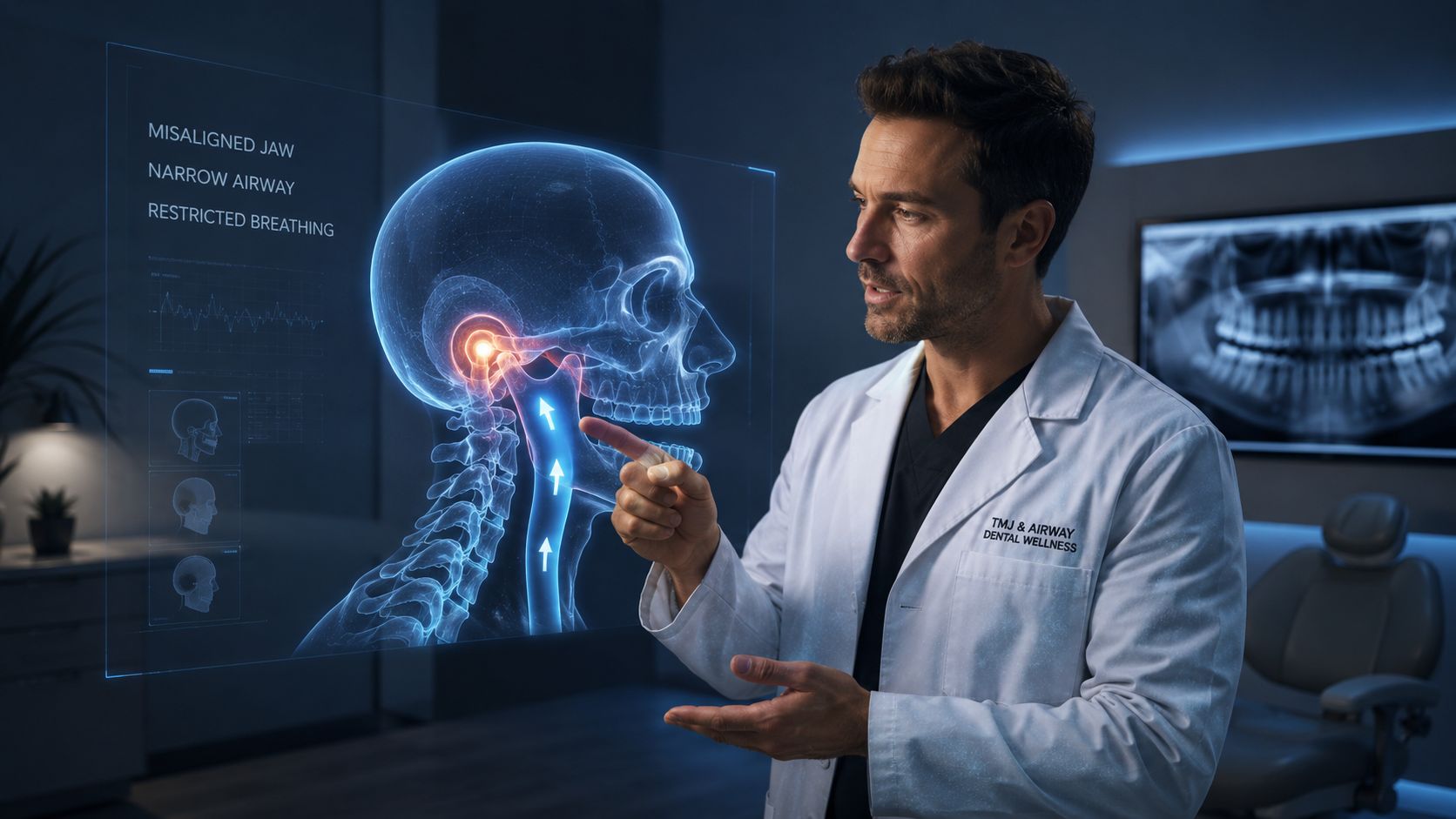
You wake up after what should have been a full night's sleep, but your jaw feels tight, your head aches, and you're dragging through the morning. By afternoon, you may notice clicking when you chew, facial soreness, or that worn-down feeling that coffee doesn't fix.
For many adults in Fair Lawn, Ridgewood, and Glen Rock, those symptoms seem unrelated. Jaw pain feels like a dental problem. Snoring, restless sleep, or daytime fatigue feels like a sleep problem. In real life, they can overlap.
That's where the TMJ sleep apnea connection becomes important. If your jaw joint is strained and your airway is unstable during sleep, your body may spend the night fighting to breathe and clenching at the same time. You're not imagining it, and you're not overreacting by asking whether the two issues could be linked.
A common story goes like this. Someone starts by searching for a dentist near me because of jaw pain, cracked dental work, or morning headaches. They assume stress is the whole problem. Then they mention snoring, poor sleep, or waking up exhausted, and suddenly the picture looks different.
In Fair Lawn, that combination deserves a careful look. Jaw soreness in the morning can point to clenching or grinding. Fatigue despite time in bed can suggest that sleep isn't restorative. When those patterns show up together, it's worth asking whether the jaw joint and the airway are affecting each other.

Some patients come in focused on one symptom only. They want help with jaw clicking, facial tension, or broken teeth from nighttime grinding. Others are looking for answers about snoring, dry mouth, or waking up unrested. The confusion is understandable because these problems don't always announce themselves clearly.
Practical rule: If you wake with both jaw discomfort and low energy, don't assume they're separate issues.
A patient-focused dental visit should connect the dots, not treat each symptom in isolation. That matters whether you're looking for a dentist in Fair Lawn, NJ, a provider for dental care, or a practice that can handle more complex concerns involving bite, jaw function, and sleep.
A local office visit is often the easiest place to start because many signs show up in the mouth and jaw first. Tooth wear, muscle tenderness, bite imbalance, and tension around the joint can all provide clues. A dentist who evaluates both TMD and airway issues can help decide whether you may also need medical sleep testing.
For families and adults in Fair Lawn, Ridgewood, and Glen Rock, it helps to have one place to begin with new patient exams, cleaning and exams, dental X-rays, and a conversation grounded in what you're experiencing day to day. Relief starts with understanding the pattern.
TMD stands for temporomandibular disorder. It involves the jaw joint, nearby muscles, and the way the bite functions. Common complaints include pain near the ears, clicking, limited opening, muscle tightness, and headaches.
OSA, or obstructive sleep apnea, happens when the airway repeatedly narrows or closes during sleep. That can lead to snoring, disrupted sleep, dry mouth, gasping, and daytime fatigue. Many people think of it as only a throat problem, but the jaw and tongue position are part of the same system.
Think of your jaw like a hinge that also helps hold space open behind the tongue. If that hinge is strained or sits too far back, the area behind it can become less stable. During sleep, when muscles relax, that reduced space may make breathing harder.
At the same time, if the airway starts to narrow at night, the body may respond by tightening jaw muscles in an effort to protect airflow. That repeated tension can leave the jaw sore by morning. So the relationship isn't random. The same anatomy is involved in both problems.
A major population-based study found that adults with a high likelihood of obstructive sleep apnea had a 73% higher incidence of first-onset TMD, with an adjusted hazard ratio of 1.73 and 248 people developing first-onset TMD over 7,068 person-years of follow-up. The average annual incidence was 3.5%, and among the 6.1% of participants classified as high-likelihood OSA, the rate of first-onset TMD was about two times greater than in those with low OSA likelihood, according to the OPPERA longitudinal study on sleep apnea symptoms and first-onset TMD.
Long-term observation shows the timing. Newer genetics research adds another layer. A 2024 Mendelian randomization study reported that OSA had a statistically significant causal influence on TMD, with an odds ratio of 1.241 and P = 0.041, while the reverse analysis found no significant causal link from TMD to OSA, according to the 2024 study on the hereditary causal relationship between OSA and TMD.
That doesn't mean every person with jaw pain has sleep apnea. It means jaw pain can be a reason to look more closely at sleep breathing, especially when the story includes snoring, clenching, or unrefreshing sleep.
Many readers get stuck on one question: “Which caused which?” In practice, the more useful question is whether both are present and keeping each other active.
If you want a plain-language refresher on joint irritation, muscle tension, and common TMD patterns, Peak Therapy's guide to TMD is a helpful overview.
Your lower jaw, tongue, and throat don't work as isolated parts. When one shifts, the others respond. That's why small differences in jaw position can matter at night.
If the lower jaw sits farther back, the tongue may also rest farther back. During sleep, relaxed muscles can make that backward position more likely to crowd the airway. Breathing then becomes less stable, especially when you're flat on your back.

The simplest way to picture it is a crowded hallway. If the jaw and tongue are positioned backward, there's less open room behind them. Air has a narrower path through the back of the throat.
A review discussing this relationship notes that a misaligned TMJ can alter the tongue's position, reducing the posterior airway space. It also describes how the body may tense jaw muscles and joints to help maintain airflow, which can worsen TMJ problems over time, as explained in the review on TMJ, airway space, and sleep-disordered breathing.
People often assume grinding is only about stress. Stress can play a role, but nighttime clenching can also be part of the body's attempt to stabilize the jaw or airway. If your system senses restricted breathing, it may recruit muscles that pull and tense around the jaw.
That can create a cycle like this:
When the airway is crowded, the jaw often stops acting like a simple chewing joint and starts acting like a support structure for breathing.
Not every patient has the same jaw shape or bite pattern, but a few features can raise suspicion:
This is one reason a dental evaluation can be so useful. The mouth often reveals what sleep symptoms alone don't.
Many people in Fair Lawn don't realize the pattern until they see the symptoms side by side. They've been treating headaches as stress, jaw pain as grinding, and fatigue as a busy schedule. The overlap can be the clue.
| Symptom | Common in TMD? | Common in Sleep Apnea? |
|---|---|---|
| Jaw pain or facial soreness | Yes | Can occur, especially when nighttime tension is present |
| Jaw clicking or popping | Yes | Not typical on its own |
| Morning headaches | Yes | Yes |
| Teeth grinding or clenching | Yes | Often overlaps |
| Snoring | Not usually a primary sign | Yes |
| Daytime sleepiness or mental fog | Can happen if pain disrupts sleep | Yes |
| Waking with a dry mouth | Not usually a primary sign | Common |
| Ear-area discomfort or pressure | Yes | Can overlap indirectly |
| Restless or unrefreshing sleep | Common when pain interrupts sleep | Yes |
| Limited jaw opening or jaw stiffness | Yes | Not usually a primary sign |
The signs aren't always dramatic. Sometimes it's just a sore jaw while eating breakfast, tension in the temples while driving, or the feeling that you slept long enough but didn't actually rest.
You might also notice:
A few comfort measures at home may help reduce strain while you're waiting for an evaluation. For example, some people sleep more comfortably with better neck support, and this guide to ergonomic pillows for comfort at home can help you think about positioning.
If your symptoms live in both columns, it's worth getting evaluated. A checklist can't diagnose you, but it can show that the pattern is real.
People often delay care because they expect a complicated process. In most cases, the first step is a straightforward thoughtful conversation and a detailed exam. The goal is to understand how your jaw, teeth, muscles, and sleep symptoms fit together.
At a visit for jaw pain, clenching, headaches, or sleep-related concerns, the team looks for signs that point toward both TMD and airway issues. That can include tooth wear, tenderness in the chewing muscles, bite imbalance, joint sounds, and how your lower jaw moves when you open and close.
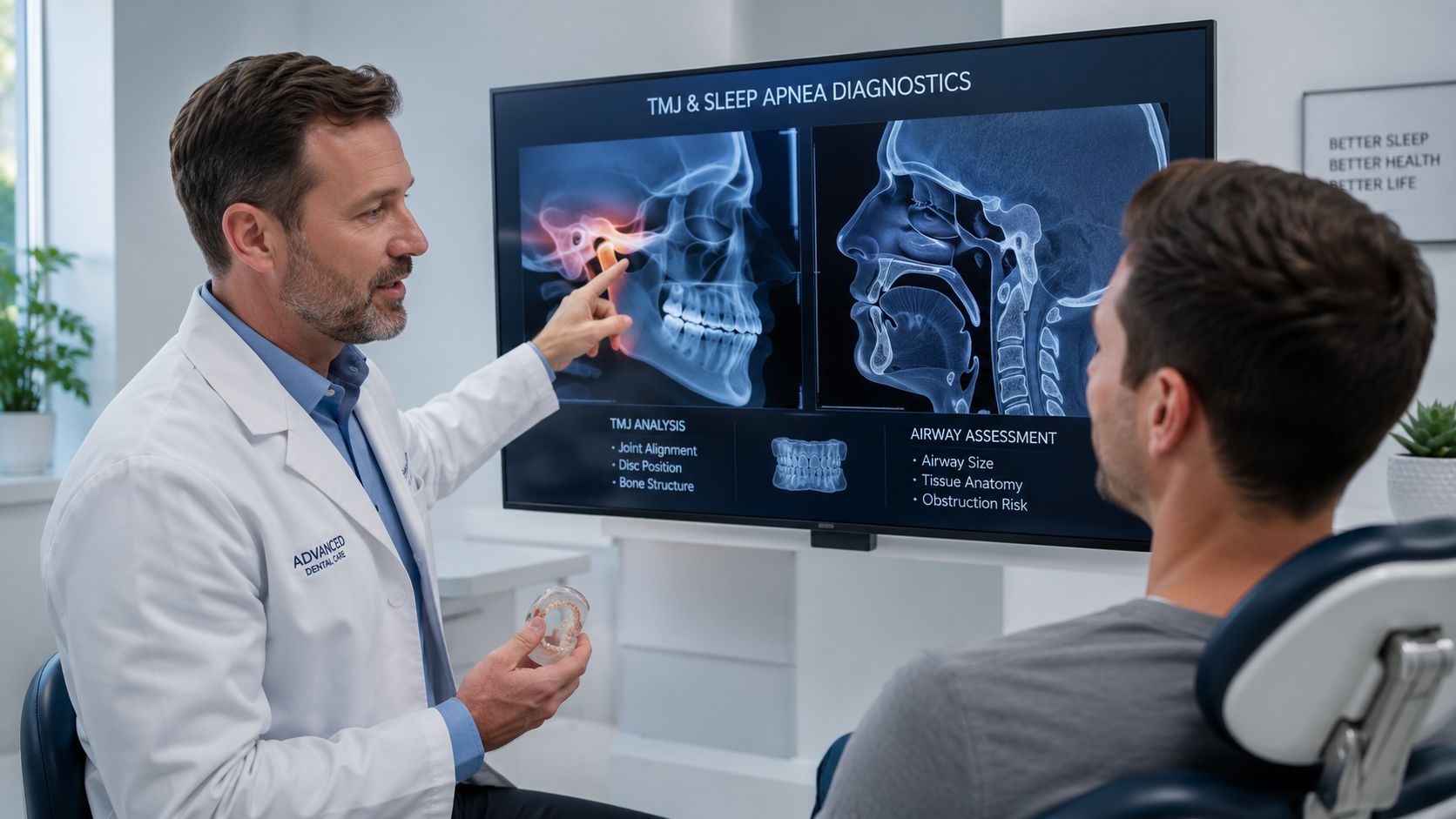
A careful dental evaluation may involve both visual and digital findings, with dental X-rays and other imaging tools providing assistance in assessing the teeth, bite, and jaw structures.
Typical parts of the workup may include:
A dentist can identify warning signs, but a formal diagnosis of sleep apnea may require coordination with a physician or sleep specialist. That collaborative step matters because treatment works best when the dental and medical sides are aligned.
For patients who want more background on the role dentistry can play, this page on sleep apnea and dental treatment explains how oral findings and sleep care often intersect.
A good diagnosis doesn't rush to one answer. It rules in what fits, rules out what doesn't, and builds a plan around your actual symptoms.
Once the pattern is clear, treatment should match the anatomy causing the trouble. That's why many dental approaches focus on jaw position, bite stability, and muscle strain rather than chasing symptoms one by one.
One of the most useful tools is a custom oral appliance. This device is made to fit your teeth and is worn during sleep. In appropriate cases, it can gently hold the lower jaw in a position that supports a more open airway while also reducing strain on the jaw joint and surrounding muscles.

The logic is mechanical. If the jaw sits in a healthier position at night, the airway may stay more open and the joint may function under less stress. That's why one appliance can sometimes support both breathing and comfort.
Benefits may include:
This is also where a dental provider can connect treatment with other services. Bite correction with Invisalign, restorative dentistry for worn or broken teeth, or a dedicated appliance plan for TMD may all support long-term improvement.
A local option for this kind of care is the TMJ treatment page from Dental Professionals of Fair Lawn, which outlines how jaw-focused treatment can fit into broader dental care.
Some patients ask whether an oral appliance replaces CPAP. The answer depends on your diagnosis and what your physician recommends. CPAP remains an important treatment for many people with sleep apnea. A dental appliance is a different tool, often considered when it matches the patient's anatomy, symptoms, and medical guidance.
Many patients prefer an oral appliance because it's compact and easier to wear than a mask-based system. Others do better with CPAP. Some need a coordinated approach. The right choice is the one that's safe, realistic, and comfortable enough to use consistently.
Here's a short overview of how these options differ:
| Option | Main purpose | What patients often notice |
|---|---|---|
| Custom oral appliance | Repositions the jaw to support the airway and reduce strain | Smaller device, dental fit, jaw-focused design |
| CPAP | Uses pressurized air to keep the airway open | Mask-based treatment, highly effective for many patients |
This short video gives a visual look at oral appliance therapy in practice.
A custom appliance works best as part of a larger plan. Sleep position, mattress support, and head elevation can also matter for some people. If you're exploring your setup at home, this article on enhancing sleep with an adjustable base gives practical ideas about positioning.
Not necessarily. That's one of the biggest misconceptions online. The evidence supports a strong relationship, but it's more accurate to say these conditions can influence each other and often share risk factors such as jaw anatomy, grinding, excess body weight, and disrupted sleep, as explained by SleepApnea.org's overview of TMJ and sleep apnea.
No. Jaw clicking alone doesn't mean you have sleep apnea. Some people have joint sounds without airway problems, and some people with sleep apnea have no jaw clicking at all. The concern grows when clicking shows up with fatigue, snoring, morning headaches, dry mouth, or noticeable clenching.
For many patients, yes, especially after an adjustment period. Because the appliance is custom-made, it's designed around your bite and comfort. Follow-up visits matter because small refinements can improve how it feels and how it functions.
That depends on what's being treated. Some people need an appliance and monitoring. Others also need bite adjustment, restorative work for grinding damage, or orthodontic planning. What matters most is getting the diagnosis right first, then building treatment in the proper order.
If you're dealing with jaw pain, morning headaches, snoring, or fatigue and want clear answers from a local dental team, schedule a consultation with Dental Professionals of Fair Lawn. A careful evaluation can help determine whether your symptoms point to a TMJ and airway issue, and what the next step should be for lasting relief.