Sleep Apnea and Dental Treatment in Fair Lawn, NJ
Tired of restless nights? Learn about sleep apnea and dental treatment options in Fair Lawn, NJ. Dental Professionals of Fair Lawn can help. Schedule a consult.
Tired of restless nights? Learn about sleep apnea and dental treatment options in Fair Lawn, NJ. Dental Professionals of Fair Lawn can help. Schedule a consult.
You wake up tired, even after what should have been a full night's sleep. Your partner says the snoring is getting worse. Some mornings you have a dry mouth, a headache, or that heavy, foggy feeling that makes the whole day harder than it should be.
That pattern is easy to brush off for months or even years. A lot of people assume they're just stressed, getting older, or sleeping lightly. In many cases, the underlying issue is sleep apnea, and dental care can play an important role in finding it and helping manage it.
For families in Fair Lawn, Ridgewood, and Glen Rock, sleep apnea and dental treatment often come together in a way patients don't expect. A dentist may be the first person to notice the signs in your mouth, your jaw, and your airway before you ever connect those clues to your sleep.
A common story sounds like this. Someone comes in for a routine dental visit, maybe for a cleaning and exam, maybe because they need a night guard, have jaw soreness, or want a dentist near me in Fair Lawn, NJ who can look at several issues at once. During the conversation, the tiredness comes up. Then the snoring. Then the fact that they never feel rested.
That's where a more complete dental evaluation can help.
At Dental Professionals of Fair Lawn, sleep concerns aren't treated like a side note. For many patients in Fair Lawn, Ridgewood, and Glen Rock, they're part of the bigger health picture. A person may come in thinking they need help with worn teeth, a dry mouth, TMJ discomfort, or even cosmetic dentistry because grinding has damaged their smile. Sometimes those symptoms point to a sleep breathing issue that deserves closer attention.

Many people see their dentist more regularly than they see a medical specialist. That makes a dental office a practical place to notice patterns early.
During a visit, patients may mention:
A local practice matters here. When you're looking for a dentist in Fair Lawn, NJ, you want a team that can connect oral symptoms with the rest of your health, not just focus on teeth in isolation.
Good sleep affects far more than your energy. It changes how comfortably you function at work, at home, and in your day-to-day life.
Practices also need to communicate clearly with the community they serve. For dental offices trying to educate patients about services people may not realize they need, outreach matters. Resources such as Facebook ads for dental practices can help explain options like sleep apnea screening in a more accessible way before a patient ever makes the first call.
Patients are often relieved to hear this first: not every snorer has sleep apnea, and not every tired patient needs the same treatment. The point is not to guess. The point is to look carefully, ask the right questions, and guide the next step.
That approach builds trust. It also makes sleep apnea and dental treatment feel less intimidating for people who are already overwhelmed, exhausted, or unsure where to begin.
Obstructive sleep apnea, often shortened to OSA, happens when the airway repeatedly narrows or closes during sleep. The easiest way to picture it is to think of a soft garden hose. When the walls stay open, air moves through. When the hose bends or collapses, flow drops or stops.
In sleep apnea, the same kind of blockage can happen in the airway as the muscles relax during sleep. The body keeps trying to breathe, but airflow is disrupted. That interruption can fragment sleep again and again through the night.

A patient rarely walks in saying, “I think my airway is collapsing at night.” They usually describe consequences.
During an exam, dentists may see clues that suggest disordered sleep breathing, including:
Those signs don't confirm sleep apnea by themselves. They do help identify who may need further evaluation.
The mouth, jaw, tongue, and throat all affect the size and stability of the airway. That's why dentistry has become a meaningful part of care for some patients with obstructive sleep apnea.
The American Dental Association states that oral appliance therapy is a primary treatment for adults with mild to moderate obstructive sleep apnea and for severe apnea patients who cannot tolerate CPAP, and it also notes that CPAP adherence can be as low as 30% to 60% while oral appliances are often better tolerated because they're smaller and less intrusive, making dentists part of the modern sleep medicine team, as explained in the ADA overview of obstructive sleep apnea and oral appliance therapy.
Practical rule: If a patient has persistent snoring, worn teeth, and unexplained daytime fatigue, it's worth screening for a sleep breathing disorder instead of treating each symptom separately.
Sleep apnea doesn't only affect sleep. It can also complicate oral health and treatment planning.
| Oral finding | Why it matters |
|---|---|
| Worn teeth | May point to nighttime grinding linked with disturbed sleep |
| Dry mouth | Can increase irritation and make the mouth feel uncomfortable on waking |
| Jaw soreness | May reflect clenching, unstable bite forces, or airway-related compensation |
| Inflamed tissues | Can make routine dental care and long-term maintenance more difficult |
That's one reason a thorough new patient exam matters. A practice that offers restorative dentistry, cleaning and exams, dental x-rays, emergency dentist services, and airway-focused evaluation can often connect symptoms that seem unrelated at first.
Most patients feel better once they understand the process. Sleep breathing evaluation is usually straightforward, and it doesn't begin with a machine or a mouthpiece. It begins with a conversation.
If someone comes in for a new patient exam, a consultation, or even because they're searching for a cosmetic dentist near me and mention headaches or clenching, the first step is listening closely to the pattern. Snoring, unrefreshing sleep, dry mouth, jaw fatigue, and daytime sleepiness all help shape whether screening makes sense.

A dental screening for sleep breathing issues often includes a review of symptoms and a close look at the structures that influence the airway.
That may involve:
Medical and sleep history
We ask what you're experiencing at night and during the day, how long it's been happening, and whether anyone has noticed pauses in breathing or severe snoring.
Head, neck, jaw, and oral exam
The exam looks at bite patterns, wear on the teeth, tongue position, oral tissues, and other anatomic features that may affect airway space or support.
Discussion of risk level
If the pattern suggests concern, the next step is not to guess. It's to move toward formal medical diagnosis.
This part matters. A dentist can identify signs and risk factors, but sleep apnea is formally diagnosed through a sleep study interpreted by a physician.
That study may be done at home with portable equipment or in a sleep lab, depending on the patient's medical situation and the physician's recommendation. Once the diagnosis is confirmed, treatment decisions can be made with much more confidence.
The best results come from collaboration. The dentist evaluates the mouth and jaw. The sleep physician confirms the diagnosis and measures what's happening during sleep.
A careful process prevents two common problems. First, it avoids handing a patient a device when the underlying issue hasn't been properly identified. Second, it makes sure treatment can be checked later to see whether it's effective.
Patients in Fair Lawn, Ridgewood, and Glen Rock often appreciate that this isn't rushed. If you're also coming in for other needs, such as Invisalign, restorative dentistry, a tooth extraction, or help from an emergency dentist, the same principle applies. Good care starts with a correct diagnosis, then moves to the right treatment, not the fastest one.
The main dental treatment for obstructive sleep apnea is oral appliance therapy. For the right patient, it can be a practical and comfortable option that fits more naturally into everyday life than a larger machine-based setup.
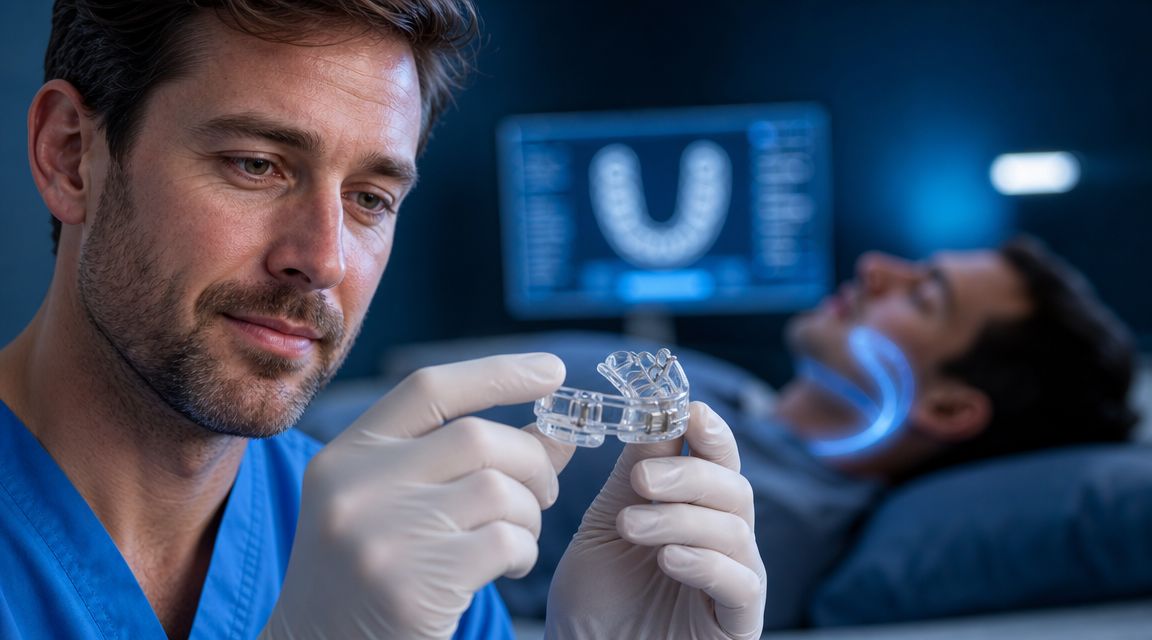
A commonly discussed appliance is a mandibular advancement device, often called a MAD. It's worn during sleep and gently positions the lower jaw forward. That small shift can help create more space behind the tongue and in the airway.

A custom oral appliance is not the same as a sports guard or an over-the-counter boil-and-bite tray. Precision matters.
A professionally made appliance is designed around your bite, your jaw movement, and your dental anatomy. It should fit securely, allow planned adjustment, and be monitored over time so it remains effective and doesn't create avoidable bite problems.
Custom design matters because the treatment depends on controlled positioning, not just putting something in the mouth at night.
For patients who are good candidates, several factors improve the chances of success:
Clinical data support the role of these devices. Research summarized by Texas A&M College of Dentistry reports that oral appliances significantly improve breathing during sleep, were effective even in severe sleep apnea in one study, reduced apnea severity by over 50% in approximately 70% of users, and completely resolved symptoms for about one-third of patients, as described in the Texas A&M review of dental solutions for sleep apnea.
A short video can help make the concept easier to see in real terms:
Sleep apnea and dental treatment sometimes overlap with other services. A patient may need support for grinding damage, cracked teeth, gum irritation, or TMJ-related discomfort while the sleep issue is being addressed.
In selected cases, orthodontic care can also matter. Invisalign may help when bite relationships and tooth position are part of a broader treatment plan, though it is not a replacement for a proper sleep apnea diagnosis or a direct substitute for oral appliance therapy. Dental Professionals of Fair Lawn also provides sleep apnea therapy and custom snore guards as part of its broader dental and airway-related services.
A good appliance should feel intentional, not improvised. If it isn't custom fitted and followed closely, the chances of discomfort or poor results go up.
Patients usually want a straightforward answer here. Which works better?
The honest answer is that CPAP and oral appliance therapy do different things well. CPAP is generally more powerful at physically controlling the airway. Oral appliance therapy is often easier for patients to wear consistently. In real life, both matter.

| Treatment | Where it often stands out | Common drawbacks |
|---|---|---|
| Oral appliance therapy | Small, quiet, portable, easier for travel, often easier to tolerate | Not right for every patient, may require adjustment, not uniformly curative |
| CPAP | Strong physiologic control of the airway, often preferred medically in many severe cases | Mask discomfort, noise, bulk, cleaning demands, lower tolerance for some users |
The central tradeoff is adherence versus raw physiologic power. The Harvard Health summary notes that custom mandibular advancement devices enlarge the airway mechanically and that some reports show about 90% compliance for oral appliances versus about 50% for CPAP, which is why oral appliances can be an important alternative when PAP therapy isn't tolerated, according to Harvard Health's discussion of dental appliances for sleep apnea.
Some people do very well with CPAP and should stay with it. Others struggle with the mask, the setup, or the feeling of sleeping attached to equipment. Those patients often ask whether there's another path.
Oral appliance therapy is commonly considered when:
For readers comparing alternatives in more detail, this guide on how to treat sleep apnea without CPAP may be helpful.
What usually fails is choosing based on wishful thinking instead of fit. A patient with significant symptoms who abandons CPAP but never follows through with an oral appliance doesn't solve the problem. The same goes for buying a generic snore device online and hoping it acts like custom medical treatment.
The right treatment is the one that matches the diagnosis and gets used night after night.
That's why the decision should include symptom pattern, severity, oral health, jaw comfort, and long-term follow-up, not just convenience alone.
For many patients, the hardest part is not wearing the appliance. It's getting started because they don't know what the process will feel like.
In practice, the process is usually calmer than expected. It begins with a consultation and review of your diagnosis, symptoms, dental history, and jaw function. If oral appliance therapy is appropriate, the next steps focus on fit, comfort, and predictable follow-up.
At the beginning, patients often want to know whether they'll need traditional impressions. In many modern dental offices, digital scanning can reduce that concern. Instead of relying on goopy molds, the teeth can be captured more comfortably with digital technology such as an iTero scanner, which helps with precision and planning.
From there, the appliance is fabricated based on your specific bite and treatment goals. When it arrives, the fitting visit is not just a handoff. The appliance is checked closely to make sure it seats properly, feels stable, and starts in a position your jaw can tolerate.
Oral appliance therapy usually works best when it's fine-tuned over time. The jaw position may need gradual adjustment rather than one aggressive change on day one.
Patients can expect follow-up visits for things like:
This part is important because success doesn't come from owning the appliance alone. It comes from using a properly fitted one and adjusting it thoughtfully.
Questions about coverage often come up early, and they should. Insurance rules can be confusing because sleep apnea treatment may involve both dental and medical components. Patients who want a clearer overview before the first visit can review this page on sleep apnea dental appliance covered by insurance.
Patients also appreciate knowing that this care can fit into broader treatment planning. If you're also considering cleaning and exams, restorative dentistry, Invisalign, Six Month Smile, cosmetic dentist near me options, or treatment for damaged teeth from grinding, those needs can be coordinated rather than handled in isolation.
Not always. Many patients start by discussing symptoms with a dentist because they're already coming in for a checkup, a new patient exam, or concerns like grinding and jaw pain. If screening suggests a sleep breathing issue, the formal diagnosis still comes through a sleep physician and sleep study.
Coverage depends on your plan and how the treatment is documented. Because sleep apnea is a medical condition, benefits may involve medical insurance, dental insurance, or a combination of both. The important step is checking your specific coverage and understanding any documentation requirements before treatment begins.
A custom appliance is designed to be much more wearable than a generic store-bought device. Most patients need an adjustment period, especially in the beginning, but comfort improves when the appliance is fabricated properly and adjusted carefully over time.
No. A night guard and a sleep apnea appliance may look somewhat similar to a patient, but they serve different purposes. A grinding guard mainly protects teeth. A sleep apnea appliance is designed to influence jaw position and support the airway during sleep.
That's common. Some patients looking for a dentist in Fair Lawn, NJ are also dealing with worn teeth, restorative needs, cosmetic concerns, or even emergency dentist issues related to clenching and fracture. Those concerns can often be evaluated alongside sleep-related treatment planning.
The first step is a consultation. Bring your symptoms, your questions, and any sleep study information you already have. If you haven't had a sleep study yet, that can be discussed so the right referral path is clear.
If you're tired of waking up exhausted, snoring heavily, or wondering whether your grinding and jaw soreness are connected to poor sleep, it's time to get answers.
If you're looking for compassionate, practical help with sleep apnea and dental treatment, contact Dental Professionals of Fair Lawn to schedule a consultation. Patients in Fair Lawn, Ridgewood, and Glen Rock can come in for a clear evaluation, honest guidance, and a treatment plan that fits their health, comfort, and daily life.