Professional Tartar Removal in Fair Lawn, NJ
Get professional tartar removal in Fair Lawn, NJ. Learn what to expect from a dental cleaning at Dental Professionals of Fair Lawn, serving Fair Lawn &
Get professional tartar removal in Fair Lawn, NJ. Learn what to expect from a dental cleaning at Dental Professionals of Fair Lawn, serving Fair Lawn &
You run your tongue along the back of your front teeth and feel a rough edge that wasn't there before. Maybe your gums bleed a little when you floss. Maybe your smile looks dull even though you brush every day. Those are the moments when many people in Fair Lawn, Ridgewood, and Glen Rock start searching for a dentist near me and wondering whether they need a simple cleaning or something more involved.
That uncertainty makes people put off care. They worry about pain, cost, or hearing the words “deep cleaning” without really knowing what that means. In practice, tartar removal is usually much more straightforward when you catch it early. The key is getting a clear diagnosis and a plain-English explanation before anything starts.
A new patient often comes in saying the same thing: “My teeth feel clean after brushing, but there's one area that still feels rough.” Another says their gums bleed near the lower front teeth. A parent from Glen Rock may notice staining around the gumline and assume it's only cosmetic. In many of these cases, the issue is tartar, not a failure of effort.
That matters because tartar doesn't respond to harder brushing. It needs the right tools and the right approach. Patients looking for a dentist in Fair Lawn, NJ usually aren't just shopping for a cleaning. They want clarity, comfort, and a team that won't make them feel embarrassed about what's going on.

Many patients don't ask for “professional tartar removal” by name. They ask questions like:
Those are fair questions. Good dental care starts by answering them directly.
A cleaning visit should never feel like a mystery. You should know what we see, what it means, and why a specific treatment is being recommended.
Patients also look for signs that a practice is attentive and accountable. If you're comparing local healthcare providers online, this guide to mastering Google reviews strategy gives useful context on how reviews reflect communication, consistency, and patient experience.
In a community practice, trust builds one conversation at a time. Whether someone is coming in for cleaning and exams, an emergency dentist visit, tooth extraction, Invisalign, Six Month Smiles, or asking about a cosmetic dentist near me, the first step is the same. Listen closely, examine carefully, and explain clearly.
Plaque is soft. Tartar is hard. That's the simplest way to understand it.
Think of plaque like a sticky film on a kitchen counter. You can wipe it away. Tartar is more like mineral scale that hardens onto a faucet or inside a pipe. Once it sets, normal wiping won't remove it. Your toothbrush works on plaque. It doesn't remove tartar after it has hardened onto the tooth.
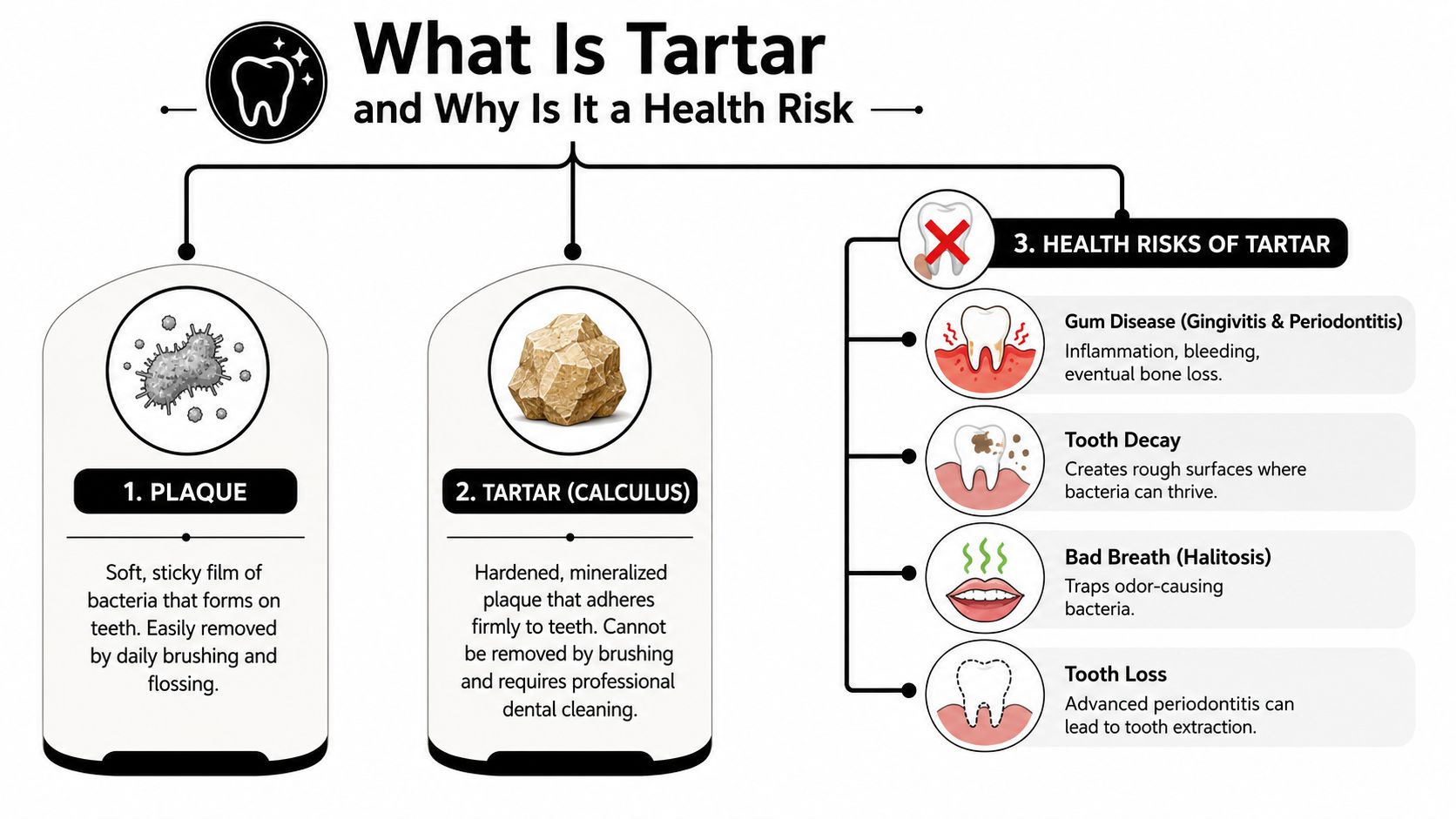
Plaque can harden into tartar in a matter of hours, and once that happens it has to be removed professionally by a dentist or hygienist using specialized instruments, as summarized in this periodontal evidence review. That's why even people with solid home habits can still develop buildup in hard-to-reach areas.
Tartar is also rough. That rough surface gives more plaque a place to cling, especially near the gumline and between teeth. The cycle feeds itself unless someone interrupts it.
If you want a broader look at why it forms in the first place, this article on what causes tartar is a helpful companion.
At first, tartar may seem like a stain or a texture issue. The actual concern is what it does to the gums.
When tartar sits at the gumline, the gums often become irritated. They may look red, swell, or bleed when brushing and flossing. That early stage is gingivitis. If buildup extends below the gums and inflammation continues, the condition can progress to periodontitis, where the supporting tissues and bone around teeth are affected.
Practical rule: If your gums bleed repeatedly in the same spots, don't assume you need to brush harder. Bleeding is often a sign that the gumline needs professional evaluation.
Common problems tied to untreated tartar include:
One fact patients deserve to hear plainly is this: professional tartar removal (scaling) is the only safe and effective method for eliminating existing calculus deposits because tartar is hardened plaque that cannot be removed by brushing or flossing alone, requiring specialized instruments like scalers used by dentists or hygienists, according to the Cleveland Clinic overview of tartar.
Tartar changes how the mouth feels. Teeth may feel rough or gritty. Floss may catch. Breath may not feel fresh for long. Some patients notice one side of the mouth always seems inflamed.
Those signs don't always mean advanced disease. They do mean it's worth checking before the problem gets deeper and harder to treat.
Many people try to solve tartar at home first. They buy scraping tools online, use whitening products more aggressively, or brush harder in the same area every day. None of those approaches fixes existing tartar safely.
The reason is simple. Tartar is bonded to the tooth surface much more firmly than plaque. Removing it without training can scratch enamel, irritate gums, and miss the buildup hiding just under the gumline. A smooth-looking tooth isn't always a clean tooth.
At-home scraping often creates two problems. First, people can injure soft tissue. Second, they can remove only part of the deposit and leave a smoothed-over area that still harbors bacteria. That gives a false sense of success while the gum stays inflamed.
Professional care solves this differently. The clinician doesn't just look. The clinician checks where the deposit is, how deep it goes, and whether the gums are reacting.
In a dental office, tartar removal usually falls into one of two categories:
That distinction matters because the treatment should match the diagnosis. Not every patient with tartar needs a deep cleaning. Not every rough area is just a routine polish either.
A proper exam looks at visible buildup, gum condition, and whether tartar may be extending beneath the tissue. If gums are inflamed or pockets are deeper than expected, the recommendation may shift from a standard cleaning to a more therapeutic one.
The depth of the tartar matters as much as the amount. A small deposit below the gumline can cause more trouble than a larger deposit you can see.
This is also where a broader dental conversation can help. During an exam, some patients also ask about dental x-rays, new patient exams, restorative dentistry, teeth whitening, or whether crowding that traps plaque could be improved with Invisalign or Six Month Smile. Those services don't replace tartar removal, but they can support a healthier long-term result.
You come in expecting a standard cleaning. Then the exam shows bleeding gums, tartar tucked below the gumline, or pockets that are deeper than they should be. That is usually the moment patients get nervous, because the word “cleaning” has been used for two different treatments.
Here is the clear version. A routine cleaning, or prophylaxis, removes plaque and tartar from the visible tooth surfaces and around the gumline in a mouth that is otherwise stable. A deep cleaning, or scaling and root planing, is periodontal treatment. It is recommended when deposits have moved below the gums and the tissues show signs of disease.
The difference is not just terminology. It changes the purpose of the visit, how long treatment may take, what you feel during the appointment, and what kind of healing we expect afterward.
The decision starts with clinical findings, not with how long it has been since your last visit.
A routine cleaning is generally appropriate when tartar is mostly above the gumline, the gums are not showing active periodontal breakdown, and pocketing stays in a healthier range. A deep cleaning is considered when we find inflamed or bleeding gums, deposits below the tissue, root surface buildup, or periodontal pockets that suggest bacteria are collecting where a toothbrush and floss cannot reach.
That is why I explain the diagnosis in plain language before treatment starts. If I recommend a routine cleaning, I should be able to tell you that the buildup is accessible and your gums are stable enough for preventive care. If I recommend scaling and root planing for deeper gumline buildup, I should be able to point to the exact signs that make it therapeutic rather than routine.
| Feature | Routine Cleaning (Prophylaxis) | Deep Cleaning (Scaling & Root Planing) |
|---|---|---|
| Main purpose | Remove plaque and tartar from visible surfaces and help maintain oral health | Remove bacterial deposits and tartar below the gums and treat periodontal infection |
| Best for | Patients with routine buildup and generally healthy gum support | Patients with periodontal pockets, bleeding gums, and subgingival calculus |
| Where the cleaning happens | Above the gumline and just along the gum margin | Under the gums and along the root surfaces |
| Typical timing | Often completed in one standard hygiene visit | May be completed in sections, depending on how much area needs treatment |
| What it feels like | Vibration, rinsing, light scraping, polishing, and a cleaner smooth feel afterward | More pressure, more time below the gumline, and sometimes local anesthetic for comfort |
| Goal after treatment | Maintain health and remove routine buildup | Reduce inflammation, lower the bacterial load, and give the gums a chance to heal and tighten |
For many patients, a regular cleaning feels straightforward. You may notice vibration from the scaler, cool water, occasional hand scaling in tighter areas, and polishing at the end. If tartar has been sitting on the front or back of the lower teeth, the immediate change in texture is often the first thing patients notice.
This type of cleaning is maintenance care. The tissues may be mildly irritated if buildup has been present, but the appointment is not designed to treat active periodontal infection below the gumline.
Deep cleaning reaches into areas that are more sensitive because the instruments are working under the gums and along the roots. Patients usually notice firmer pressure, more focused instrumentation, and more tenderness if the gums are already inflamed.
Comfort matters here. In practice, that can mean numbing the area, treating one section at a time, checking in often, and being honest about what is normal versus what would be unexpected. A well-managed deep cleaning should feel controlled, not rushed.
There is also a real trade-off to understand. A routine cleaning is simpler and easier, but it will not solve disease that is sitting below the gums. A deep cleaning takes more from the patient on the day of treatment, yet it addresses the source of ongoing inflammation instead of skimming over it.
Anxiety usually drops once the diagnosis matches the treatment. Patients do better when they know whether we are maintaining healthy conditions or treating infection below the gumline.
If a dentist tells you that you need a deep cleaning, a fair question is, “What are you seeing that makes this different from a regular cleaning?” You deserve a direct clinical answer, stated clearly and without pressure.
You come in because your teeth feel rough near the gumline, or because floss has started catching in the same spots every night. What helps most at that point is a visit that feels orderly and clear. We start by finding out whether you need a routine cleaning or treatment that goes deeper, then we explain why in plain language before any instruments come out. When you're looking for a dentist near me because your gums bleed, your teeth feel coated, or you are overdue for cleaning and exams, that kind of clarity usually lowers the stress right away.

The first part of the appointment is diagnostic. We review what you have noticed at home, examine the gumline carefully, and check for the signs that separate simple buildup from periodontal disease. That includes looking at how much tartar is visible, whether the gums are swollen or bleeding easily, and whether there are areas that suggest deposits below the gumline.
If deeper buildup is suspected, digital X-rays may be recommended to look at bone levels and rule out problems that are not visible during a surface exam. That matters because treatment should match the condition. A patient with light buildup above the gums should not be scheduled the same way as someone with root surface deposits and active inflammation.
Pace matters too.
Dr. Jody Bardash and the team adjust the visit to the person in the chair. Some patients want every step explained before we begin. Others do better with shorter check-ins and fewer surprises. Either approach works if the plan is clear and the treatment is done carefully.
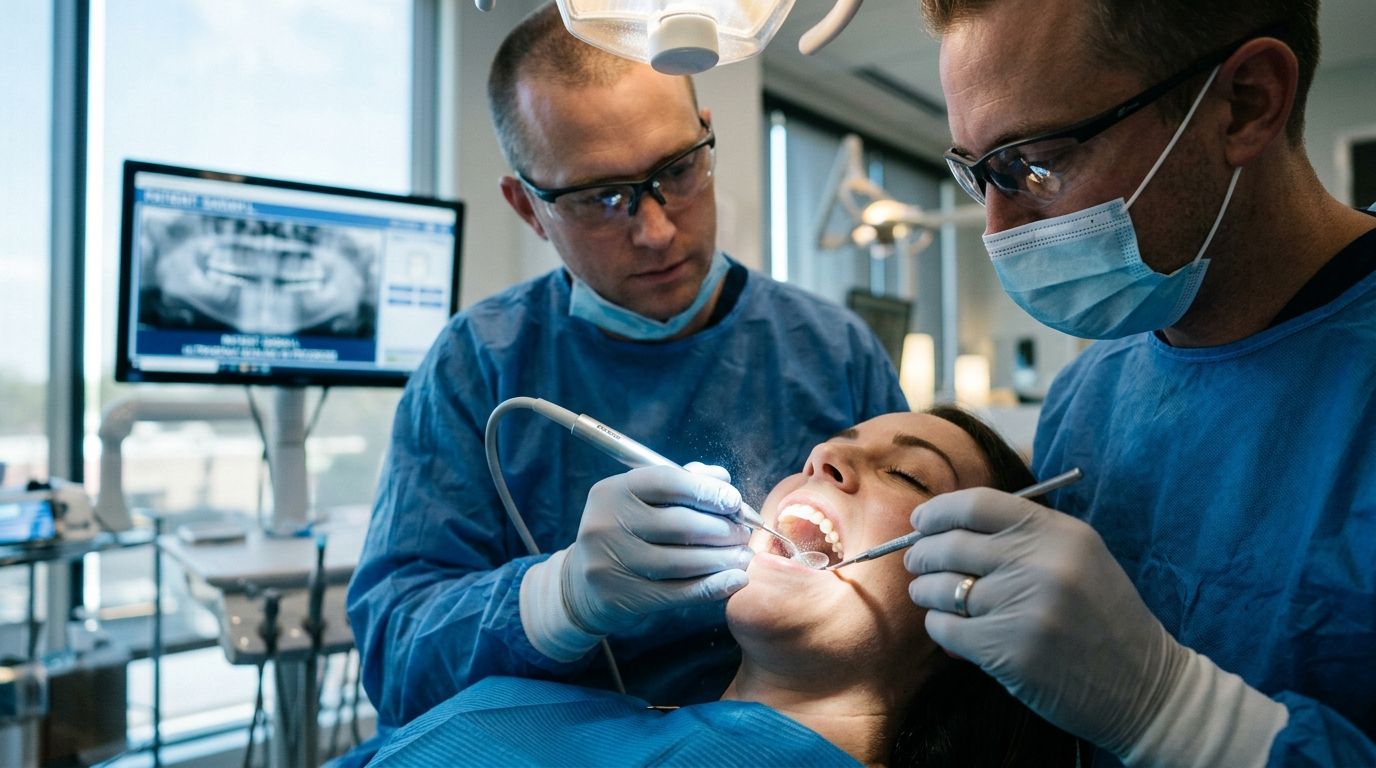
For many patients, the cleaning starts with an ultrasonic scaler. The tip vibrates while a stream of water helps wash away loosened debris, which makes it efficient for breaking up tartar that is firmly attached to the teeth. Patients usually notice a combination of cool water, vibration, and light pressure. If the buildup is heavier or the gums are inflamed, the sensation can feel sharper in certain areas, and we adjust accordingly.
Ultrasonic instruments are useful, but they are not the whole appointment. After larger deposits are removed, hand instruments are often used to refine the surfaces, especially around contours, tight spaces, and areas near the roots where precision matters more than speed. That combination gives a cleaner result than relying on one method alone.
The practical trade-off is straightforward. Faster removal is helpful, but gentle control matters more than finishing quickly.
Patients often describe the end result the same way. Their teeth feel smooth again.
That feeling usually comes from careful hand-finishing and polishing after the heavier tartar has been taken off. The goal is not to make the teeth look artificially glossy. The goal is to leave fewer rough areas where plaque can collect again quickly. In a routine cleaning, that finishing step is usually simple. In deeper periodontal treatment, some areas need more attention because the roots and pockets are harder to access and often more sensitive.
To help patients understand the process visually, this short video can be useful:
If you are nervous, say it at the beginning. That changes how we pace the appointment. We can use local anesthetic when deeper areas are being treated, give breaks when the jaw gets tired, and work in smaller sections if that makes the visit easier to handle. Patients usually do better when they know what they are about to feel and what is still within the normal range.
Sedation dentistry is also an option for some anxious patients who need more than reassurance and pacing. The right choice depends on the amount of treatment, your level of anxiety, and your medical history. The point is not to push you through care. The point is to make sure the appointment is tolerable enough that needed treatment gets completed.
Once the tartar is removed and the gums are healthier, some patients ask about teeth whitening because stains are easier to judge on a clean surface. Others want to address crowding that keeps trapping plaque, which leads to questions about Invisalign or Six Month Smiles. Some need restorative dentistry, tooth extraction, or want to discuss dental implants near me after long-term periodontal problems. Those conversations can wait until the mouth is clean and the diagnosis is clear. That order gives you better decisions and better results.
After tartar removal, most patients feel two things right away. Their teeth feel smoother, and their mouth feels cleaner. If the cleaning was more involved, there may also be some temporary tenderness, especially near the gums.
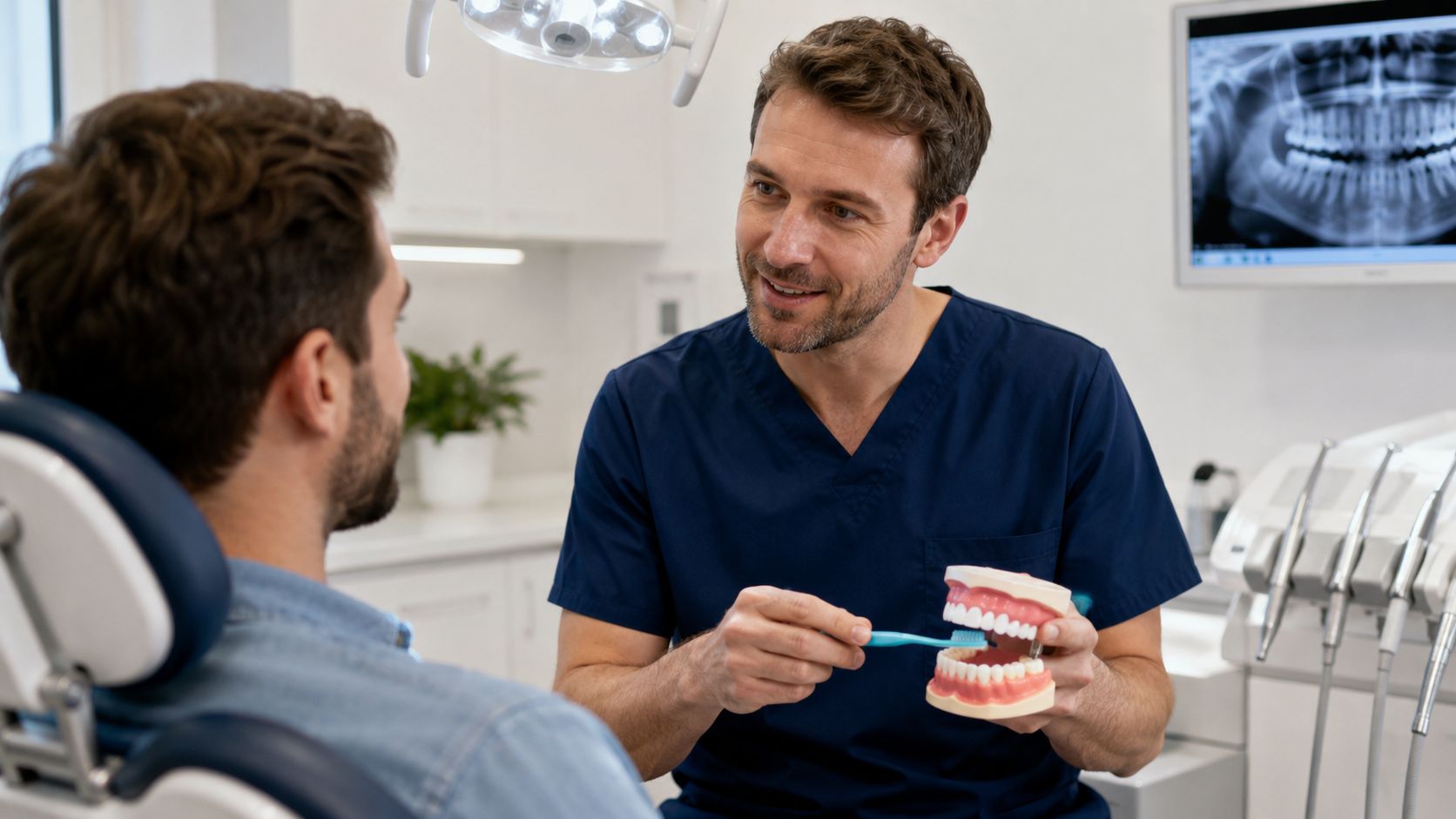
That sensitivity usually settles with gentle brushing, a soft diet if needed, and avoiding the urge to scrub the area aggressively. The goal after treatment is to keep the gumline clean while the tissue calms down.
A few simple habits help:
If you've had deeper periodontal treatment, follow the specific instructions you were given. That may matter more than any generic advice online.
Prevention works best when it's specific. The issue usually isn't only how often you brush. It's whether you're reaching the areas where plaque stays long enough to harden.
Electric toothbrushes can help. In a review of oral hygiene devices, the O-R electric brush showed 70.3% greater whole-mouth plaque reduction, 71.8% for proximal surfaces, and 102.9% for lingual surfaces compared with manual brushing, with P < 0.001, according to this review in the periodontal maintenance literature. That doesn't mean one tool solves everything, but it does support recommending an electric brush for patients who repeatedly collect plaque in the same spots.
Toothpaste choice can matter too. Dentifrices with 62% or 67% sodium bicarbonate removed more plaque than those with 0% sodium bicarbonate in a timed brushing model, as reported in this clinical review of baking soda dentifrices.
One reason patients get frustrated is something called burnished calculus. That's tartar that has been smoothed over rather than fully removed. It may not be obvious visually, but the deposit is still there.
A clinician confirms true smoothness by tactile checks, not by appearance alone. In the public education gap described in this video discussion of burnished calculus and tactile confirmation, proper verification may involve floss wrapping and explorer detection. That's why someone can feel like they're doing everything right at home and still keep having the same area flare up.
Perfect brushing can't remove burnished calculus. If the same spot keeps bleeding or feeling rough, it needs professional re-evaluation.
For ongoing prevention, frequency matters. The American Dental Association has long recommended professional cleanings at least twice per year, and most insurance plans cover that preventive care at 100% for two routine visits. For higher-risk patients, including smokers and people with active gum disease, the interval often increases to every 3 to 4 months, according to this summary of ADA-aligned tartar removal guidance.
That schedule isn't arbitrary. It reflects how quickly some mouths accumulate calculus and how much support the gums need to stay stable.
A professional tartar removal visit should leave you with more than cleaner teeth. It should give you fresher breath, a smoother smile, less gum irritation, and a clear understanding of what your mouth needs next. For many patients in Fair Lawn, Ridgewood, and Glen Rock, the biggest relief is finally knowing whether they need a routine cleaning or periodontal treatment, instead of guessing.
If you've been delaying care because you're worried about pain, embarrassment, or hidden treatment decisions, get the exam first. A good dental visit doesn't start with pressure. It starts with answers. That applies whether you're due for a cleaning, searching for an emergency dentist, considering cosmetic dentist near me options, looking into dental implants near me, or planning future care such as Invisalign, Six Month Smile, restorative dentistry, or tooth extraction.
Healthy gums make every other part of dentistry work better. Clean teeth are easier to maintain, easier to brighten, and easier to restore well.
If your teeth feel rough, your gums bleed, or it's been too long since your last visit, now's a good time to schedule care locally and get a straightforward plan.
Ready to take the next step with Dental Professionals of Fair Lawn? Schedule your consultation today to discuss professional tartar removal, cleaning and exams, cosmetic dentistry, restorative dentistry, Invisalign, dental implants, or urgent dental concerns. If you're in Fair Lawn, Ridgewood, or Glen Rock and want experienced, compassionate care, contact the office and book your visit online.