Fair Lawn: How to Care for Dental Implants in 2026
Learn how to care for dental implants with our 2026 guide for Fair Lawn, NJ patients. Protect your investment & ensure lasting results. Contact us today!
Learn how to care for dental implants with our 2026 guide for Fair Lawn, NJ patients. Protect your investment & ensure lasting results. Contact us today!
If you're reading this with a new implant, a temporary tooth, or a fresh treatment plan on your mind, you're probably feeling two things at once. Relief that the hard part is moving forward, and uncertainty about what happens next.
That's normal. Patients in Fair Lawn often tell us the same thing after implant treatment. They're excited to smile, eat, and speak more comfortably, but they also worry about doing something wrong at home. A dental implant is strong, but the tissue around it still needs thoughtful care, especially early on.
The evening after implant treatment often feels strangely quiet. You are home, the appointment is over, and now every small sensation gets your attention. A little pressure. A little tenderness. Questions start lining up quickly, especially if this is your first implant or your first full-arch restoration.
At our Fair Lawn office, we try to reframe that moment. Implant care is not a test you have to pass perfectly. It is an ongoing partnership between what we do in the office and what you do at home. The implant works like a house foundation. It is strong, but the surrounding support still needs steady care if you want the whole structure to stay healthy for years.
Dental implants are designed to last a long time, but long-term success depends on more than the implant itself. The gum tissue has to form a healthy seal. The bone has to stay stable. Plaque has to be controlled day after day, much like caring for natural teeth, but with a little more intention around the implant site and the restoration attached to it.
In simple terms, the implant can be very durable, while the tissue around it is where problems usually begin if home care slips. That is why regular brushing, careful cleaning around the implant, and follow-up visits all play a role in protecting your result.
A dental implant does best with steady maintenance, not occasional attention.
Most implant questions are practical, not technical. Patients want to know what to do tonight, what changes after healing, and whether their cleaning routine should differ based on the type of restoration they have.
Here are the questions we hear most often:
Asking those questions shows you are already focused on the right things. Small habits repeated consistently usually shape implant health more than any single product or technique. For readers who also want a practical overview of durability, our guide on how long dental implants last is a helpful companion.
One detail that often gets overlooked is that implant care is not one-size-fits-all. A single implant is cleaned differently than a full-arch prosthesis, and the first two weeks require a different mindset than the months and years that follow. Understanding those stages helps patients feel calmer, because you do not have to master everything at once. You just need to know what your mouth needs right now.
The first two weeks are about protection. You're not trying to deep-clean the area. You're trying to let the tissues settle so the implant site can heal without being disturbed.
If you're ever unsure, choose the gentler option and call your dental office. It's much better to ask early than to irritate a healing site.
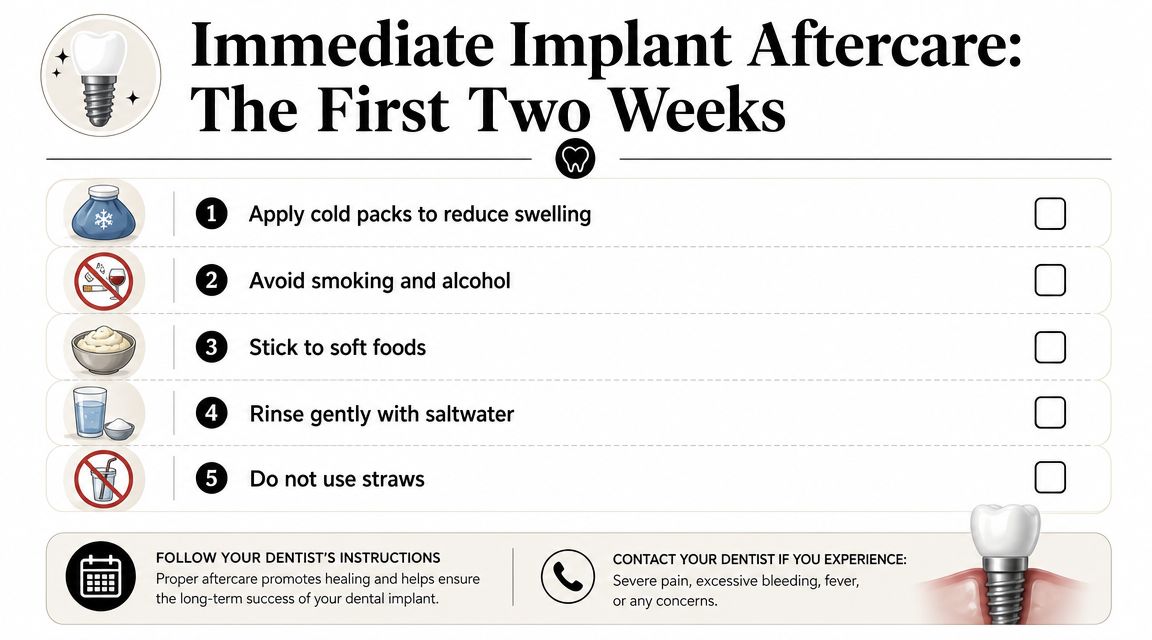
Start with rest, soft foods, and gentle habits. Your body is trying to form a stable seal around the area, and rough cleaning can interfere with that.
Many patients get mixed up. They hear “keep it clean” and assume that means flossing aggressively around the implant on day two. It doesn't.
Clinical guidance notes that after surgery, patients are often told to avoid flossing or water flossing near the surgical area until cleared, and some protocols recommend turning off the motor of an electric brush during early healing so the site isn't disturbed, as described in clinical maintenance guidance for implant patients.
Use this as your mental checklist:
Healing rule: Early aftercare should be gentle enough that you're cleaning without challenging the tissue attachment.
Most patients want a date. Realistically, the answer depends on how the site looks, whether you have stitches, and what type of restoration you're wearing.
A safe way to think about it is by stages:
| Healing stage | Main goal | Best approach |
|---|---|---|
| First days | Protect the site | Soft foods, gentle rinsing if instructed, no direct flossing or water jet at the implant |
| Early healing | Reduce irritation | Light brushing around nearby teeth, careful cleaning without pressure |
| After clearance | Resume targeted cleaning | Add floss threaders, implant floss, or water irrigation only when your dentist approves |
If you had treatment from a cosmetic dentist near me search and expected only esthetic advice, this is the part people often underestimate. Beautiful implant results depend on careful healing, not just a well-placed crown.
Once the healing phase is over, implant care becomes a daily routine. It shouldn't be complicated, but it should be consistent, allowing patients to learn the practical version of how to care for dental implants for the long haul.
A simple routine usually works better than a drawer full of gadgets you never use.
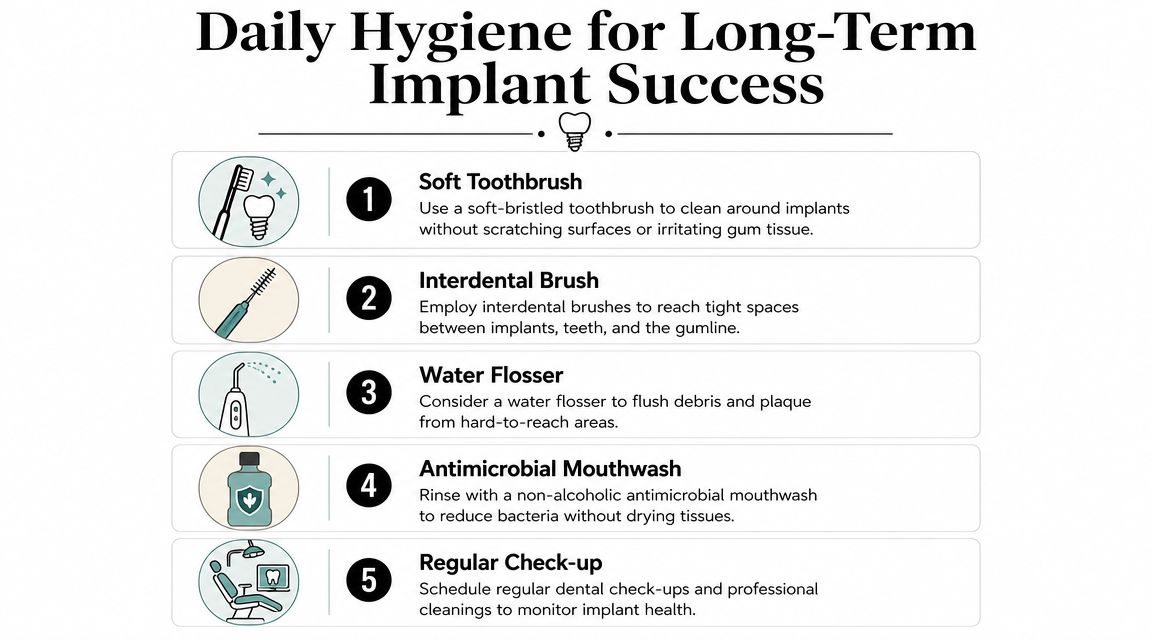
For long-term maintenance, an evidence-aligned routine is to brush twice daily with a soft-bristle or electric brush, clean between areas with implant-specific floss or interdental brushes, and use a water flosser when regular floss can't reach under bridges or full-arch restorations, based on practical implant home-care guidance.
That sounds simple, but technique matters more than people think.
Here's a short video that helps patients visualize daily home care around implants:
You do not need every product on the shelf. You need the right tool for your specific restoration.
A few examples patients often find useful:
Clean where the restoration meets the gum, not just where food gets stuck. Those are not always the same place.
The most common issue isn't laziness. It's misunderstanding.
Many patients brush carefully and still leave plaque at the implant-gum junction because the crown looks clean from the front. Others use too much force because they think a stronger scrub means a better clean. With implants, gentler and more precise usually wins.
A helpful home setup might include a soft electric brush, one interdental brush size recommended by your dentist, and one floss option you'll consistently use. If you need help building that routine, Dental Professionals of Fair Lawn can review your implant design and show you which tool fits the shape of your restoration.
For those interested in restorative dentistry, dental implants near me, or a dentist in Fair Lawn, NJ, this maintenance phase is where long-term value really shows up. The day-to-day habits protect the work you already invested in.
A single implant and an All-on-4 restoration do not collect plaque the same way. That means they shouldn't be cleaned the same way either.
Many online guides are often too generic. “Brush and floss daily” is true, but it doesn't tell you how to clean under a full arch or around connected restorations.
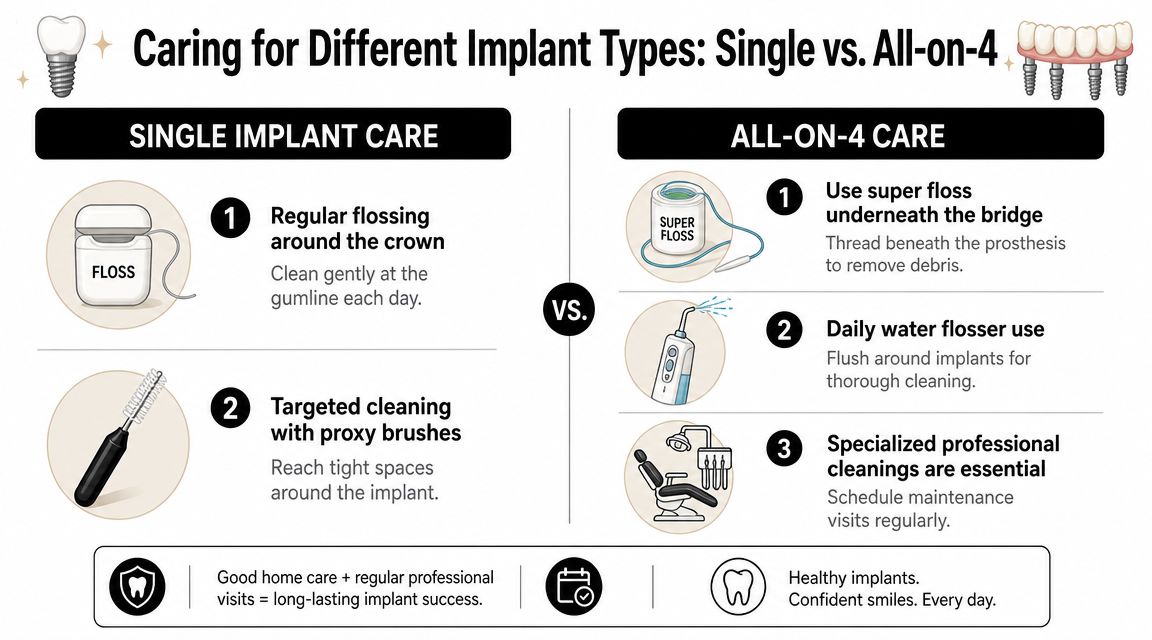
A single implant usually acts most like a natural tooth from the patient's point of view. You still need to pay special attention to the gumline and the contact areas beside the crown, but access is often straightforward.
A single implant routine often includes:
For many patients, the challenge is remembering that the implant can't “feel” plaque the same way a natural tooth might feel irritation. You have to look, not just rely on sensation.
An All-on-4 or full-arch bridge creates different cleaning challenges because food and plaque can collect underneath the prosthesis. That area isn't visible in the mirror unless you really look for it.
Cleaning often requires more than one tool. Depending on the design, patients may need a water flosser, larger interdental brushes, or threader-style floss to reach under the bridge and along the tissue side. If you're researching All-on-4 implant-supported dentures, this maintenance difference is one of the most important things to understand before treatment.
| Type of restoration | Main challenge | Helpful tools |
|---|---|---|
| Single implant | Plaque at the crown-gum junction | Soft brush, floss, interdental brush |
| Connected implants | Tight areas between units | Threader floss, small interdental cleaners |
| All-on-4 or full arch | Debris under the prosthesis | Water flosser, specialty floss, larger cleaning aids |
Full-arch implants can look easy to care for because you don't see spaces from the front. The cleaning work happens underneath.
Patients looking for dental implants near me after tooth extraction or full-mouth rehabilitation should know this before treatment starts. The prosthesis type changes the home-care plan.
Good home care is only half the picture. The other half is noticing change early and getting professional eyes on the implant before a small issue becomes a bigger one.
Implants don't usually fail out of nowhere. The surrounding tissue often shows warning signs first.
The main biological problem dentists try to prevent is peri-implantitis. Care should focus on plaque control where the implant meets the gum and on catching inflammation early. Mayo Clinic also notes that implants need regular dental checkups and professional monitoring just like natural teeth, as explained in Mayo Clinic's overview of dental implant care.
Call your dentist if you notice:
None of these automatically means the implant is failing. But they do mean the area deserves attention.
Think of peri-implantitis as inflammation and breakdown around the implant support system. The danger isn't just surface irritation. The primary concern is what ongoing inflammation can do to the tissues that help keep the implant stable.
That's why skipping maintenance visits is risky. You may feel fine and still have early inflammation that a professional can spot before you can.
A good implant maintenance visit is more specific than a routine glance. Your dentist or hygienist checks the tissues, evaluates how well you're cleaning the area, and looks at the restoration itself to make sure nothing is trapping plaque or taking too much force.
A visit may include:
If an implant feels different, looks different, or cleans differently than it did before, it's worth getting checked.
For some patients, follow-up may be recommended more often, especially if they have a history of gum problems or other risk factors. That steady partnership is part of what people are really looking for when they search dentist near me, emergency dentist, or new patient exam in Fair Lawn.
Patients usually ask very practical questions after implant treatment. Here are some of the ones we hear most often in Fair Lawn, Ridgewood, and Glen Rock.
Sometimes, yes. It depends on the stage of healing and the type of mouthwash.
During early healing, your dentist may want you to avoid strong rinses or anything that irritates the tissue. Later on, many patients do well with a gentle, non-alcohol rinse as part of their routine. If a rinse burns, that's a sign to ask before continuing.
Not once you've healed and your dentist has cleared you to use it normally. In fact, many implant patients do well with electric brushes because the motion is consistent and the brush heads are often soft.
The confusion comes during the early healing stage. As noted earlier, some protocols recommend avoiding powered brushing directly at a fresh site until the tissue is more stable.
It can be helpful in the right phase and the right position. It can also be too aggressive if used too soon or aimed poorly at a healing site.
That's why timing matters. Water flossers are often especially useful for bridges and full-arch cases, but they should be introduced with guidance rather than guesswork.
Don't wait for pain. Gum inflammation can start unnoticed.
If the tissue looks red, bleeds, or seems puffy, schedule an exam. The earlier your dentist sees it, the easier it usually is to adjust your cleaning and address the cause.
Implants have strong long-term durability when patients keep up with home care and follow-up. In a large cohort study of 10,871 implants, cumulative survival was 97.4% at 3 years, 96.7% at 5 years, 92.5% at 10 years, and 86% at 15 years, according to this long-term clinical implant study.
That statistic is reassuring, but it also carries a message. Long-term success is tied to maintenance, not luck.
Yes. Implants still need monitoring, professional cleaning, and periodic evaluation. They replace missing teeth, but they don't replace dental care.
If you're searching for a dentist in Fair Lawn, NJ who can help with ongoing implant maintenance, cosmetic dentistry, restorative dentistry, dental x-rays, and routine dental care, the key is finding a team that pays attention to both the restoration and the tissue around it.
Call promptly if you notice bleeding that keeps recurring, swelling that's getting worse instead of better, a loose restoration, or any sudden change in how the implant feels when you bite.
Small changes are easier to address when they're new.
If you want help building a clear, personalized plan for implant aftercare, schedule a visit with Dental Professionals of Fair Lawn. Our team works with patients in Fair Lawn, Ridgewood, Glen Rock, and nearby New Jersey communities to support healing, monitor implants over time, and keep your smile healthy, comfortable, and easy to maintain.