How Long Do Dental Implants Last? A Fair Lawn, NJ Guide
Wondering how long do dental implants last? Our Fair Lawn dentists explain the 20+ year lifespan and care needed. Get a permanent smile solution near you.
Wondering how long do dental implants last? Our Fair Lawn dentists explain the 20+ year lifespan and care needed. Get a permanent smile solution near you.
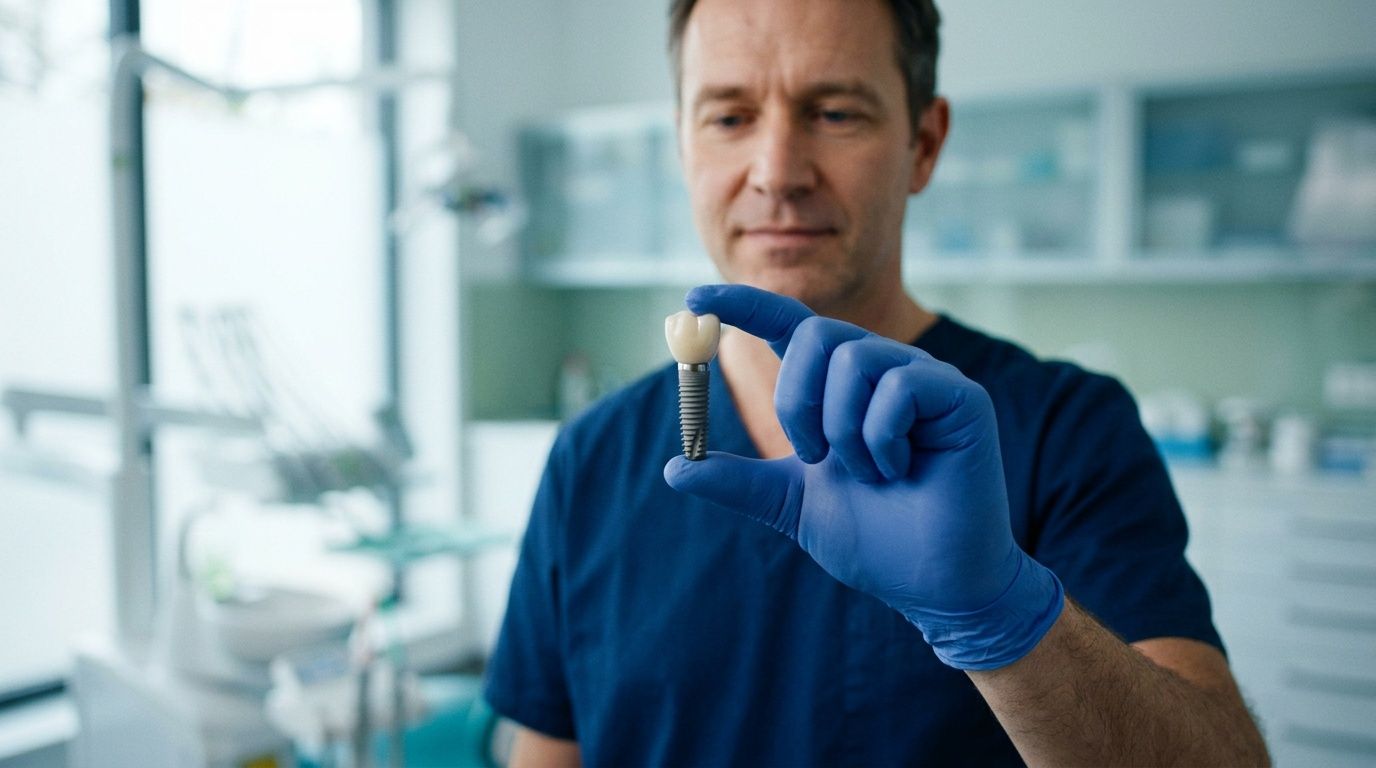
A missing tooth changes small parts of your day before it changes anything dramatic. You start chewing on one side. You smile a little tighter in photos. If the gap is visible, you may catch yourself thinking about it during conversations more than anyone else does.
That is why so many patients search how long do dental implants last before they decide anything. They want more than a replacement tooth. They want a solution that feels stable, looks natural, and does not put them back in the same position a few years later.
For patients in Fair Lawn, Ridgewood, and Glen Rock, that question is practical. You want to know what lasts, what needs maintenance, and what kind of care protects your investment over time. A dental implant can be an excellent long-term answer, but the honest answer is more nuanced than “forever.” Different parts of the implant last for different lengths of time, and the result depends on both treatment quality and daily habits.
A patient who loses a tooth rarely calls it an emergency unless there is pain. But the effects show up quickly. Chewing feels awkward. Certain foods become harder to manage. The empty space can make neighboring teeth shift over time, and many people feel older than they should when they catch that gap in the mirror.
In Fair Lawn, this is often the moment when someone starts looking for dental implants near me instead of another short-term fix. They are not only asking whether an implant looks good. They are asking whether it is worth doing once and doing well.

Patients generally understand the basic idea of an implant. It replaces a missing tooth without relying on a removable appliance. What they want to know is whether it behaves like a durable part of their mouth or like a restoration that will need frequent replacement.
That concern is reasonable. A bridge, denture, and implant do not age the same way. They also do not place the same demands on nearby teeth and bone.
Patients often tell their dentist some version of the same thing:
An implant replaces the root and the visible tooth. That matters because the jawbone responds better when it has support in the area where the tooth used to be. A removable option may fill the space cosmetically, but it does not work the same way.
For many adults searching for a dentist in Fair Lawn, NJ, implants stand out because they are the closest thing modern dentistry has to rebuilding the tooth from the foundation up. They do require planning, healthy gums, and follow-through at home. But when those pieces are in place, implants are widely viewed as the most durable tooth replacement option.
Key takeaway: If your main goal is a stable, long-term replacement for a missing tooth, an implant usually offers the strongest foundation. The part above the gum and the part below it do not wear the same way, and that distinction matters.
A patient in Fair Lawn may come in years after implant treatment and say, “The tooth feels worn. Did the implant fail?” In many cases, the answer is no. The part under the gum and the part you chew with do not usually age at the same rate.
That point matters because it changes how to judge long-term value. An implant is a system made of separate components, and each one faces different stresses over time.
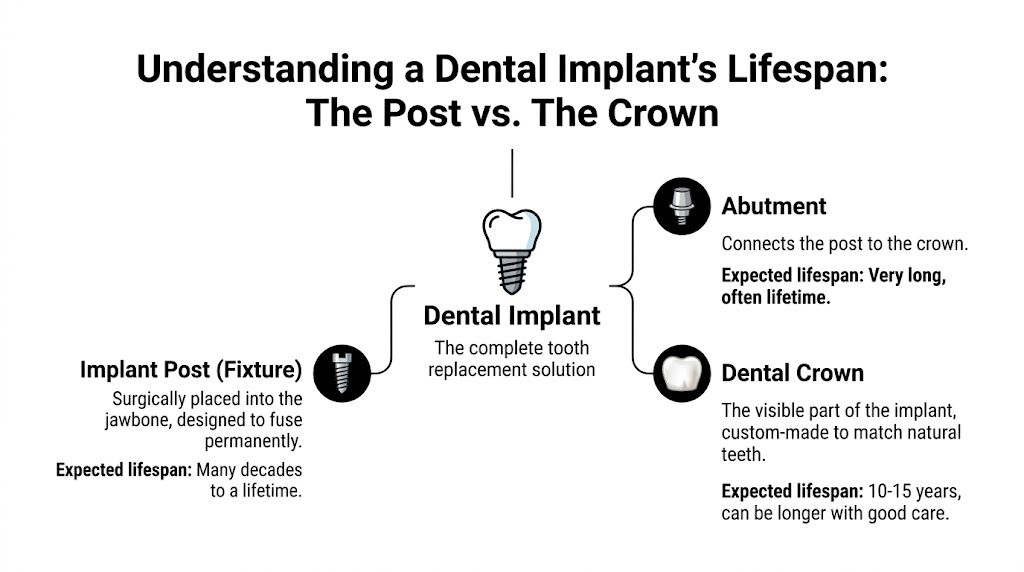
A completed implant restoration includes three main parts:
The implant post
This is the titanium fixture placed in the jawbone. It replaces the root of the missing tooth. Its stability depends on osseointegration, which is the bond between the implant surface and the surrounding bone.
The abutment
This is the connector that joins the post to the visible restoration.
The crown
This is the custom-made tooth you see above the gumline. It handles daily biting and chewing forces and is designed to match the rest of the smile.
The implant post is usually the longest-lasting part of the restoration. Long-term patient guidance from the Cleveland Clinic's overview of dental implants notes that the implant itself can last for many years and may last a lifetime with good oral hygiene and regular dental care.
That is the foundation patients are investing in. In a healthy mouth, with good bone support and stable gums, the post often remains in place long after the visible tooth has needed maintenance.
The crown usually has a shorter service life than the post. It carries the everyday wear. Chewing pressure, nighttime grinding, small bite changes, and normal material fatigue all affect the crown first.
In practice, that distinction helps patients avoid the wrong conclusion. A worn or chipped crown does not automatically mean the implant below it is failing. It often means the restoration above the gumline has done its job for years and now needs repair or replacement.
Back teeth deserve special mention here. A molar implant crown generally takes more force than a front tooth crown, so it may show wear sooner. Patients who clench or grind often put even more stress on that top portion.
The abutment sits between the two. It is protected more than the crown but still part of the mechanical connection, so its condition matters. Many abutments remain stable for a long time, though they can need replacement if a screw loosens, the bite changes, or the crown is being redesigned.
This is one reason careful planning and follow-up matter. At our Fair Lawn office, we look at the entire implant system during maintenance visits, not just whether the crown still looks good from the front.
| Component | What it does | Typical long-term expectation |
|---|---|---|
| Implant post | Anchors in the jawbone | Usually the longest-lasting part |
| Abutment | Connects post to crown | Often long-lasting, may need service over time |
| Crown | Visible chewing surface | Most likely part to wear or need replacement |
Practical tip: If the crown needs to be replaced years later, that can be routine maintenance, not a failed implant.
Patients make better decisions when they know what is meant to last and what is meant to be maintained. The post is the long-term anchor. The crown is the working surface, and working surfaces wear.
That difference highlights the value of implant treatment. A bridge or denture may need replacement as a whole. With an implant, the underlying support can remain healthy while the visible part is updated as needed. In a practice that tracks bite force, gum health, bone levels, and restoration wear over time, that approach gives patients in Fair Lawn a clearer picture of what to expect and how to protect their investment.
A patient in Fair Lawn will often ask a fair question. “Are implants really permanent, or do they just last longer than the alternatives?”
The answer comes from long-term follow-up, not marketing language. Implant dentistry has decades of clinical research behind it, so we can discuss durability with much more confidence than we can for many other restorative options.
Published evidence has followed implants far beyond the first few years after placement. In a systematic review in the International Journal of Oral & Maxillofacial Implants, researchers reported high long-term survival for dental implants over extended follow-up periods. That matters because survival over many years is what patients are really asking about.
Another large review published in Clinical Oral Implants Research found that implant-supported restorations continue to perform well over time, while also showing that maintenance and technical service are part of normal long-term care. That matches what we see in practice. A well-placed, well-maintained implant can remain stable for many years, but long-term success still depends on regular monitoring.
Thirty-year follow-up data is rare in dentistry. Dental implants have it. That alone separates them from treatments with a much shorter evidence base.
Research supports more than simple “still in place” survival. It supports the idea that implants can remain functional, comfortable, and integrated with the jawbone for the long haul when treatment planning and maintenance are handled properly.
That has meaning in the chair.
A treatment earns the label “permanent solution” because it replaces the root structure in bone and is designed to stay there. In my view, that phrase should be used carefully. It should mean the implant post is intended as a lasting foundation, while the crown above it may still need service or replacement after years of chewing wear.
That distinction protects patients from the wrong expectation. It also highlights the strength of implants. The underlying support can keep doing its job long after the visible tooth has needed routine restorative maintenance.
Patients do not benefit from statistics alone. They benefit from careful execution.
An implant has the best chance of serving you for decades when the case is planned precisely, the bite is balanced correctly, and bone and gum health are checked over time. At Dental Professionals of Fair Lawn, that is why follow-up is not treated as an afterthought. We evaluate the implant itself, the surrounding tissue, the bite forces on the restoration, and early signs of wear before they become larger problems.
Clinical studies show implants can be a durable, long-range treatment. Daily care and professional maintenance are what help that evidence become your outcome.
Clinical perspective: “Permanent” in implant dentistry means built to remain in the jaw as a long-term root replacement. It does not mean the restoration will never need upkeep.
Two patients can receive excellent implants and have different long-term experiences. The difference usually comes down to a mix of anatomy, daily care, health habits, and treatment planning.
Some factors are in your control every day. Others depend on bone quality, bite forces, and where the implant is placed in the mouth.

Implants do not sit in the mouth as isolated pieces. They rely on the quality of the surrounding bone. Research shows that lower jaw implants typically demonstrate superior longevity compared to upper jaw implants, which is attributed to greater bone density in the mandible, according to this clinical review of 15,483 dental implants.
That same review found a complex relationship between implant length and survival. Implants under 10 mm can achieve survival rates over 92 percent, sometimes outperforming longer implants in areas with adequate bone density. This is why careful planning matters more than assuming “bigger” means “better.”
A dentist may recommend bone grafting or a sinus lift in some cases not to complicate treatment, but to create a more stable foundation for long-term success.
The same review reported a 98.12 percent overall success rate with proper oral hygiene, healthy gingival tissues, and regular prophylactic checkups. That is one of the clearest reminders that the work done at home matters as much as the procedure itself.
Daily care should include:
Patients who want their implants to last should think beyond “I got it done.” The maintenance phase starts immediately.
Not every problem starts with decay or infection. Some begin with force. If you clench or grind, the implant crown and surrounding structures can take repeated stress. Back teeth are especially vulnerable because they handle stronger chewing pressure.
Hard chewing habits matter too. Ice, very hard candy, and using teeth as tools create avoidable strain on the restoration.
If you are concerned about warning signs, this discussion of why dental implants fail is a helpful place to start.
A visual explanation can help make these maintenance ideas easier to understand:
Implants are not interchangeable parts placed the same way in every patient. The quality of diagnosis, imaging, bite analysis, and restorative planning shapes the long-term result.
A strong implant case usually includes attention to:
| Factor | Why it matters |
|---|---|
| Bone support | The implant needs stable surrounding bone |
| Implant position | Placement affects force distribution and cleanability |
| Gum health | Healthy tissue helps protect the implant over time |
| Restoration design | A well-shaped crown is easier to maintain and function with |
Practical advice: The best implant is not the fastest one to place. It is the one planned around your anatomy, your bite, and your long-term ability to keep it healthy.
A Fair Lawn patient often asks the same practical question after losing a tooth. Should I place one implant, connect a bridge, or use something removable and simpler for now?
All three options can fill the space. They do not age the same way, and they do not place the same demands on the rest of your mouth. That difference matters more over ten or fifteen years than it does on day one.
| Feature | Dental Implant | Fixed Bridge | Removable Denture |
|---|---|---|---|
| Expected lifespan | The implant post can serve for decades with good bone support and home care. The crown may need replacement earlier because it takes the daily wear. | Bridges often last many years but commonly need replacement sooner than an implant-supported solution. | Dentures usually need more frequent adjustment or replacement as the fit changes over time. |
| Support source | Anchored in the jawbone | Supported by neighboring teeth | Rests on gums |
| Effect on nearby teeth | Does not require support from adjacent teeth | Usually requires neighboring teeth to be prepared | Does not depend on adjacent teeth in the same way |
| Main maintenance issue | The crown or abutment may wear before the implant post does | Supporting teeth can decay, fracture, or change over time | Fit, retention, and comfort often change as the jaw reshapes |
| Stability | Fixed and secure | Fixed | Removable |
A long-term review in the Journal of Clinical Medicine discusses the maintenance demands and survival patterns of implants, tooth-supported prostheses, and removable options over time: Long-term outcomes of dental implants and prostheses.
A fixed bridge can be a sound treatment choice. It avoids implant surgery, restores appearance quickly, and works well in selected cases.
The trade-off is support. A traditional bridge usually depends on the teeth on either side of the gap. Those teeth may need to be reshaped, even if they are otherwise healthy. If one supporting tooth develops decay, a crack, or gum loss later, the whole bridge can be affected.
That is one reason I discuss bridges differently for a 30-year-old with healthy adjacent teeth than I do for a patient who already has large fillings or crowns on those teeth. The right answer depends on what is already happening in that part of the mouth.
Dentures still have an important role, especially when several teeth are missing or a patient needs a lower-cost starting point.
They are also the option most likely to change with time. As the jaw and gums remodel, the denture can loosen, rub, or lose chewing efficiency. Some patients do very well with dentures. Others never feel fully confident eating or speaking with them.
That difference is real in daily life.
Implants stand apart because they replace the missing tooth without asking neighboring teeth to do the work. In many cases, that gives patients the longest useful life from the foundation itself.
The distinction between the implant post and the visible crown is the part patients rarely hear clearly. The post in the bone is built for long service. The crown on top is the part more likely to need repair or replacement first because it handles years of biting force, grinding, and normal wear. At our Fair Lawn office, that difference shapes how we plan treatment and how we explain long-term value. The goal is not just to place an implant. The goal is to create a restoration that is cleanable, stable, and realistic for your bite.
For a single missing tooth, implants usually offer the strongest long-range balance of stability, tissue preservation, and independence from nearby teeth.
Decision point: If you want a fixed replacement that protects adjacent teeth and offers the best chance of lasting well over time, an implant is usually the option I recommend first, assuming your bone, gums, and overall health support it.
Patients usually feel better about implant treatment once they understand the sequence. The process is not rushed. It is planned in stages so the final tooth looks right, functions well, and has the best chance to last.
That slower, more deliberate approach is often what gives implants their long-term strength.

The first visit focuses on diagnosis, not immediate treatment. The team evaluates the missing tooth area, nearby teeth, your bite, gum condition, and the amount of available bone.
At this stage, modern planning tools matter. Digital scanning with systems such as iTero helps capture a detailed picture of the mouth without the mess of traditional impressions. If a patient is considering anything from a single implant to All-on-4, planning has to be precise from the beginning.
Some patients need additional support before the implant is placed. Bone grafting or a sinus lift may be part of the plan if the existing foundation is not ideal.
Implant placement is a surgical procedure, but it is usually much less intimidating than many patients expect. Comfort measures are part of the experience, and sedation dentistry can help anxious patients complete treatment with more ease.
Once the implant post is placed, healing becomes the focus. The jawbone needs time to integrate with the titanium post. That biological stability is what allows the implant to function as a long-term replacement rather than a short-term repair.
After the implant is stable, the restorative portion begins. This includes the abutment and the final crown or full-arch prosthesis, depending on the case.
The visible result matters here. The final restoration should match the smile, support a comfortable bite, and be shaped in a way that the patient can clean well at home.
Patients exploring treatment options can review the practice’s approach to dental implants in New Jersey.
The journey does not end when the crown goes in. Follow-up care protects the investment.
That usually includes:
For patients in Fair Lawn, Ridgewood, and Glen Rock, this kind of ongoing relationship matters. Implant success is not just about the day of surgery. It depends on planning, execution, and years of maintenance afterward.
A common Fair Lawn conversation goes like this: a patient is ready to replace a missing tooth, but wants a straight answer about what may need attention 10 or 15 years from now. That is the right question to ask.
Often, yes. The implant post placed in the bone is built for long-term function, and many posts remain stable for decades. Research published in the Journal of Oral Medicine and Oral Surgery found high long-term survival rates for implant fixtures, which supports what dentists see in practice when treatment planning, placement, and maintenance are handled carefully.
The part patients usually replace first is the crown. Chewing forces, grinding, bite changes, and normal wear affect the visible tooth on top long before the titanium post fails. In plain terms, the foundation and the restoration have different timelines. That distinction matters because it gives patients a clearer picture of future maintenance.
Bleeding around the implant, swelling, tenderness, bad taste, or a bite that suddenly feels off all deserve attention. Those changes can point to inflammation in the gum tissue or stress on the restoration.
A loose feeling matters.
Sometimes the implant itself is stable and the problem is a screw, crown, or bite adjustment. Sometimes the tissue around the implant needs treatment before bone loss starts. The earlier we see it, the more options we usually have.
They follow the same basic rule. The implants underneath can last much longer than the prosthetic teeth attached to them.
A full-arch case carries force across multiple implants, and the prosthesis has more acrylic, porcelain, or layered material that can wear, chip, or need adjustment over time. That is why maintenance for full-arch treatment is more than a quick visual check. At regular visits, we look at the health of the supporting implants, the fit of the prosthesis, and the way the bite is distributing pressure.
Coverage depends on the plan. Some policies contribute to a replacement crown or repair. Others exclude implant-related treatment or place limits on how often a restoration can be replaced.
Patients should plan for future upkeep from the start. Replacing a worn implant crown is usually much simpler and less invasive than replacing the implant post, but it still carries a cost and should be part of the long-term discussion.
An implant should be checked at routine dental visits and cleaned with the same consistency you would expect for natural teeth. Those appointments let your dentist monitor the gum seal, supporting bone, bite pressure, and condition of the crown or prosthesis.
At Dental Professionals of Fair Lawn, that follow-up is part of protecting the investment. We use those visits to catch small changes early, especially in patients who clench, grind, have a history of gum disease, or wear a full-arch restoration. Good implant care is not just about keeping the area clean. It is about watching for wear patterns before they turn into repairs.
Final takeaway: The implant post may serve you for decades. The crown or full-arch teeth on top usually need more periodic maintenance. Patients who do best long term are the ones who keep up with home care, stay consistent with checkups, and come in early when something feels different.
If you are weighing your options for a missing tooth and want a clear, honest discussion about long-term results, schedule a consultation with Dental Professionals of Fair Lawn. The team serves Fair Lawn, Ridgewood, Glen Rock, and nearby New Jersey communities with full implant care, thoughtful treatment planning, and long-term support designed to protect your smile for years to come.