Dental Implants in Fair Lawn, NJ: Your Guide to a Lasting Smile
Discover why do dental implants fail and how to ensure success. Our Fair Lawn dentists explain the causes, risks, and prevention. Schedule a consult today.
Discover why do dental implants fail and how to ensure success. Our Fair Lawn dentists explain the causes, risks, and prevention. Schedule a consult today.
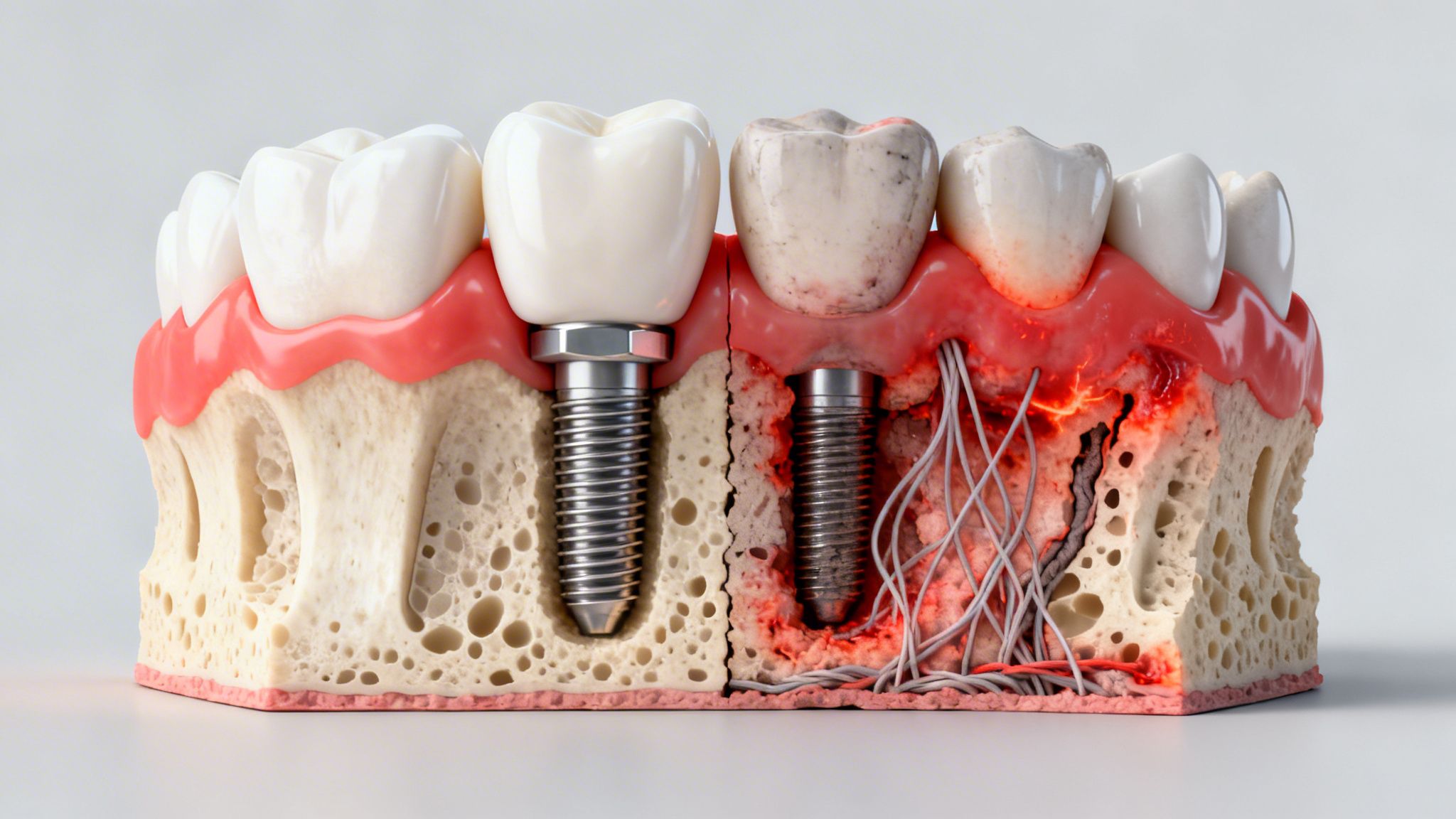
If you're considering dental implants to replace a missing tooth, your first question is likely, "Will they last?" It's a great question, and one we hear often from our patients in Fair Lawn. The short answer is yes, they're designed for the long haul. Understanding what can go wrong is the key to ensuring your investment in a healthy, bright smile is a success.
The main reasons an implant might fail are typically an infection around the post (peri-implantitis), the implant not fusing properly with your jawbone (osseointegration), or certain lifestyle habits. Here at Dental Professionals of Fair Lawn, our entire process is built around preventing these problems, so you can feel confident in your new smile. If you're looking for a new dentist in Fair Lawn, NJ, we're here to help you get the best possible results.
Dental implants boast a success rate of over 95%, which is fantastic news for anyone seeking a permanent tooth replacement. But when you’re investing in your smile, you want to be certain you're in that 95%. As a local practice that has served families across Fair Lawn, Glen Rock, and Ridgewood for years, our philosophy is simple: informed patients get the best results.
Think of a dental implant as a new, artificial tooth root. It’s a small titanium post that, once placed by your dentist, needs to become one with your jawbone. This biological bond, called osseointegration, creates the rock-solid foundation for your new tooth. If that bond doesn't form correctly, the entire structure is at risk. That's why choosing an experienced cosmetic dentist near you is so important.
The success of a dental implant is a true partnership. It depends on our team's expert planning and surgical skill, combined with your commitment to great long-term oral hygiene.
Implant failure rarely happens out of the blue. It’s almost always tied to specific, and often preventable, issues. We can break them down into three main categories:
The image below gives a great visual breakdown of how these factors—infection, fusion failure, and lifestyle choices—are all interconnected.
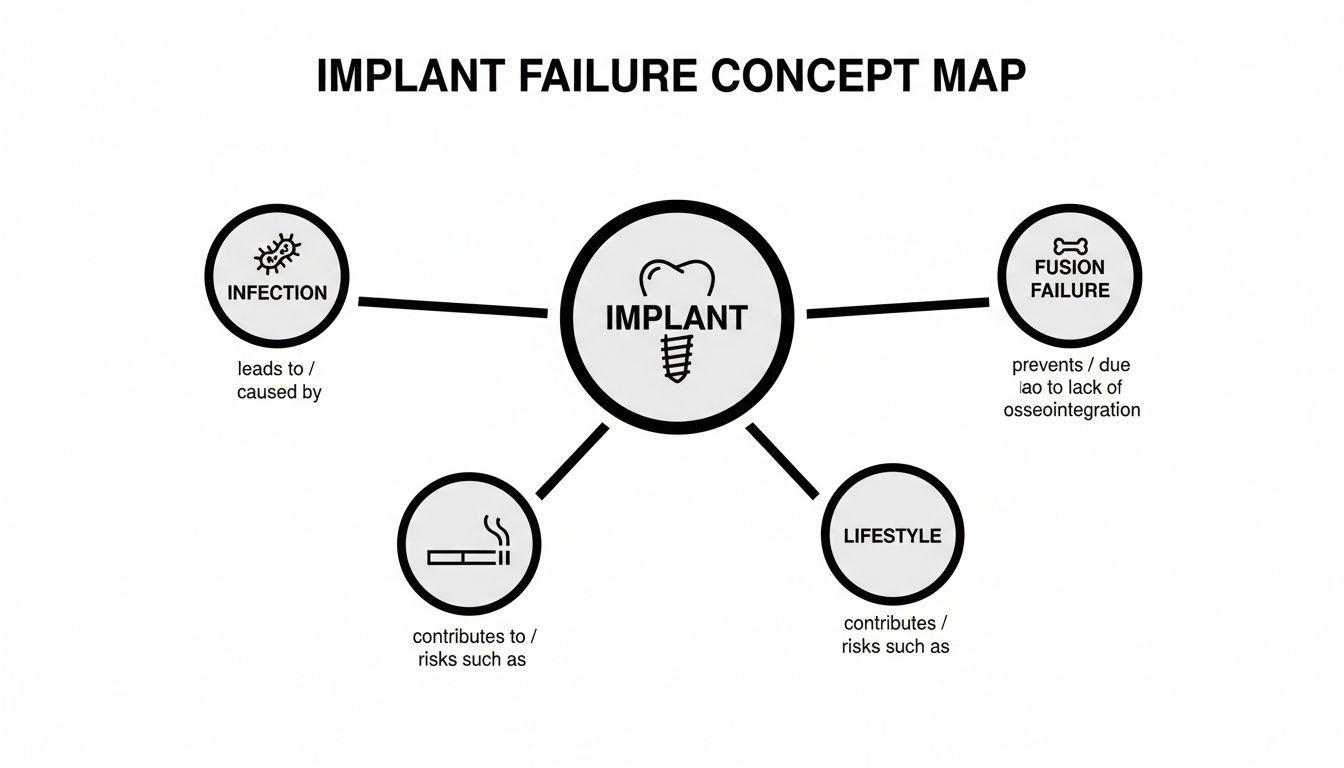
As you can see, a healthy implant depends on getting multiple things right. This is why our Fair Lawn dental team is so meticulous in our approach to your dental care.
To show you exactly how we manage these risks, we've put together a table outlining the common causes of implant failure and the proactive steps we take at our Fair Lawn practice to ensure a successful outcome for your new smile.
| Potential Cause of Failure | How We Ensure Success at Our Fair Lawn Practice |
|---|---|
| Insufficient Jawbone | We use 3D facial scanning and CBCT scans to precisely measure bone density. If needed, we perform a bone graft to build a strong foundation before implant placement. |
| Poor Implant Placement | Dr. Jody Bardash uses guided surgery techniques for unparalleled accuracy, ensuring the implant is placed at the perfect angle and depth for optimal stability and aesthetics. |
| Infection (Peri-implantitis) | We provide detailed post-op care instructions and emphasize regular cleanings and exams to manage bacteria. For existing issues, we offer specialized peri-implantitis treatment to save at-risk implants. |
| Patient Medical Conditions | We conduct a thorough medical history review during your new patient exam. For patients with conditions like diabetes, we coordinate with their physicians to ensure they are managed well before, during, and after surgery. |
| Smoking and Lifestyle Habits | We provide clear counseling on how smoking impacts healing and offer support for quitting. We also educate patients on the best long-term hygiene practices. |
| Overloading the Implant | We ensure the implant fully integrates with the bone before placing the final crown. For full-arch cases, we use the proven All-on-4® treatment concept to distribute biting forces evenly. |
By addressing each of these potential hurdles with advanced planning and expert restorative dentistry, we give your implant the strongest possible start. Our goal isn't just to replace a tooth; it's to provide a solution that feels, functions, and looks completely natural for decades to come.
When our patients in Fair Lawn ask, "why do dental implants fail?" it’s a great question. It's important to know that failure isn't just one thing—it usually happens on two different timelines: early or late. Understanding this difference is the first step toward prevention and highlights the partnership between our dental team and you in making sure your implant thrives.
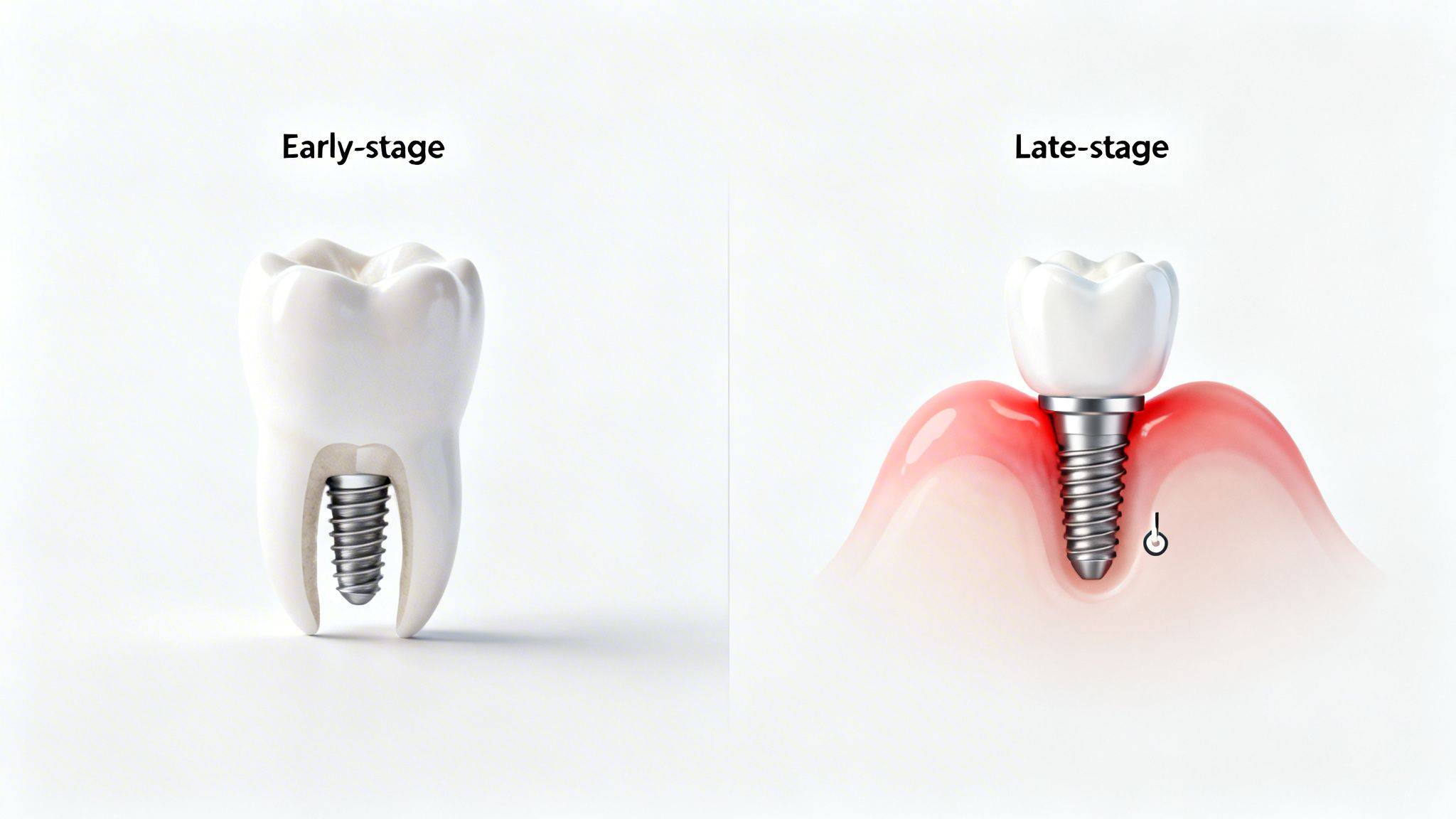
Knowing the timeline helps our Fair Lawn dental team zero in on the cause and create the right plan, whether you're here for a routine cleaning and exam or an urgent concern.
Early failure is when a problem arises within the first few months after the implant is placed. Almost always, the culprit is a failure of osseointegration. This is the natural process where your jawbone grows onto and fuses with the titanium implant, creating a solid foundation. If that bond doesn’t form, the implant will never be stable.
Think about setting a fence post in concrete. If the concrete is weak or the post gets wiggled before it sets, it will never be sturdy. It's the same with an implant; if the jawbone can’t get a firm grip from the start, the whole structure is compromised.
Several issues can interfere with this critical healing phase:
The first three to six months are crucial for an implant’s future. Our focus during this period is to maintain a stable, clean environment so your body can do its amazing work of locking that implant into place.
Late stage failure is different. It occurs a year or more after the implant has already fused successfully and you’ve been using it without issues. This can be especially frustrating, but the good news is that these later-stage problems are almost always caused by factors that we can manage and prevent with good dental care.
By far the most common cause of late failure is peri-implantitis. This is an inflammatory disease, much like gum disease, that attacks the gum and bone tissue around an implant. It’s triggered by plaque bacteria that accumulate at the base of the implant, leading to an infection that slowly erodes the supporting bone.
Other causes of late-stage problems include:
Knowing the difference empowers our patients from Fair Lawn, Ridgewood, and Glen Rock to be true partners in their success. We bring the expertise to ensure your implant is placed perfectly; your commitment to great hygiene and regular checkups protects that investment for a lifetime.
When we talk about what makes a dental implant successful, it’s about more than just the procedure itself. Your overall health and the specifics of the surgery are two sides of the same coin. Think of it this way: your body provides the "soil," and your dentist carefully plants the "seed." For a strong, lasting result, you need both to be in great shape.
This is why we don't see pre-existing medical conditions as roadblocks. Instead, they are important details we use to plan your journey. At Dental Professionals of Fair Lawn, our first priority is understanding your unique health so we can navigate it successfully together.
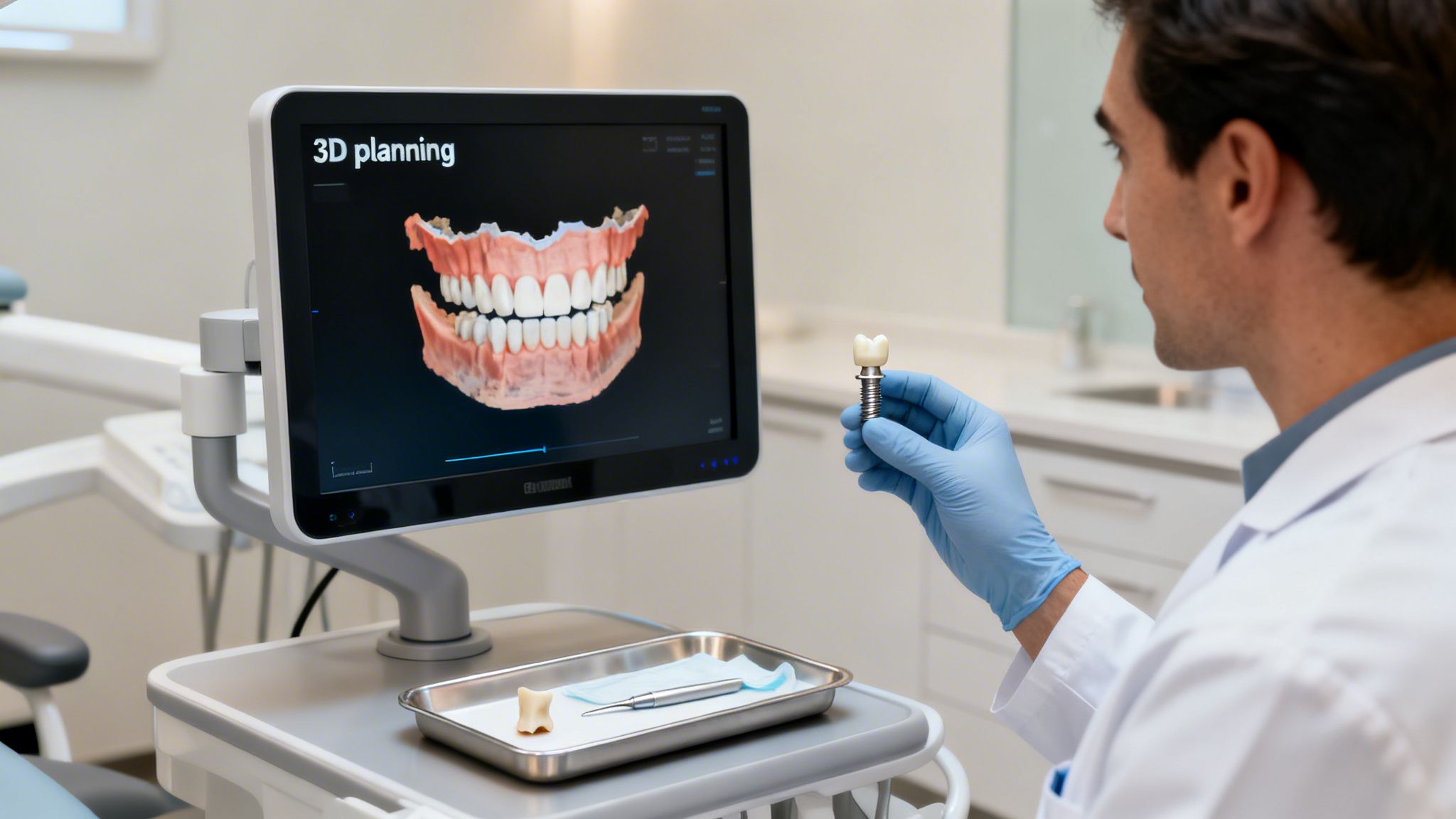
A deep dive into your medical history is always our starting point. It’s a crucial conversation that allows us to build a complete picture of your health before we begin your treatment.
Certain health issues can change how the body heals or affect bone quality, which we must factor into our plan. Our approach is collaborative; we work closely with you and your physician to make sure any conditions are well-managed, creating the ideal environment for your new implant to thrive.
Some common examples include:
A medical diagnosis is not a disqualifier for dental implants. It just means we need a more careful, customized plan. That's exactly what we specialize in here at our Fair Lawn practice.
By understanding your specific health profile, Dr. Jody Bardash can adjust the surgical technique, give you tailored aftercare instructions, and coordinate with your doctor to ensure everything goes smoothly.
Just as critical as your body's health are the technical details of the surgery. This is where an experienced implant dentist and the right technology make all the difference. We believe in meticulous planning to remove any guesswork from the equation.
For instance, selecting the right size implant for the amount of bone you have is essential. Trying to place an implant that's too short is a known risk. A major 10-year study showed that implants less than 10 mm long had a failure rate of 16%—a huge jump compared to longer implants.
Bone quality is another massive factor. Placing an implant into "soft" bone requires a specific touch to guarantee stability. This is where our technology shines. At Dental Professionals of Fair Lawn, we use advanced 3D facial scanning and CBCT imaging to create a precise digital blueprint of your jaw. This allows us to:
If a patient's bone isn't quite ready, that's not a problem. Dr. Bardash is skilled in procedures like bone grafting and sinus lifts, which we perform right in our office. These techniques rebuild your jaw, creating the strong, solid foundation your implant needs for a successful, long-term restorative dentistry solution.
Getting a dental implant to last a lifetime is a partnership. Our team at Dental Professionals of Fair Lawn handles the precision surgery and restoration, but what you do at home every day is just as critical. Your daily habits are a huge part of the equation for long-term success, and we want to be your partners in making sure your investment thrives.
Think of it like planting a tree. We can choose the perfect spot and make sure it's planted correctly, but it still needs the right conditions—sunlight and water—to grow strong roots. Your new implant is the same; it needs a healthy environment inside your mouth to stay solid for years to come.
When it comes to dental implants, smoking is one of the biggest roadblocks to success. Nicotine constricts your blood vessels, which dramatically reduces the blood flow to your jawbone and gums. This is a problem because that blood carries the oxygen and nutrients your body desperately needs to heal.
This poor circulation creates a cascade of issues. Healing after surgery slows down, which can interfere with the critical bone-fusing process. It also leaves the surgical site more vulnerable to infection and significantly increases the chances of implant failure. It's a risk we take very seriously.
For a deeper dive into this topic, we've put together a guide on how smoking affects dental implants.
Your implant crown can't get a cavity, but that doesn't mean you can skip brushing and flossing. The gum and bone tissue around the implant are still very much alive and susceptible to bacteria. If you let plaque build up around the base of your implant, you’re inviting an infection called peri-implantitis.
Peri-implantitis is essentially gum disease for dental implants. It’s an infection that inflames the surrounding tissues and can begin to destroy the jawbone that holds your implant in place. If it's not stopped, the implant will become loose and fail.
The best way to prevent this is simple: excellent daily cleaning. We will walk you through exactly how to brush and floss around your new tooth. This daily diligence, paired with regular professional cleanings at our Fair Lawn office, is the key to keeping your implant healthy for the long haul.
Another common threat to an implant is something many people don't know they're doing: teeth grinding or clenching (bruxism). This often happens at night, putting tremendous, repetitive force on your implant—way more pressure than from just chewing food.
Over time, this constant pounding can cause serious problems:
During your dental exams, we always look for signs of grinding. If we see evidence of it, we’ll recommend a custom-fit night guard. It’s a simple, comfortable appliance you wear while you sleep, acting as a cushion to protect your implant—and all your other teeth—from the damaging forces of bruxism.
Spotting a problem with your dental implant early is always the best-case scenario. It gives our team the greatest chance to intervene and potentially save it. While a healthy implant should feel so natural you forget it's there, any new or strange sensation is your cue to pay close attention. If you're experiencing any of the symptoms below, please don't hesitate to call your "dentist near me."
At Dental Professionals of Fair Lawn, we take these concerns seriously. As an experienced emergency dentist in the community, we know that quick action can be the difference between a simple fix and a much bigger problem.
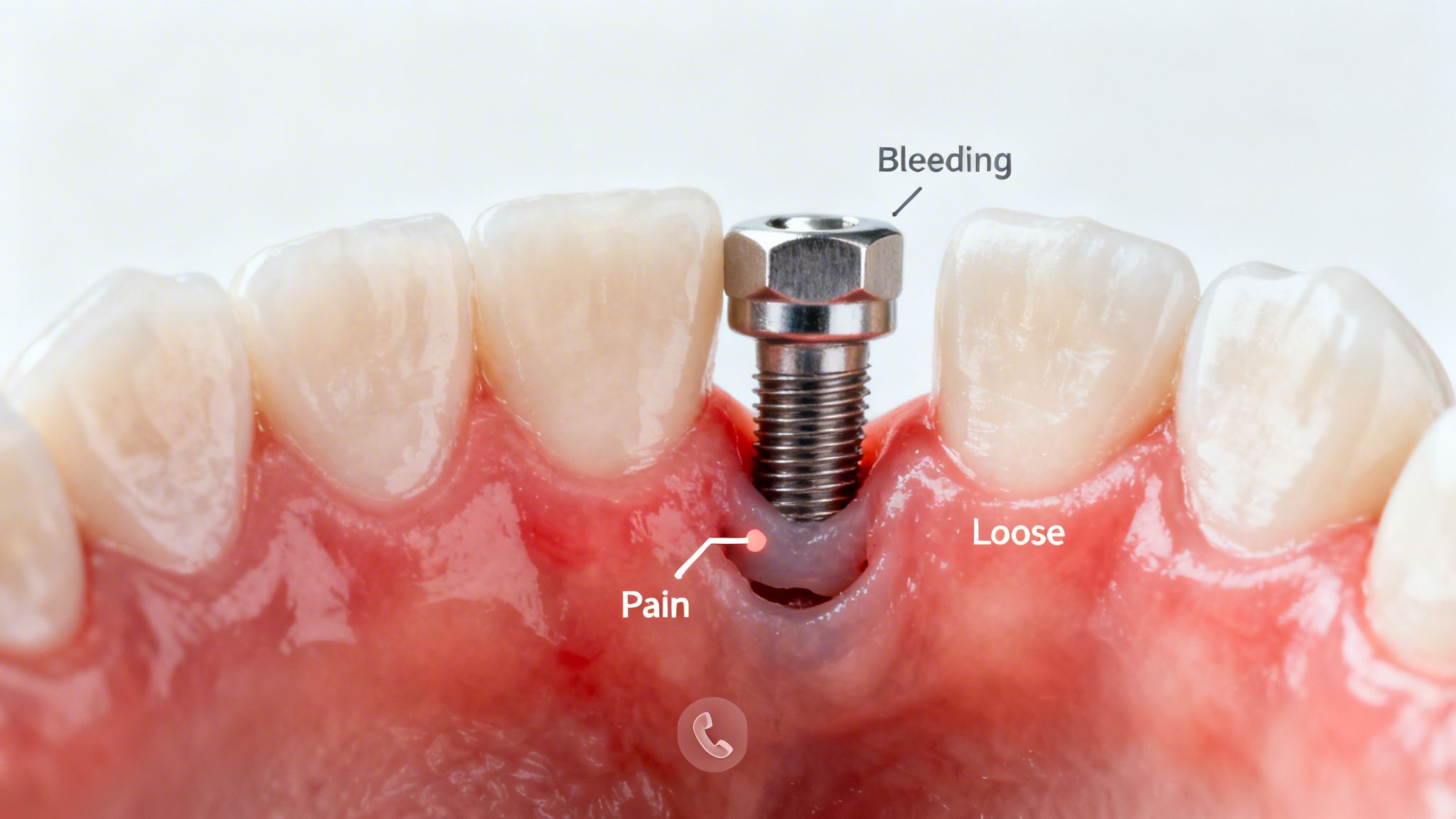
Think back to when you first had your implant placed. Some soreness was expected, but after that, it should have faded. If you're now feeling persistent pain, that’s your body sending a signal that something is wrong.
Be alert for a deep, throbbing ache from the bone around the implant, or a sharp pain when you chew. This could signal an infection or a problem with how the implant is fused to your jaw. Any pain that suddenly appears months or years later is a definite red flag that warrants an immediate call to our office.
Take a look at the gums surrounding your implant. Healthy gums are pale pink, firm, and fit snugly around the crown. They should not bleed when you brush or floss. If you see redness or blood, it's often the first sign of peri-implant disease, the number one cause of late-stage implant failure.
Keep an eye out for these specific signs:
Here’s the bottom line: a successful dental implant should be rock solid. It is anchored directly into your jawbone and should feel just as stable as a healthy tooth. Any sensation of wiggling or movement is a major warning sign.
If an implant feels loose—whether you can feel it move with your tongue or physically wiggle it—this is a critical sign of failure. It almost always means the implant has lost its bond with the bone, a process called osseointegration.
Sometimes, it might just be the crown or connector piece that has come loose, which is a simpler fix. But it's impossible to know on your own, and you should never try to tighten it yourself. As your local dentist in Fair Lawn, NJ, we urge you to let us take a look so we can pinpoint the cause without causing more damage.
If any of these symptoms sound familiar, don't wait. Contact our Fair Lawn office immediately. We'll use tools like digital dental x-rays and a gentle exam to figure out exactly what’s going on. From there, we’ll create a clear plan to protect your investment and restore your comfort.
Understanding the potential risks of implant failure is one thing, but knowing how to avoid them is what truly matters. When it comes to your smile, the single most effective step you can take is choosing the right dental team from the start.
At Dental Professionals of Fair Lawn, we don't just place implants—we partner with you to build a lasting, beautiful smile from the ground up. Our entire process is designed to prevent problems before they begin, combining decades of experience with the most advanced technology in modern dentistry.
Dr. Jody Bardash brings over 30 years of clinical experience to every procedure. That expertise is invaluable, allowing him to anticipate challenges and navigate even complex cases with confidence. We pair this seasoned know-how with powerful in-office technology to ensure absolute precision.
Our state-of-the-art tools include:
It’s interesting to see how technology is improving the patient experience. For example, some forward-thinking clinics are now using specialized AI customer support in dental practices to improve communication and streamline care.
We know every person's dental situation is unique. That’s why we provide a complete range of services right here in our Fair Lawn office, from cosmetic dentistry to tooth extractions. We are fully equipped to manage even the most challenging cases, so you can receive consistent, expert care all under one roof.
From your first consultation to your final restoration, our team is with you at every step. We are committed to providing a seamless and supportive experience for our neighbors in Fair Lawn, Ridgewood, and Glen Rock.
If we find you don't have enough bone to support an implant, we have the solution. Dr. Bardash is an expert in both bone grafting and sinus lift procedures, which skillfully rebuild the jawbone. For those looking to replace a full set of teeth, we specialize in the All-on-4® treatment concept—a fantastic technique that can provide a stable, complete set of teeth.
We also understand that dental anxiety is real. To ensure you can get the care you need comfortably, we proudly offer sedation dentistry. Your comfort is our top priority.
We invite you to see how our patient-first approach can help you get your smile back with confidence. You can learn more about our work and see real results by checking out our smile gallery for dental implants in New Jersey.
It’s completely normal to have questions when you're considering dental implants. As your partners in dental health here in Fair Lawn, we want you to feel confident and informed. Here are some of the things our patients often ask.
Yes, but it all comes down to catching the problem early. If we spot mild gum inflammation (peri-mucositis), we can often turn things around with a thorough professional cleaning and tweaks to your home care.
However, if the infection has progressed and started to damage the jawbone (peri-implantitis), the treatment becomes more complex. We might need a specialized procedure to clean the implant and rebuild lost bone. The key is to act fast. If you notice any swelling, soreness, or anything that feels "off," call our practice right away for an exam. The sooner we see you, the better our chances of saving it.
This is a critical question we answer with incredible accuracy during your first visit. In our Fair Lawn office, we use advanced 3D imaging (CBCT scans) to get a detailed, three-dimensional look at your jaw. This gives us precise measurements of your bone's height, width, and density.
A lack of bone doesn't automatically mean you can't get an implant. It just means we need to build a stronger foundation first.
If your scan reveals your bone is thin or soft, don't worry. Dr. Bardash is highly experienced in bone grafting and sinus lift procedures. These techniques rebuild and strengthen your jaw, creating the solid base your implant needs to be successful for years to come.
The All-on-4® treatment concept is so effective because of brilliant engineering. Instead of placing implants straight up and down, this technique angles the posts to use the densest bone you already have. By tilting the implants, we can often bypass weaker areas and avoid the need for extensive bone grafting.
This specific angulation creates a very strong, stable base that can securely support a full bridge of permanent teeth. Our deep experience with the All-on-4 protocol, combined with careful digital planning, allows us to provide a secure, comfortable, and predictable result for our patients in and around Fair Lawn.
Your comfort is our top priority. The implant placement itself is performed with local anesthesia, so you won't feel any pain during the surgery. Most of our patients are pleasantly surprised by how comfortable the experience is.
For anyone feeling anxious, we also offer sedation dentistry options here in our Fair Lawn office. This can help you feel completely calm and relaxed. Afterward, you can expect some mild soreness, but it's typically managed easily with over-the-counter pain medication for a day or two.
Ready to restore your smile with confidence and find a dentist near you? The team at Dental Professionals of Fair Lawn is here to answer your questions and create a personalized plan just for you. Schedule your consultation today by visiting us online at https://dentalprofessionalsoffairlawn.com.