Full Mouth Dental Implants: Options in Fair Lawn, NJ 2026
Considering full mouth dental implants in Fair Lawn, NJ? Explore options, costs, and the process at Dental Professionals of Fair Lawn. Regain your smile.
Considering full mouth dental implants in Fair Lawn, NJ? Explore options, costs, and the process at Dental Professionals of Fair Lawn. Regain your smile.
If you're reading this, there's a good chance meals have become frustrating, smiling in photos feels uncomfortable, or you're tired of dealing with teeth that hurt, move, or keep breaking. Many people reach this point slowly. First they avoid certain foods. Then they chew on one side. Then they smile with their lips closed and start wondering if they'll ever feel normal again.
That feeling is more common than many might think. Missing or failing teeth don't just change your appearance. They can affect speech, comfort, daily confidence, and the simple ease of sitting down with family and enjoying a meal. When several teeth are compromised at once, the problem can feel overwhelming.
For people searching for a dentist near me or dental implants near me in Fair Lawn, NJ, the biggest challenge is often knowing what full mouth treatment involves. Many guides jump straight into technical terms or make everything sound fast and simple. It is more personal than that. There is a process, there are choices, and understanding them makes the entire experience less intimidating.
A lot of patients arrive at this stage carrying more than a dental problem. They carry embarrassment, hesitation, and fatigue. They may have worn dentures that move at the wrong moment. They may have several damaged teeth and feel stuck between repeated repairs and a more complete solution. Some haven't seen a dentist in a while because they were afraid of hearing how much work was needed.
One common story goes like this. A person can still get through the day, but only by making quiet adjustments. Toast is out. Steak is out. Apples are cut into tiny pieces. Social dinners become stressful. Laughing without covering the mouth stops feeling natural. What started as “just a few bad teeth” slowly becomes something that touches every part of life.
Teeth are tied to identity in a way people don't always expect. You notice them when you speak, eat, and look in the mirror. If several teeth are missing or failing, it can feel like you've lost control over something basic and visible.
That's why full mouth dental implants matter to many patients. They aren't only about replacing teeth. They can restore structure, function, and confidence in a way that feels stable and natural.
Full mouth treatment is often as much an emotional reset as it is a dental procedure.
For families looking for a dentist in Fair Lawn, NJ, convenience matters too. It's easier to move forward when care is available close to home and follow-up visits don't require a long trip. Patients in Fair Lawn, Ridgewood, and Glen Rock often want one trusted office that can handle exams, imaging, restorative care, and implant planning in one setting.
That same search often starts with broader needs. Some people first look for help with a painful tooth, an emergency dentist, or a possible tooth extraction. Others start from the cosmetic side, typing in cosmetic dentist near me, Invisalign, or Six Month Smile because they want a better smile and then learn that missing teeth need a more complete fix. However they arrive, the goal is the same. Relief, clarity, and a path forward.
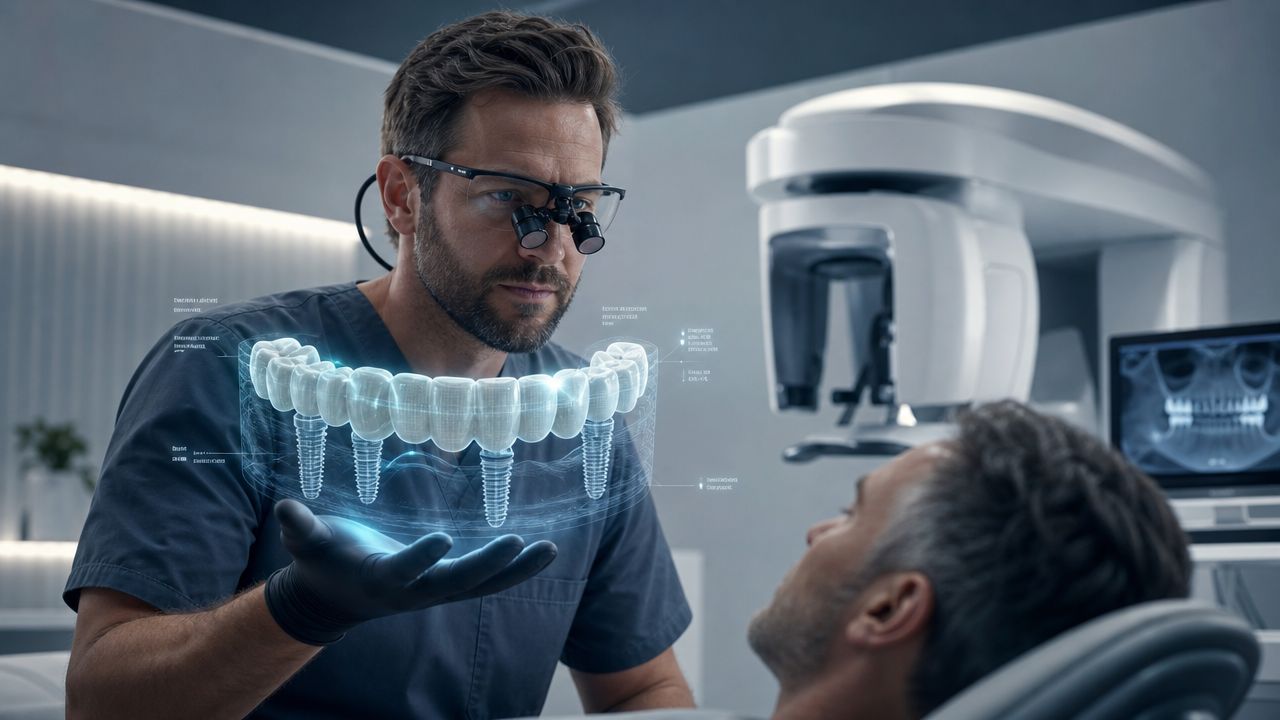
Full mouth dental implants replace most or all teeth in the upper jaw, lower jaw, or both by attaching a full set of replacement teeth to implants placed in the jawbone. An implant is a small post, usually made of titanium, that takes the place of a missing tooth root. Instead of resting only on the gums, the new teeth are supported from within the bone.
That difference changes how the teeth feel in daily life. Many patients describe implant-supported teeth as more secure for eating, speaking, and smiling than a traditional denture that lifts out.
A point that often causes confusion is the phrase "full mouth implants." It does not always mean one implant for every missing tooth. In many cases, a small number of implants support an entire arch of teeth. For example, some patients receive a fixed bridge attached to several implants, while others do better with an implant-supported denture that can be removed for cleaning. Our All on 4 implant supported dentures page explains one of the most common fixed options in more detail.
A full mouth implant restoration has three main components: the implant body, the abutment, and the prosthetic teeth.

Here is what each part does:
You can picture it like building a house. The implant body is the footing in the ground, the abutment is the connector, and the teeth are the finished structure you see and use every day. If the base is stable, everything above it works better.
After an implant is placed, healing begins. During that healing phase, the bone grows around the implant in a process called osseointegration. In simple terms, the jaw locks onto the implant and holds it firmly.
That bond is the reason implant treatment takes time and planning. The goal is not only to place new teeth. The goal is to create a base that can handle years of chewing, talking, and daily use.
Practical rule: The best implant result usually comes from matching the treatment plan to your bone health, gum condition, and commitment to home care.
A fuller smile is often the first change people notice, but appearance is only part of the story. Full mouth dental implants can restore biting strength, clearer speech, and the sense that your teeth belong to you again. For many people, the emotional relief starts when they stop worrying that their teeth will move, click, or shift at the wrong moment.
Your exam helps determine whether implants are a good fit and which kind of implant solution makes sense. We look at bone levels, gum health, remaining teeth, bite pressure, and habits such as smoking or inconsistent brushing. Some patients are good candidates for a fixed set of teeth. Others may be healthier and more comfortable with a removable implant-supported option. Understanding that difference early can save a lot of frustration later.
Choosing among full mouth implant options can feel confusing at first, especially if one office says “fixed teeth” and another says “snap-in dentures.” Many patients assume one choice is clearly better than the others. In reality, each option solves a different problem, and the best answer depends on how your mouth looks today and how you want to live with your new teeth over time.
A helpful way to frame this is to ask two questions. Do you want teeth that stay in all the time, or a solution you remove for cleaning? And does your bone support a fixed design, or would a removable design be healthier, simpler, or more practical?

This is the option many people picture first. A full set of upper or lower teeth is attached to a small number of implants, so the bridge stays in place and is removed only by the dental team.
According to this overview of full mouth implant design, full mouth dental implants often use four to six implants per arch to support a fixed bridge, can restore up to 95% of natural bite strength, and may reduce the need for bone grafting compared with older approaches that used eight or more implants per arch.
Patients often like this option because it feels secure and close to having natural teeth again. You do not take it out at night, and many people find that speaking and eating feel more normal once they adapt. If you want to learn how this approach works in daily life, All-on-4 implant-supported dentures in Fair Lawn explain one common type of fixed full-arch treatment.
An implant-supported overdenture is different from a traditional denture. It connects to implants for stability, so it does not float or shift the same way a regular denture can. You still remove it for cleaning.
For some patients, that is not a downgrade. It is a smart match.
This option can be especially helpful for people with more bone loss, for patients who want easier cleaning access, or for those trying to balance stability with cost. Many people feel genuine relief when they learn that “removable” does not mean loose. It often means secure during the day and easier to maintain at home.
This is the most customized approach. Instead of one bridge across the arch, multiple implants support individual teeth or smaller groups of teeth.
It can create a very natural feel and a highly detailed result, but it also asks more of the patient and the jawbone. More implants usually mean more planning, more healing considerations, and higher cost. This path tends to fit patients with strong bone volume and a goal of rebuilding the mouth in the most tooth-by-tooth way possible.
| Option | How it works | Best for | Main tradeoff |
|---|---|---|---|
| Fixed full-arch bridge | One full bridge attached to several implants | Patients who want a non-removable solution | Requires enough support for a fixed design |
| Implant-supported overdenture | Removable denture that snaps onto implants | Patients with more bone loss or those seeking a practical implant option | Must be removed for cleaning |
| Individual implants | Multiple implants support individual teeth | Patients wanting a highly individualized rebuild | Most complex treatment path |
The right choice is the one that fits your anatomy, your goals, and the kind of daily routine you can maintain with confidence. For many patients, the biggest relief comes from finally understanding that full mouth implants are not one treatment. They are a group of solutions, and your plan should be built around you.
One of the biggest sources of anxiety is not knowing how long this takes. Patients hear phrases like “teeth in a day” and assume the full process is finished immediately. What usually happens is more nuanced, and understanding that upfront prevents disappointment later.
The day of surgery can be a major milestone, but it usually isn't the finish line.

The first visit is focused on information. Your dentist examines your teeth, gums, bite, and jaw structure, then uses imaging to study the available bone and plan implant positions. This is also when you'll talk through related needs such as extractions, restorative dentistry, sedation, and healing expectations.
If you'd like a deeper look at each phase, this dental implant timeline guide gives a helpful overview of what patients can expect over time.
For many patients, the surgical appointment includes removing failing teeth if needed, placing implants, and delivering a temporary set of teeth. This temporary restoration can look very good and can make a huge emotional difference right away.
Still, temporary doesn't mean final. The temporary teeth are designed to help you function and smile during healing while protecting the implants.
A short visual explanation can make that easier to picture:
According to this explanation of permanent implant timing, patients may walk out with temporary teeth on day one, but the final permanent titanium-fixed bridge usually requires 3 to 6 months for osseointegration plus additional healing time for the gums, for a total of 6 to 12 months before the permanent set is ready.
That timeline is often the part patients appreciate hearing most clearly. It sets honest expectations. You can have teeth early in the process, but your strongest, most refined final result takes more time.
Once the implants have healed well and the tissues are stable, impressions or digital records are used to create the final restoration. Depending on the case, that may be acrylic or zirconia. The final teeth are adjusted for fit, comfort, and bite balance.
After that, maintenance begins. Regular cleanings, exams, and home care are what protect the work you've invested in.
The temporary smile gives you function quickly. The permanent smile is built more slowly so it lasts.
Traditional dentures still have an important place in dentistry. They can restore appearance and offer a non-surgical option for many people. But if you've ever worn a loose denture, you already know their limitations can affect comfort, food choices, and confidence.
Full mouth dental implants change the experience because they anchor the replacement teeth to implants rather than relying only on the gums.

The first benefit many patients describe isn't technical. It's relief. They aren't thinking about whether the denture will move. They aren't worrying about adhesive. They aren't planning every meal around what they can manage safely.
A fixed or implant-retained solution can make eating, speaking, and smiling feel more predictable. That daily security matters.
Implants also support the jaw in a way traditional dentures don't. Because implants interact with the bone like tooth roots, they can help preserve the jaw over time. That support can make facial structure and bite feel more stable.
Another major difference is chewing ability. Patients often want to know if they'll be able to enjoy foods they gave up years ago. A well-planned implant restoration can greatly improve function and widen food choices once healing is complete.
Here's a straightforward comparison:
The clinical track record is strong. This review of dental implant success data notes a 95 to 98% success rate within the first five years, and cites a 2026 large-scale national dataset reporting a clinical success rate of 97.83%.
That doesn't mean implants are effortless or guaranteed. Surgery is still surgery. Healing takes time. Care matters. Patients need healthy gums, enough bone support, and a commitment to good oral hygiene.
A good implant result isn't only about placement day. It's about choosing the right case and maintaining the result afterward.
Implants aren't automatically the right answer for everyone. Some patients are better served by a removable implant-supported option. Others may need treatment for gum disease first. Some prefer a non-surgical path.
The key is not to compare implants and dentures as “modern versus outdated.” The better comparison is stability, function, maintenance, anatomy, and what fits your life best. When implants are appropriate, many people find they offer a level of comfort and confidence that traditional dentures can't match.
When patients visit a local office for full mouth care, they want more than technical skill. They want to know who will guide them, how clearly the process will be explained, and whether they'll feel comfortable asking questions. That experience matters just as much as the treatment plan.
In Fair Lawn, a modern implant visit often begins with careful records rather than quick assumptions. The team studies your current smile, bite, jaw structure, and goals before recommending whether you need restorative care, extractions, implant treatment, or another path entirely.
A full mouth consultation is usually a conversation first. Patients often come in worried that they'll be judged for how long they've waited or how complicated things have become. A good implant office doesn't do that. It listens, evaluates, and prioritizes what will make your mouth healthier and your next steps clearer.
At a practice utilizing advanced technology, that may include 3D imaging, facial scanning, and digital planning tools that help the dentist visualize implant placement and final tooth position before treatment begins. This kind of planning supports accuracy and helps patients understand what their new smile can realistically look like.
Fear keeps many people from seeking care until the problem becomes urgent. That's why comfort options can make such a difference. For patients who feel nervous about surgery, sedation dentistry can help them complete treatment more calmly and confidently.
This is especially important in a practice that also provides broader services such as cleaning and exams, dental x-rays, new patient exams, restorative dentistry, cosmetic services, and emergency care. Some implant patients first arrive because of pain, infection, or broken teeth. Others are already established patients who want a complete smile rebuild after years of patchwork treatment.
Dr. Jody Bardash brings 30+ years of experience to patient care, which can be reassuring when you're considering complex treatment. Experience doesn't remove every step of the process, but it often helps patients feel that their concerns are being heard and their treatment is being approached carefully.
For residents of Fair Lawn, Ridgewood, and Glen Rock, that local continuity matters. It means your evaluation, planning, treatment, and follow-up can happen with one team that knows your case and your goals.
A full mouth implant plan can feel like a big unknown at first. Many patients are less worried about the idea of new teeth than they are about the day-to-day reality. Will it hurt. What will it cost. Will cleaning be difficult. Those are the right questions to ask.
During the procedure, your mouth is numb, and sedation may be available if you feel anxious. The surgery itself is usually more comfortable than patients expect.
Recovery is the part that takes preparation. Some soreness, swelling, and tenderness are normal, especially if teeth were removed at the same time. For many patients, it feels more like healing after a major dental procedure than sharp pain. Good aftercare, soft foods, rest, and follow-up visits make a real difference.
The cost depends on the design of your treatment. A fixed full-arch bridge and a removable implant-supported overdenture are built differently, and the number of implants, extractions, bone changes, and materials all affect the final fee.
This is one reason the consultation matters so much. Two patients can both say, "I need full mouth implants," and need very different treatment. Many offices also offer financing, which can make the process easier to budget over time.
Cleaning depends on whether your new teeth are fixed or removable. That point confuses many patients, and it matters.
A fixed bridge stays in place, so you clean around the gums and under the restoration with the tools your dentist recommends. A removable overdenture comes out for cleaning, more like a denture that snaps securely into place. Both options need daily care and regular office visits, just like a car needs routine maintenance even after you replace the engine.
A simple home routine often includes:
Possibly. Bone loss does not automatically rule out implants.
The better question is which type of implant solution fits your anatomy safely and predictably. Some patients are good candidates for a fixed bridge. Others do better with a removable implant-supported overdenture because it places different demands on the bone and can be easier to maintain. Imaging and treatment planning answer that question clearly. The goal is not to fit you into a label. The goal is to choose a solution your mouth can support for the long term.
If you're ready to explore full mouth dental implants, restorative dentistry, cosmetic dentistry, or even urgent care from an emergency dentist in Fair Lawn, the next step is a personal consultation. Dental Professionals of Fair Lawn serves patients in Fair Lawn, Ridgewood, and Glen Rock with complete care that includes dental implants, tooth extraction, Invisalign, Six Month Smile, cleaning and exams, and advanced treatment planning. Schedule a visit to discuss your options, get clear answers, and find out which solution fits your health, comfort, and smile goals.