Damon System Braces Cost: Your 2026 Fair Lawn Guide
Learn the Damon System braces cost in Fair Lawn, NJ. Discover price factors, payment options, and get your perfect smile at Dental Professionals of Fair Lawn.
Learn the Damon System braces cost in Fair Lawn, NJ. Discover price factors, payment options, and get your perfect smile at Dental Professionals of Fair Lawn.
Damon braces in the United States typically cost $3,800 to $8,000 nationally, and the exact fee depends on your case. At Dental Professionals of Fair Lawn, our team can give you a precise, personalized quote during a no-obligation consultation so you know what treatment would involve before you commit.
If you're in Fair Lawn, Ridgewood, or Glen Rock, you're probably asking a simple question with a lot of smaller questions underneath it. How much will braces cost. Will they be noticeable. Will insurance help. Is Damon better than Invisalign or traditional braces for your family member's smile and daily routine.
Those are the right questions to ask. Orthodontic treatment is a health decision, a cosmetic decision, and a financial decision all at once. Families searching for a dentist near me, an emergency dentist, or a dentist in Fair Lawn, NJ often want one office that can explain treatment clearly, handle routine dental care, and help them make a smart long-term choice.
A lot of patients start in the same place. A teen is getting ready for school photos and feels self-conscious about crowding. An adult has wanted straighter teeth for years but keeps putting it off because the pricing feels unclear. A parent is trying to compare Invisalign, traditional braces, and the Damon System without getting lost in marketing language.
That uncertainty is normal. Cost matters, but so do comfort, appearance, oral hygiene, and whether treatment fits real life in Fair Lawn.
The Damon System has become a common option for teens and adults who want fixed braces with a more modern design. Many people are drawn to it because it can feel cleaner and simpler than braces that rely on elastic ties.
In practical terms, families usually want answers to four things:
The most helpful consultation isn't the one that promises the most. It's the one that explains the trade-offs clearly.
For patients looking for a cosmetic dentist near me, Invisalign, Six Month Smile, or broader dental care such as cleaning and exams, dental x-rays, new patient exams, teeth whitening, restorative dentistry, or tooth extraction, it helps to work with one office that looks at the whole picture.
Dr. Bardash approaches orthodontic planning the same way. A straight smile should also support healthier gums, easier home care, and stable long-term function. That matters whether you're exploring braces for a child, a teen, or yourself.
Damon braces use a self-ligating bracket. Instead of holding the wire with elastic bands around each bracket, the bracket has a small sliding component built into it. According to Smile Doctors' overview of Damon braces, the system has been clinically proven over 20 years and has resulted in more than 7 million documented successful smiles globally.
That design difference is the core of what makes Damon feel different from traditional braces.
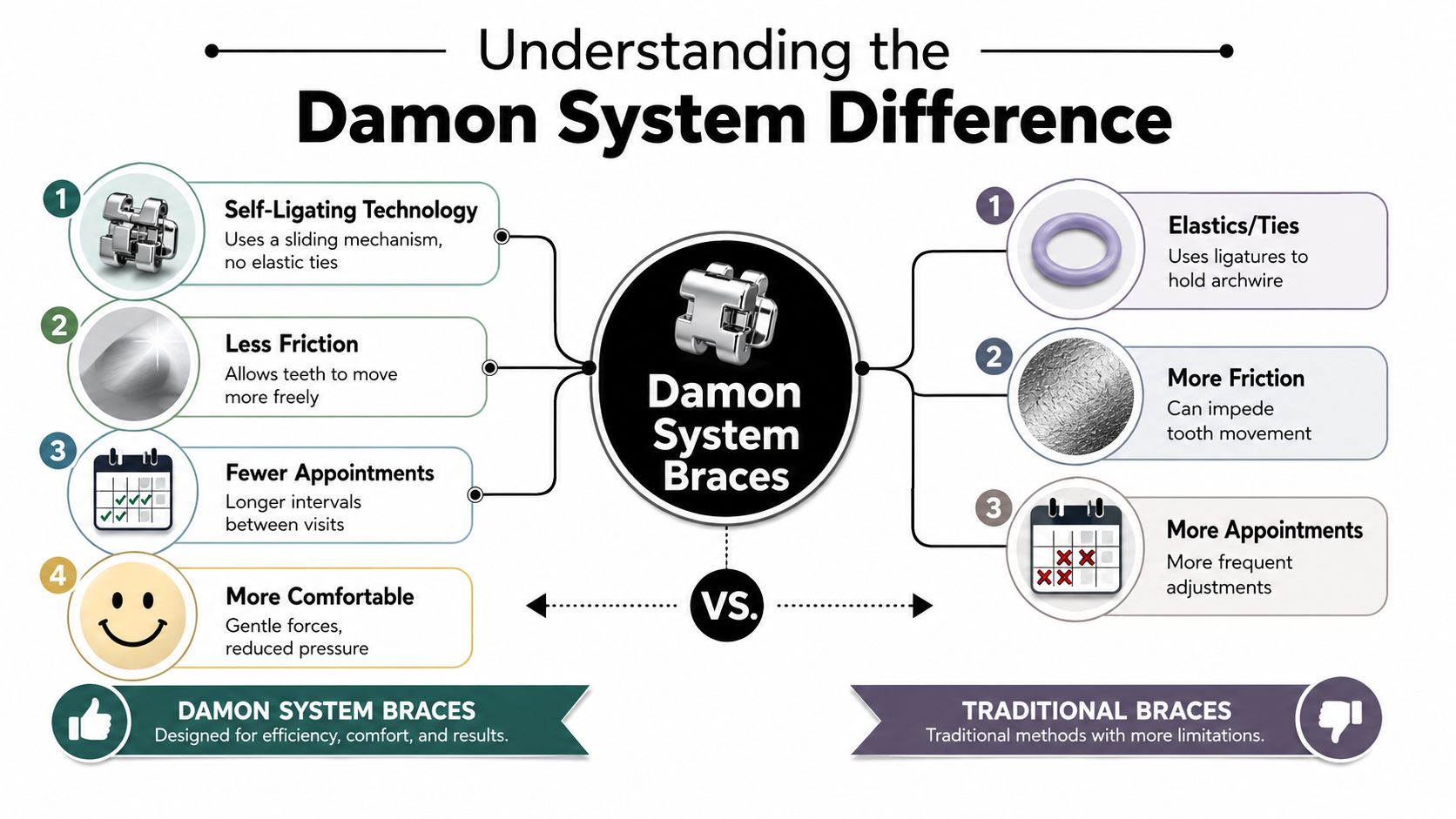
Think of a traditional bracket like a wire held in place by a tiny rubber tie. Think of a Damon bracket more like a small track with a built-in door. The wire is still doing the work of guiding tooth movement, but the way it's secured is different.
That matters because the absence of elastic ties changes the way the system handles friction during adjustments. Many patients like that the brackets can feel smoother and can be easier to keep clean around the edges.
Damon can be a strong choice for patients who want full braces treatment but don't want the look or maintenance style of older bracket systems. In daily life, the benefits people often care about most are straightforward:
Practical rule: The right orthodontic system is the one that fits your bite, your goals, and your ability to keep treatment on track.
Honesty matters. Damon is well-designed technology, but it isn't magic. Marketing sometimes suggests dramatically faster treatment or other sweeping advantages. The stronger evidence does not support those bigger promises consistently.
For families in Fair Lawn, that's good news. It means the decision should be based on fit, comfort preferences, appearance, and the details of the case, not on hype.
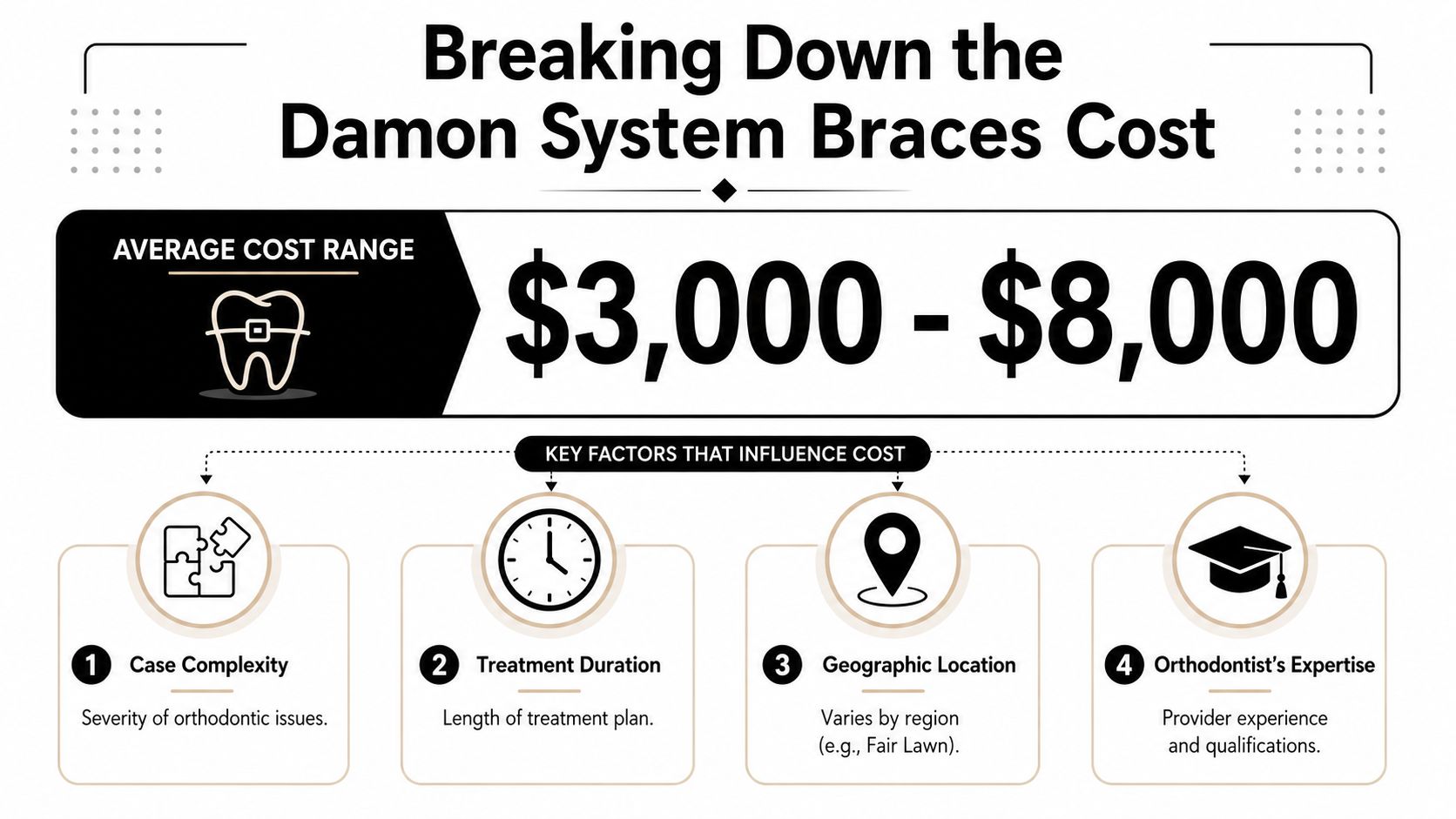
The average Damon System braces cost in the United States typically ranges from $3,800 to $8,000, and that range is comparable to traditional metal braces at $3,000 to $7,000 and clear aligner systems like Invisalign at $3,000 to $7,000, based on this cost guide on Damon braces.
That price range surprises some patients because they expect Damon to be dramatically more expensive. In reality, it often sits in the same general pricing conversation as other modern orthodontic options.
Orthodontic treatment isn't just a bracket fee. The total cost reflects diagnosis, planning, appliances, monitoring, adjustments, and finishing the case well. With Damon, part of the higher end of the fee range can relate to the self-ligating bracket technology itself, which reduces friction during wire changes.
That doesn't automatically mean every patient should choose Damon. It means the fee should be considered in the context of the whole treatment plan, not just the hardware.
A short educational video can help if you're still visualizing how the system works.
National averages are useful, but they aren't the final answer for your family. A local quote should account for your bite, crowding, spacing, tooth positions, and whether any other dental needs need to be handled first. That can include restorative planning, gum health review, or in some cases a tooth extraction before orthodontic movement begins.
A good consultation should leave you with a clear understanding of:
| Cost question | What you should know |
|---|---|
| Starting range | Damon commonly falls within the same broad pricing range as other orthodontic systems |
| What changes the fee | Complexity and treatment design matter more than marketing claims |
| What should be included | Records, appliances, visits, and follow-up details should be explained clearly |
| How to compare options | Compare total treatment value, not just the appliance name |
Some patients come in after searching dentist near me or dentist in Fair Lawn, NJ because they want one straight answer. The honest answer is that a national range helps you budget, but a personalized exam is what gives you certainty.
That's why an in-office evaluation matters. It turns a broad estimate into a real plan.
Two patients can both ask about Damon and still receive different quotes. That isn't inconsistency. It's because orthodontics is customized.
According to Tooth by Tooth's Damon clear braces review, the typical U.S. cost for Damon braces ranges from $3,800 to $8,000, which is comparable to standard ceramic braces and only slightly higher than traditional metal braces that typically run $3,000 to $7,000. The key issue isn't the bracket name alone. It's how much treatment your teeth and bite need.
Here are the factors that usually shape the final fee most:
Straightening teeth isn't separate from overall oral health. If someone has active decay, inflamed gums, or broken restorations, those issues usually need attention before orthodontic movement. That's one reason families often prefer an office equipped to coordinate dental care, dental x-rays, new patient exams, and follow-up treatment in one place.
When treatment starts with a complete exam, cost discussions become clearer because you're planning the full mouth, not just the visible crowding.
A useful consultation isn't only about the fee. It should also answer practical questions such as:
Those questions help turn a vague price search into a treatment decision that makes sense for your family.
A lot of families don't choose Damon in isolation. They're comparing it with Invisalign and traditional braces, and sometimes they also ask about Six Month Smile for more cosmetic-focused correction.
The right choice depends on the bite, appearance goals, and how disciplined the patient will be with home care and follow-through. If you'd like a deeper side-by-side review, this Damon braces vs Invisalign comparison is a helpful next read.
| Feature | Damon System | Traditional Braces | Invisalign |
|---|---|---|---|
| Appearance | Less noticeable than older metal braces, especially if a clearer bracket is used | Most visible option | Very discreet |
| How it works | Fixed self-ligating brackets with a sliding mechanism | Fixed brackets with ties holding the wire | Removable clear trays |
| Daily compliance | Low patient compliance burden because braces stay on | Low patient compliance burden because braces stay on | Higher compliance burden because trays must be worn as directed |
| Cleaning | Many patients find them easier to clean around than tied brackets | Ties can create more areas for buildup | Trays must be removed for eating and cleaned regularly |
| Lifestyle fit | Good for patients who want fixed treatment with a modern bracket design | Good for patients comfortable with a traditional approach | Good for patients who want minimal visibility and can stay consistent |
| Typical cost range | Falls within the broad orthodontic range discussed earlier | Falls within the broad orthodontic range discussed earlier | Falls within the broad orthodontic range discussed earlier |
Damon often appeals to adults and teens who want fixed braces without some of the maintenance features associated with elastic ties. Traditional braces remain reliable and familiar. Invisalign is attractive for patients who strongly value appearance and want removability.
Each option comes with trade-offs:
Sometimes a patient comes in asking only for Damon and leaves realizing Invisalign fits their work life better. Sometimes the opposite happens. Fixed braces can be the smarter choice when compliance is a concern or when full control is needed.
That broader discussion matters if you're also looking for cosmetic dentistry, restorative dentistry, or future treatments like dental implants near me. Orthodontic planning often affects how the whole smile is restored later.
The sticker price matters, but the out-of-pocket cost is what families really need to plan for. Insurance can help, monthly payments can help, and tax-advantaged health accounts can help. The key is understanding how those pieces fit together before treatment starts.
Many dental insurance plans offer orthodontic coverage for Damon braces, but coverage varies significantly. In one patient example shared in a braces discussion, the patient reported $2,000 out-of-pocket after insurance covered $4,000 of a $6,000 total, which shows how much the final personal cost can depend on the individual policy, as described in this patient cost discussion about Damon braces coverage.
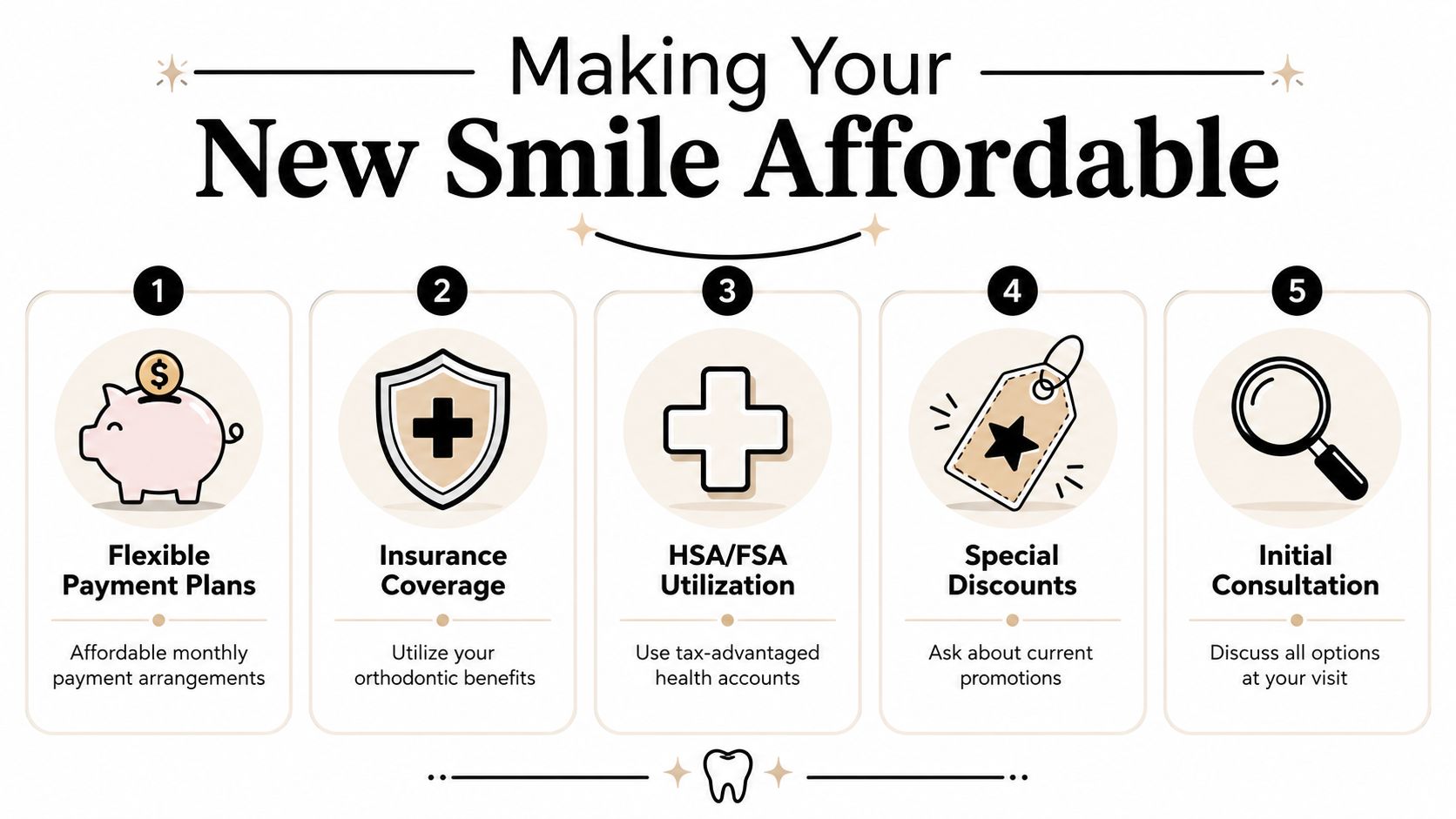
Most families don't pay for orthodontics in one simple lump sum and move on. They combine available tools.
A financing page is useful, but the true value is having the office explain what your specific options look like. Patients who want to review available payment pathways can start with the practice's orthodontic financing and payment information.
Paying for orthodontics is often less about finding one perfect discount and more about combining insurance, timing, and a payment structure that your family can sustain.
Even when two families in the same town choose the same appliance, their out-of-pocket numbers may look very different. One policy may include orthodontic coverage for dependents only. Another may help an adult patient. A third may cover part of the treatment but leave deductibles and copays behind.
That's why I always recommend asking for the full financial picture in writing. You should know the treatment fee, estimated insurance contribution if applicable, and what your monthly responsibility would be under financing.
The first visit should feel clear, not intimidating. You'll talk about what bothers you, whether that's crowding, spacing, bite alignment, appearance, or cleaning around overlapping teeth. From there, the exam helps determine whether Damon, Invisalign, traditional braces, or another approach makes the most sense.
Dr. Jody Bardash evaluates tooth position, bite relationships, gum health, and any related dental concerns that could affect timing. If digital records are needed, tools such as iTero digital scanning can make the process more comfortable and precise than old-style impressions.
The appointment is also where families can discuss related needs under one roof, including preventive care, cosmetic improvements, restorative work, oral surgery, or an emergency dentist visit if a painful issue needs attention before orthodontics begins.
By the end of a good consultation, you should understand:
For families in Fair Lawn, Ridgewood, and Glen Rock, that kind of clarity is often the turning point. Once the plan is specific, the decision gets much easier.
If you're considering braces and want straight answers about fit, cost, and financing, schedule a consultation with Dental Professionals of Fair Lawn. Dr. Bardash and the team can evaluate your smile, explain whether Damon is the right option, and give you a personalized treatment quote that makes the next step clear.