Cosmetic Bonding vs Veneers in Fair Lawn, NJ
Cosmetic bonding vs veneers? Our Fair Lawn dentists compare cost, process, and durability to help you choose the right cosmetic treatment for your smile.
Cosmetic bonding vs veneers? Our Fair Lawn dentists compare cost, process, and durability to help you choose the right cosmetic treatment for your smile.
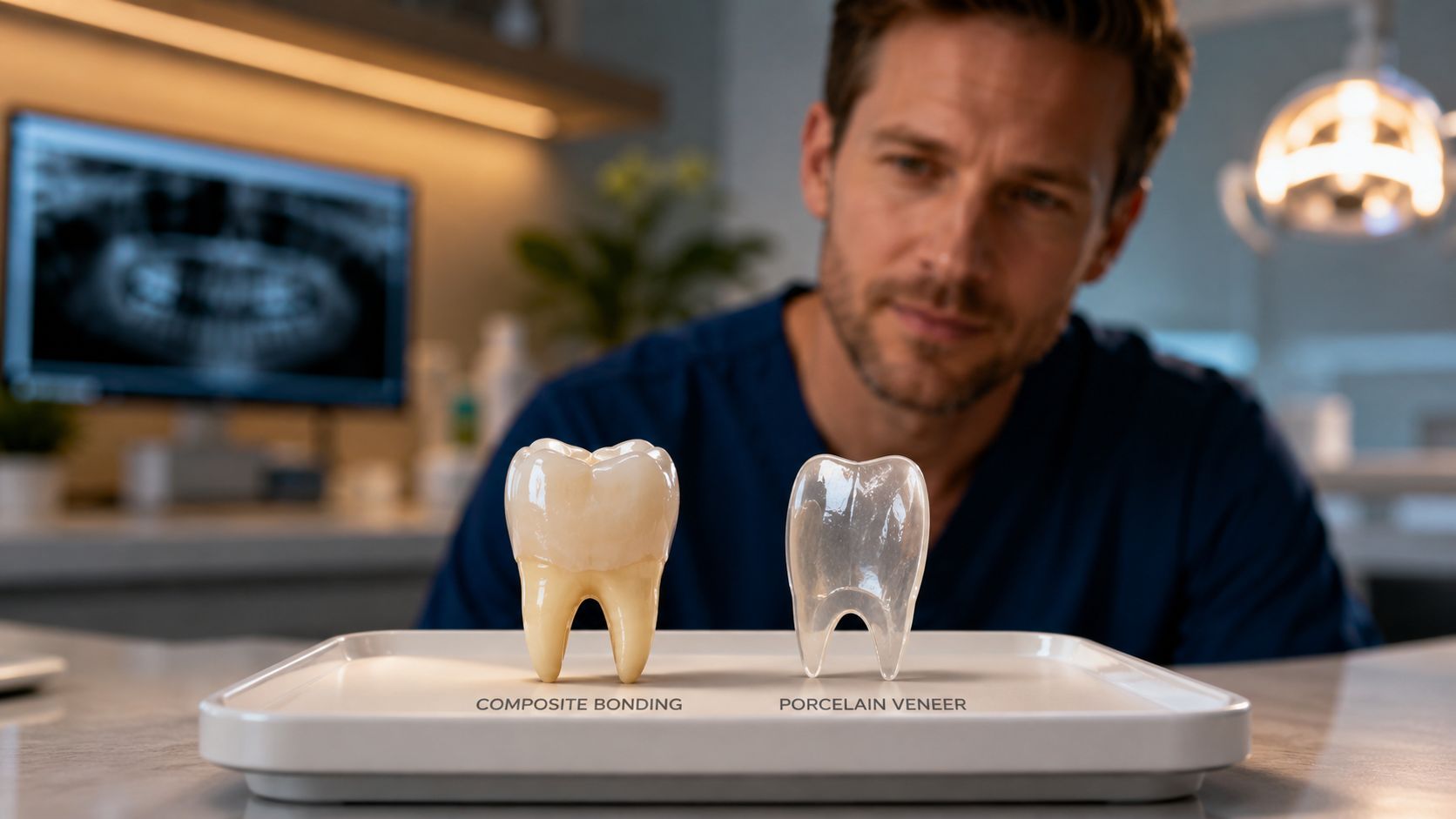
A lot of people who search for a cosmetic dentist near me in Fair Lawn are in the same spot. They're not dealing with severe pain. They're dealing with a smile that makes them hold back a little. A chipped front tooth from years ago. A small gap that shows up in every photo. Staining that whitening alone won't fully fix.
If that sounds familiar, you're not being overly focused on appearance. Your smile affects how you speak, laugh, and show up in everyday life. When patients from Fair Lawn, Ridgewood, and Glen Rock come in asking about cosmetic bonding vs veneers, they usually want a simple answer. Both can be excellent choices, but they serve different goals.
Sometimes the decision starts with a very ordinary moment. You catch your reflection before work, or someone snaps a family photo, and your eyes go straight to one tooth. Maybe it's a chipped edge. Maybe one front tooth looks darker than the others. Maybe a small space between teeth has bothered you for years.
That's often when people start searching for a dentist in Fair Lawn, NJ or a cosmetic dentist near me. They want to know what's possible, but they also want to know what makes sense for their own teeth, budget, and long-term health.

Patients don't usually walk in saying, “I want composite resin” or “I want porcelain.” They say things like:
Those are the right questions.
Cosmetic bonding and porcelain veneers can both improve chips, uneven edges, discoloration, and spacing. The difference is in how much change you need, how conservative you want to be, and how you feel about a treatment being reversible or permanent.
Practical rule: If the problem is small and isolated, bonding often enters the conversation first. If the goal is broader smile redesign, veneers usually deserve a closer look.
Online, the comparison often gets reduced to “bonding is cheaper, veneers are better.” That's too simplistic. Modern cosmetic dentistry is more thoughtful than that.
A younger adult may want the most conservative option possible. Another patient may want a more complete smile makeover and stronger stain resistance. Someone with worn edges or a stronger bite may need a different recommendation than someone fixing a single chipped corner.
That's why this decision should feel personal, not generic. In a local consultation, the discussion often includes more than cosmetic goals alone. It may connect with teeth whitening, gum shape, bite position, past dental work, and even whether orthodontic options like Invisalign or Six Month Smiles should be part of the plan.
The easiest way to understand cosmetic bonding vs veneers is to think about how each treatment changes the tooth.
Cosmetic bonding adds material directly onto the tooth. Veneers place a custom shell over the front of the tooth. Both can look beautiful, but they're built in different ways and used for different situations.

Bonding uses a tooth-colored composite resin that the dentist places, shapes, and polishes directly on the tooth. A good way to picture it is like careful sculpting. If a tooth has a small chip, a narrow gap, or a limited area of discoloration, bonding can often correct it with very little intervention.
A patient-friendly summary from Aspen Dental's bonding and veneers overview describes bonding as a single-visit, minimally invasive repair that uses tooth-colored composite resin for small chips, gaps, and discoloration, while veneers are custom-fabricated shells that usually need multiple visits and more enamel removal for broader changes.
If you want a closer look at the material and technique, this explanation of how teeth bonding works helps make the process easier to picture.
Porcelain veneers are thin, custom-made shells that cover the front surface of the tooth. I often describe them as something like a custom cover for the visible part of the tooth. They're designed in advance, fabricated outside the mouth, and then bonded into place.
Veneers are often chosen when the cosmetic goal is larger than a small repair. They can help when someone wants to improve the color, shape, size, or overall uniformity of several front teeth at once.
Both treatments can improve appearance, so it's easy to assume they overlap completely. They don't.
Bonding is usually better for targeted corrections. Veneers are usually better for broader aesthetic change.
Bonding fixes and refines. Veneers redesign and unify.
That difference matters. A patient who only needs a small corner repaired may not need the commitment of veneers. A patient who wants to change several visible front teeth in a coordinated way may feel frustrated if they try to force bonding to do a veneer-level job.
Knowing what happens in the chair often makes the choice less stressful. Patients usually feel much more comfortable once they understand what the actual appointments look like and what each option asks of their natural teeth.
Bonding is often the simpler path. A key distinction noted by Cleveland Clinic's dental bonding overview is that bonding is reversible, while veneers are generally permanent because enamel must be removed to place them. The same source says bonding can usually be done in a single visit, takes about 30 to 60 minutes per tooth, and typically lasts 3 to 10 years.
For a patient, that often means a straightforward appointment. The tooth is prepared gently, the composite is placed in layers, the shape is refined, and the surface is polished so it blends with neighboring teeth. If the issue is a small chip on a front tooth, the whole visit can feel more like careful detail work than major dental treatment.
Veneers take more planning. Since they're custom-fabricated, the process usually unfolds over more than one visit.
At the consultation, the dentist studies your smile, facial proportions, bite, tooth shape, and goals. Digital tools are highly beneficial in this process. Dr. Bardash often uses digital scanning to evaluate the smile in a more precise and visual way, which makes the conversation less abstract for patients who want to see what's changing before they commit.
After planning comes tooth preparation. Because veneers are generally permanent, this part matters. A small amount of enamel is typically adjusted so the porcelain can sit properly and look natural. Temporary restorations may be used while the final veneers are being made.
Many patients rightly pause here, and they should. Reversible and permanent are not small details. They shape the whole decision.
Here's a simple way to consider it:
A good cosmetic plan shouldn't make you feel rushed. It should help you understand what you're keeping, what you're changing, and why.
Comfort matters too. Patients who feel anxious about treatment often do better when the office uses digital imaging, clear communication, and sedation options when appropriate. That's especially important for people who have delayed cosmetic or restorative care because of dental fear.
When patients want the quick version first, a side-by-side table helps.
| Feature | Cosmetic Bonding | Porcelain Veneers |
|---|---|---|
| Main material | Tooth-colored composite resin | Custom porcelain shells |
| Best for | Small chips, narrow gaps, limited discoloration, minor reshaping | Broader smile changes involving color, shape, size, and mild alignment concerns |
| Treatment pace | Often completed in one visit | Usually completed over multiple visits |
| Tooth preparation | Minimal | More enamel removal is usually needed |
| Reversibility | Generally reversible | Generally permanent |
| Appearance | Natural-looking and artistic, especially for small corrections | Very refined, uniform look for multi-tooth cosmetic design |
| Durability | More prone to chipping and staining | Stronger long-term option with better stain resistance |
A useful benchmark from Cottage Grove Dental Care's comparison of veneers and bonding says bonding generally lasts about 3 to 7 years, while porcelain veneers are commonly cited at 10 to 15 years or more with proper care. That same comparison describes bonding as more prone to chipping and staining, and notes that veneers are often the stronger long-term choice for patients with higher bite forces or larger aesthetic corrections.
That doesn't mean bonding is flimsy. It means the material has limits. If you bite hard, grind your teeth, or want to change multiple front teeth in a major way, porcelain often carries those demands more predictably.
If a bonded edge chips, repair can be relatively straightforward. If a veneer fails or is damaged, the next step is usually more involved.
Bonding can look beautiful. In skilled hands, it can be subtle, natural, and highly effective for small problems. But porcelain usually gives more control for a full smile makeover because the shape, surface texture, and final finish are crafted in a more controlled way.
If you're researching smile design details, this article on how dental veneers work can help you understand why veneers are often chosen for more extensive cosmetic cases.
A pattern shows up often in consultations:
Neither choice is automatically better. The better choice is the one that matches your goals.
For most patients, the question isn't just “What looks better?” It's “What am I signing up for over time?”
One neutral comparison from Dentistry in Redfern on porcelain veneers vs cosmetic bonding reports composite bonding at about $250 to $600 per tooth versus porcelain veneers at about $925 to $2,500 per tooth. The same source notes that veneers usually last 10 to 15 years and resist staining better, while bonding often lasts 3 to 10 years.
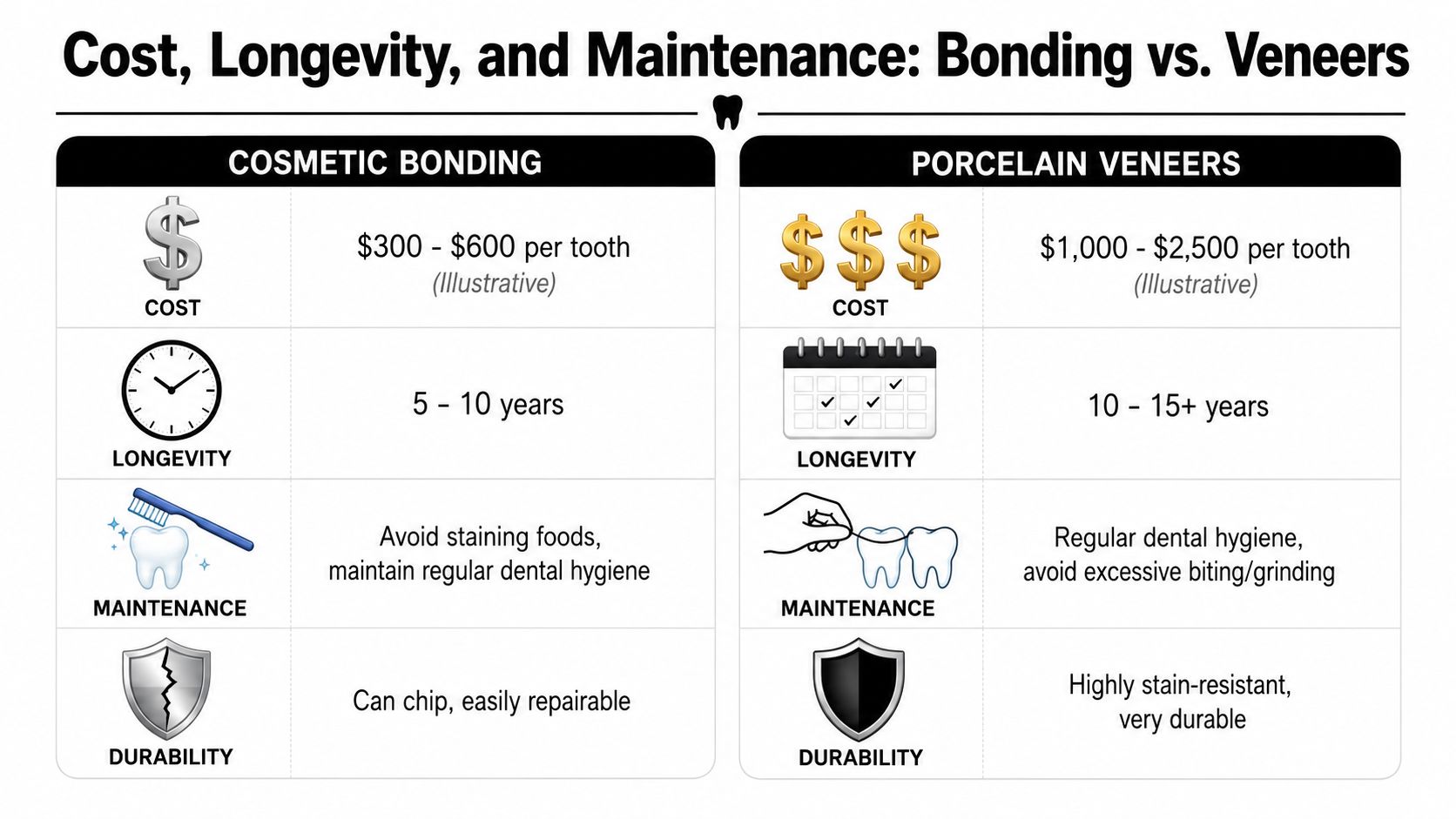
The higher veneer cost usually reflects the material, the custom lab fabrication, and the planning involved. Bonding costs less up front because it's placed directly on the tooth and typically completed more straightforwardly.
Initial price matters, but it isn't the whole story. Bonding can be a smart choice when the issue is minor and the patient wants a conservative approach. Still, because the material is more likely to stain or chip over time, maintenance may become part of the long-term picture.
Veneers ask for a larger first investment, but many patients value the longer service life and stronger stain resistance. That's why “less expensive” and “better value” are not always the same thing.
Key takeaway: The right financial choice depends on how many teeth you want to change, how long you want the result to last, and how willing you are to accept future touch-ups.
Whether you choose bonding or veneers, longevity depends on daily habits and regular dental care. The basics stay the same:
That's where ongoing dental care, cleaning and exams, and occasional dental x-rays support cosmetic treatment. A smile makeover lasts longer when the foundation stays healthy.
The right decision usually becomes clearer when you stop asking which treatment is “better” and start asking which one fits your priorities.

Some patients care most about preserving natural tooth structure. They may be younger, they may have only minor flaws, or they may not want a permanent step yet. For them, modern composite deserves more credit than it often gets.
Recent expert commentary in this discussion of composite bonding vs porcelain veneers notes that modern composite resins have improved in polishability and appearance over the last 10 to 15 years, and in some cases can visually rival porcelain while requiring little or no tooth reduction. That's an important shift in how dentists think about treatment planning.
This is one reason a careful cosmetic consultation can be so helpful. At Dental Professionals of Fair Lawn, patients can review smile options with Dr. Bardash using digital scanning so the decision is based on their actual tooth shape, bite, and cosmetic goals rather than a generic internet checklist.
Veneers often make more sense when someone wants a coordinated change across several front teeth. If the concern involves color, shape, width, visible wear, and overall symmetry all at once, porcelain can provide more control and a more unified finish.
That doesn't mean every smile makeover should go straight to veneers. Sometimes whitening, bonding, minor orthodontics, or reshaping should come first. For patients thinking beyond one or two teeth, broader treatment planning matters. If you're also exploring replacement options for missing teeth, this 2026 guide to full arch implants is a useful outside resource because it shows how cosmetic goals and whole-mouth function can overlap.
A short visual explanation can also help if you're comparing appearance and process side by side.
Ask yourself:
Those answers usually tell us more than any trend or buzzword. The best smile is the one that fits your face, your habits, and your comfort level.
No. Whitening changes natural tooth color, but it doesn't change the color of bonded resin or porcelain veneers. If you're planning to brighten your smile, it's usually smart to discuss whitening first so the final cosmetic work can be matched to the shade you want.
Yes, when they're designed and finished properly, both bonding and veneers should feel smooth and natural. Patients usually notice the look first, not an odd sensation. If something feels bulky or catches your bite, it should be adjusted.
Most patients tolerate both procedures very well. Bonding is usually quite gentle. Veneers involve more preparation, so comfort planning matters more. Local anesthetic and, when appropriate, sedation can make the process much easier for anxious patients.
That's an important question because not every smile concern should be solved with bonding or veneers alone. If the teeth look short because too much gum shows, or if alignment is the main issue, orthodontic or gum treatment may be part of the answer. For a broader perspective, this orthodontic guide for gummy smiles is a helpful outside resource.
Often, yes. Cosmetic work may be part of a bigger plan that includes new patient exams, whitening, gum contouring, Invisalign, restorative dentistry, or even an emergency dentist visit if a broken tooth started the conversation. The key is making sure the teeth and gums are healthy first.
If you're weighing cosmetic bonding vs veneers and want guidance for your specific smile, schedule a consultation with Dental Professionals of Fair Lawn. A personalized exam can help you decide whether a conservative repair or a more extensive smile makeover fits your goals, your timeline, and your long-term oral health.