Average Cost of Deep Cleaning Teeth: A 2026 NJ Guide
What is the average cost of deep cleaning teeth in NJ? Our Fair Lawn dentists explain pricing, insurance, and how to save on scaling and root planing.
What is the average cost of deep cleaning teeth in NJ? Our Fair Lawn dentists explain pricing, insurance, and how to save on scaling and root planing.

TL;DR: The average cost of deep cleaning teeth (scaling and root planing) is typically $150 to $350 per quadrant, with full-mouth treatment usually ranging from $600 to $1,600 without insurance. In the Fair Lawn, New Jersey area, pricing often aligns with the higher end of that range because this market sits close to the NYC metro region.
If you were recently told you need a deep cleaning, you’re probably weighing two questions at once. First, do you really need it? Second, what is this going to cost?
Those concerns are reasonable. Patients don’t walk into a dental visit expecting to hear the words “periodontal therapy” or “scaling and root planing.” They come in because their gums bleed, their breath seems off, or it’s time for a cleaning and exam. Then they learn the care they need goes beyond a routine polish.
For patients in Fair Lawn, Ridgewood, and Glen Rock, the answer isn’t just about a national average. Local pricing matters. So does understanding what you’re paying for, what affects the fee, and why treating gum disease early usually saves you from more invasive dental care later.
A common visit starts like this. A patient comes in expecting a standard cleaning, then hears that the gums are inflamed, tartar has built up below the gumline, and a deep cleaning may be the better treatment. That can feel unsettling, especially if there’s no pain yet.
Pain isn’t the only signal that something’s wrong. Gum disease often develops subtly. Bleeding when brushing, tenderness, swelling, or persistent bad breath can all point to irritation below the gumline, where a toothbrush can’t do enough.

Many adults associate “cleaning” with prevention. Deep cleaning is different because it treats active disease. That’s why the conversation changes from routine maintenance to therapy for the gums and the supporting structures around the teeth.
If your gums bleed regularly, it helps to understand what that symptom can mean. A helpful patient-friendly resource is Why Do My Gums Bleed When I Brush?, which explains common causes in plain language.
Bleeding gums aren’t something to ignore and “watch.” They usually mean the tissue is inflamed and needs attention.
Patients often worry that a deep cleaning means they’ve done something wrong. That’s not how experienced dental teams see it. Gum disease can develop gradually, and many people don’t notice it until a dentist or hygienist measures the pockets around the teeth and finds buildup underneath the gums.
The right next step is clarity, not fear. A careful exam, appropriate dental x-rays when needed, and a clear treatment plan help you understand whether you need treatment in one area or throughout the mouth. If you want a fuller overview of the purpose behind this procedure, this guide on the benefits of deep cleaning the teeth gives useful background.
For many patients, the biggest relief comes from learning that this is a standard, well-established treatment. It’s not cosmetic. It’s not elective in the usual sense. It’s one of the most practical ways to protect your gums and keep your natural teeth stable.
A dental deep cleaning is the everyday term for scaling and root planing. It’s a treatment used when bacteria and hardened deposits have moved below the gumline and started affecting the health of the gums and tooth roots.
A standard cleaning focuses on the exposed parts of the teeth above the gums. Deep cleaning reaches into the space between the tooth and the gum where infection can take hold.

A simple comparison helps. If a boat looks clean above the water but has buildup underneath, washing the deck won’t solve the underlying problem. The same idea applies here. If the infection is below the gumline, a routine cleaning on the visible surfaces won’t remove what’s causing the inflammation.
That’s why deep cleaning is considered therapy, not just hygiene maintenance.
The treatment has two parts:
When buildup stays under the gums, it can create or deepen pockets between the teeth and gums. Those pockets hold more bacteria. More bacteria lead to more inflammation. That cycle is what deep cleaning aims to interrupt.
Practical rule: A regular cleaning helps maintain healthy gums. A deep cleaning helps treat gums that are already diseased.
When gum disease keeps progressing, patients can eventually face loose teeth, gum recession, and bone loss around the roots. Deep cleaning is one of the most effective early interventions because it addresses the infection before more advanced treatment becomes necessary.
The procedure is often part of a broader periodontal plan. Depending on what the exam shows, patients may also need closer maintenance visits afterward so the gums can stay stable. If you want to see how this treatment fits into clinical care, learn more about scaling and root planing.
It isn’t the same as a cosmetic service like teeth whitening. It isn’t performed just because there’s a little stain on the teeth. And it doesn’t replace regular cleaning and exams. Instead, it fills a different role. It treats infection where standard cleanings can’t reach.
That distinction matters when patients compare prices. You’re not paying for a longer version of a routine cleaning. You’re paying for treatment targeted at active gum disease.
The national pricing range gives you a starting point, but local context matters if you live in Bergen County. According to Dentblanche Dental’s deep cleaning cost guide, the average cost of deep cleaning teeth in the United States ranges from $150 to $350 per quadrant without insurance, and full-mouth treatment typically costs $600 to $1,600. The same source notes that urban areas near Fair Lawn, NJ often fall toward the higher end, and insurance often covers 50 to 80 percent when the treatment is medically necessary.

Dentists usually price this treatment by quadrant. A quadrant is one quarter of the mouth. Some patients need treatment in two quadrants. Others need all four.
That’s why two people can hear “you need a deep cleaning” and receive very different estimates. The average cost of deep cleaning teeth isn’t one flat fee. It depends on how much of the mouth needs periodontal therapy.
| Service | Cost Per Quadrant National Avg. | Cost Per Quadrant NJ Metro Avg. | Full Mouth 4 Quadrants Est. |
|---|---|---|---|
| Deep cleaning teeth | $150 to $350 | Often toward the higher end of $150 to $350 | $600 to $1,600 |
For patients in Fair Lawn, Glen Rock, and nearby communities, it’s reasonable to expect estimates that reflect metro-area overhead. That doesn’t mean every case lands at the top of the range. It means local practices generally don’t price like rural markets.
Fair Lawn sits in a region where office costs, staffing, and operating expenses are typically higher than in smaller markets. That affects dentistry just like it affects other healthcare services.
Patients searching “dentist near me” or “dentist in Fair Lawn NJ” often compare fees online, but online comparisons can mislead when they ignore geography. A low estimate from a distant rural area doesn’t tell you much about what a patient in Bergen County should realistically expect.
Local cost context matters. The same procedure can be priced differently simply because one practice operates in a higher-cost metro market.
Deep cleaning is easier to understand when you compare it to the alternative. If gum disease progresses, treatment may eventually shift from cleaning and gum therapy to extraction, restorative work, or replacing missing teeth. That’s where the value becomes clear.
Patients who are also considering cosmetic dentistry, Invisalign, dental implants, or restorative treatment should pay special attention to gum health. Healthy gums create a better foundation for almost every other dental service. Treating gum disease first often makes the rest of the treatment plan more predictable.
The best next step isn’t guessing based on averages alone. It’s getting a personalized exam so the office can tell you how many quadrants are involved and whether insurance is likely to reduce your out-of-pocket cost.
Once you understand the average range, the next question is why one estimate comes in lower and another higher. The answer is usually a mix of clinical need and local market conditions.
According to Kirkwood Family Dental’s discussion of deep cleaning costs, major metropolitan areas like New York and surrounding New Jersey suburbs often run $250 to $350 per quadrant, compared with $150 to $250 in rural areas. The same source notes that most dental insurance plans cover 50 to 80 percent, and that a full-mouth treatment without coverage can average $800 to $1,400.
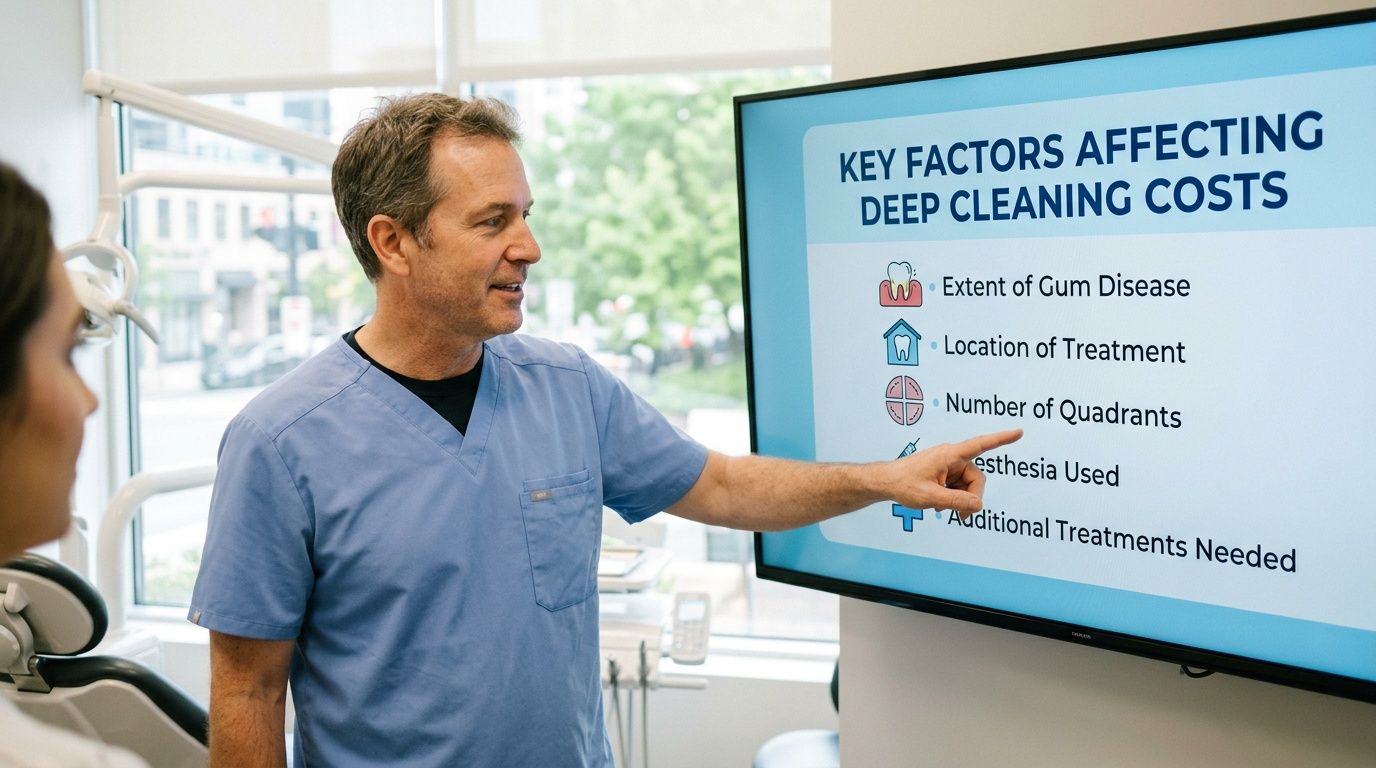
A patient with lighter buildup and shallower areas of inflammation usually needs less chair time than a patient with heavier tartar and more advanced periodontal involvement. That affects how much treatment is needed in each area of the mouth.
Deep cleaning isn’t billed as a generic appointment. It’s tied to the level of disease that has to be treated.
This factor is straightforward. More treated quadrants mean a higher total fee.
Some patients only need one side treated. Others need care throughout the mouth. Until the dentist measures the gums and identifies where the disease is active, any estimate is only a rough range.
For many people, local anesthetic makes the procedure much easier. It allows the hygienist or dentist to clean thoroughly below the gumline without unnecessary discomfort.
Some patients also ask about sedation dentistry because they feel nervous about treatment, have sensitive teeth, or haven’t had dental care in a long time. Sedation can be a good option for comfort and completion of care, but it can change the overall fee. The exact amount depends on the approach used, the length of the visit, and the patient’s medical history.
A proper periodontal diagnosis may involve:
These aren’t extras for the sake of extras. They help the dental team decide whether deep cleaning is the right treatment and whether healing is progressing as expected.
A useful estimate doesn’t just list a fee. It ties the fee to what the team found during the exam.
Many deep cleanings are handled in a general dental office. That’s common and appropriate in many cases. When gum disease is more advanced or the case is medically complex, referral to a periodontist may be the right move.
Specialists often charge differently because they focus on advanced gum and bone conditions. That doesn’t mean a specialist is always necessary. It means the final price can reflect who provides the treatment and how difficult the case is.
Patients often focus on the line item. Dentists focus on matching the treatment to the disease. The right match usually gives you the best value.
When deep cleaning is recommended for active gum disease, dental insurance usually treats it differently from a routine cleaning. It’s considered medically necessary periodontal care rather than simple preventive maintenance.
That difference matters because coverage is often better than patients expect.

The verified cost data for deep cleaning consistently shows that many plans help offset a meaningful part of the fee when the procedure is necessary to treat periodontal disease. In practical terms, that often changes the conversation from “I can’t do this” to “I can plan for this.”
If you receive dental benefits through work and want a plain-language overview of how employer-sponsored plans are structured, Group Dental Coverage offers a useful starting point.
Patients should still expect variation. Every plan has its own deductible, annual maximums, and rules about what documentation is required. That’s why a benefit check matters before treatment begins.
Deep cleaning does more than reduce a bill through insurance coverage. It can help you avoid future treatment that is harder on your schedule, your comfort, and your budget.
If infected gums continue to break down the support around teeth, patients may later need:
That’s why early treatment usually makes financial sense. It addresses the problem while it’s still centered around cleaning infected root surfaces and helping the gums heal.
Treating gum disease early is often the less expensive path, even before insurance enters the picture.
Routine cleanings and exams help prevent disease. Deep cleaning helps control disease once it’s active. If your dentist recommends periodontal therapy, waiting usually doesn’t make the condition simpler.
Some patients hope they can return to a regular cleaning schedule without first treating the deeper buildup. In practice, that usually doesn’t work well. The bacterial deposits under the gums remain in place, and the inflammation tends to continue.
A short explanation can help patients visualize the difference in coverage and care:
The most practical move is to ask for a written estimate, confirm what your plan covers, and move forward before the problem becomes more complicated than it needs to be.
Most patients feel better once they know how the visit works. The appointment is methodical, not rushed, and comfort is a central part of it.
The first step is making sure the area is numb enough for treatment. That matters because cleaning beneath the gumline can be uncomfortable if the tissues are inflamed. Once the area is comfortable, the clinician uses specialized instruments to remove buildup from below the gums and smooth the root surfaces.
Depending on how much of the mouth needs care, treatment may be completed in one visit or divided into separate visits. That approach lets the team work thoroughly while keeping the appointment manageable for the patient.
Patients with dental anxiety often assume a deep cleaning will be overwhelming. In reality, several things usually make it much easier:
For some patients, hearing that they won’t be expected to “tough it out” changes the entire experience.
Modern periodontal care may also include tools that improve precision and comfort. In some practices, laser dentistry can play a role in managing soft tissue and supporting healing, depending on the clinical situation.
After treatment, you’ll receive home care instructions and a plan for follow-up. That part matters. A deep cleaning works best when patients keep up with brushing, flossing, and recommended maintenance visits afterward.
The appointment itself is only part of the success. Healing and maintenance are what protect the result.
Patients from Fair Lawn, Ridgewood, and Glen Rock often come in worried about discomfort and leave saying the appointment was more manageable than expected. That’s usually what happens when the diagnosis is clear, the numbing is adequate, and the team takes time to keep the experience calm.
If you’ve been told you need a deep cleaning, don’t let uncertainty delay the decision. Gum disease is easier to manage when it’s treated early, and waiting usually narrows your options rather than expanding them.
The good news is that this procedure is familiar, targeted, and designed to protect your long-term oral health. It can reduce inflammation, help stabilize the gums, and support the health of the teeth you already have. It also creates a stronger foundation for future dental care, whether that means preventive visits, restorative work, cosmetic treatment, or implant planning.
A personalized exam is the only way to know what your mouth needs. That visit can clarify whether you need treatment in one area or several, what your insurance may cover, and what the most practical next step looks like for your comfort and budget.
If your gums bleed, feel tender, or you were recently told you need periodontal therapy, now is the right time to get answers.
If you’re looking for compassionate periodontal care, new patient exams, routine dental care, cosmetic dentistry, Invisalign, dental implants, or an experienced dentist in Fair Lawn, NJ, schedule a visit with Dental Professionals of Fair Lawn. Dr. Jody Bardash and the team serve families and adults throughout Fair Lawn, Ridgewood, and Glen Rock with personalized treatment plans focused on comfort, long-term health, and confident smiles.