Fair Lawn NJ: All on Four Dental Implants Guide
Learn about all on four dental implants in Fair Lawn, NJ. Process, cost, benefits & what to expect at Dental Professionals of Fair Lawn.
Learn about all on four dental implants in Fair Lawn, NJ. Process, cost, benefits & what to expect at Dental Professionals of Fair Lawn.
If you're reading this, you may already know the daily frustration of major tooth loss. Meals become work. Smiling in photos feels uncomfortable. Dentures may move when you talk, rub sore spots, or make you second-guess simple moments like laughing with family or ordering at a restaurant.
Many people in Fair Lawn reach a point where they want something steadier and more natural. They don't want another temporary fix. They want to eat with confidence, speak clearly, and stop thinking about their teeth all day.
For patients in Fair Lawn, Ridgewood, and Glen Rock, that search often leads to All-on-4 dental implants, a treatment designed to replace a full arch of teeth with a fixed set supported by four implants. It can be life-changing, but it also raises a lot of questions. How does it work? Who qualifies? What does the process feel like? And what happens after treatment is complete?
A common story goes like this. Someone has spent years dealing with damaged teeth, extractions, or loose dentures. They avoid crunchy foods. They smile with their lips closed. They keep putting off treatment because the whole subject feels overwhelming.
That emotional side matters just as much as the dental side.
When teeth are missing or unstable, everyday life changes in quiet ways. You may chew on one side only. You may avoid social events built around food. You may feel older than you are because your teeth no longer feel secure. Many patients don't say all of this out loud at first, but they feel it.
Living with failing teeth can wear people down physically and emotionally, even when they look calm on the outside.
In Fair Lawn, patients often want a solution that's both advanced and personal. They aren't just searching for “dental implants near me.” They're looking for a dentist who will slow down, explain the options clearly, and help them feel safe making a big decision.
All-on-4 treatment is often considered when someone has:
For the right patient, this isn't just cosmetic dentistry. It's restorative care that can affect speech, food choices, comfort, and confidence.
Patients in Fair Lawn, Ridgewood, and Glen Rock often prefer care close to home, especially for a treatment that includes consultation, surgery, follow-up visits, and long-term maintenance. That local relationship matters. When questions come up, it's reassuring to know your care team is nearby and familiar with your case.
If you've been putting this off because it feels too complicated, that's understandable. The good news is that once the process is broken down into plain language, it becomes much easier to understand.
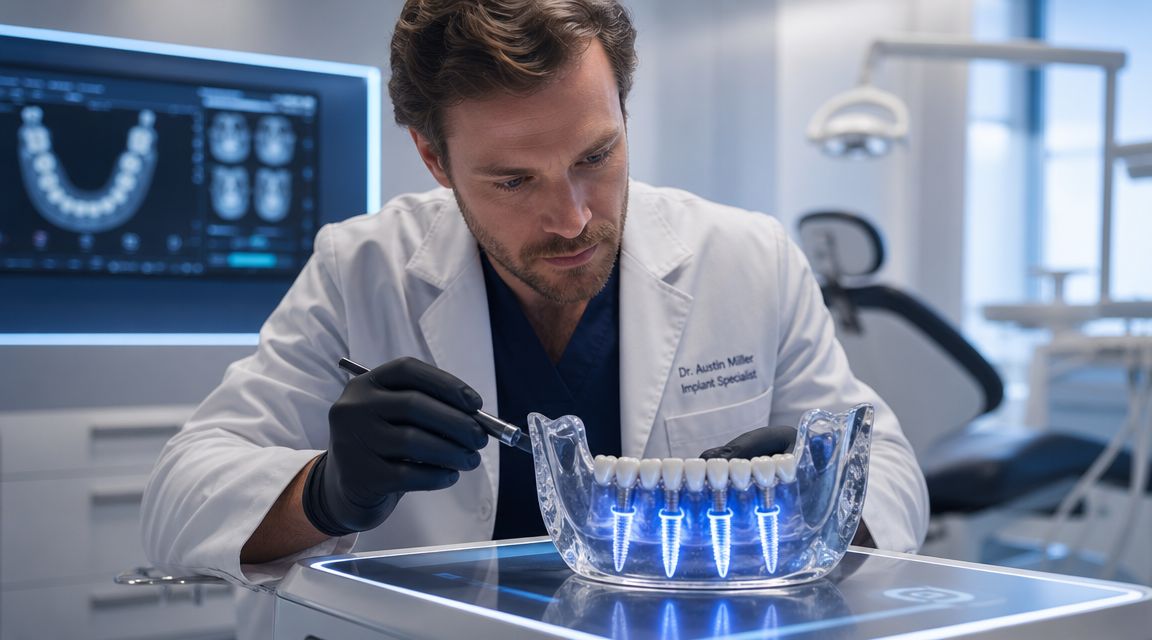
All-on-4 dental implants are a way to replace a full upper or lower arch of teeth using four implants as anchors for a fixed restoration. Instead of placing one implant for every missing tooth, the dentist uses a small number of strategically positioned implants to support a complete set of replacement teeth.
A simple way to picture it is a bridge resting on four strong supports. You don't need a separate support under every part of the bridge if the foundation is planned well.
Two implants are usually placed toward the front of the jaw, where bone is often more available. The two back implants are commonly tilted, which helps the dentist use available bone efficiently and create support for the full arch. The result is a stable, non-removable set of teeth for people who are missing most or all teeth in that arch.

This approach is different from replacing teeth one by one. It's built for full-arch restoration. That's why it often appeals to people who are tired of dentures, facing multiple extractions, or trying to avoid a long series of separate procedures.
Many individuals ask some version of these questions:
| Question | Plain-language answer |
|---|---|
| Is it removable? | No. The restoration is fixed in place by the dental team. |
| Does it replace one tooth or many? | It replaces a full arch, not a single missing tooth. |
| Is it meant to look natural? | Yes. The goal is a full smile that looks balanced and feels secure. |
| Is it only for denture wearers? | No. It can also help people with multiple failing or missing teeth. |
Practical rule: All-on-4 is usually about replacing an entire row of teeth with one stable solution, not repairing one isolated gap.
This treatment gained attention because it offers efficiency without giving up long-term reliability. A summary of the published literature reported a 99.2% success rate at 10 years in one long-term study and a 94.8% survival rate at 15 years in another, as discussed in this review of long-term All-on-4 success rates.
That doesn't mean every patient has the same experience. It does mean the treatment has a serious clinical track record and isn't just a trend.
For many people, the biggest benefit is simple. Their teeth stop feeling like a problem they have to manage every day.
Not everyone who wants All-on-4 is automatically a candidate, but many more people qualify than they expect. Patients often assume they're “too old,” have “too much bone loss,” or have waited “too long.” Those concerns are common, and a proper evaluation often gives a clearer answer than guesswork.
This treatment is frequently considered by patients who are:
Age by itself usually isn't the key question. Your overall health, healing ability, gum condition, and treatment goals matter more than the number on your birthday.
A consultation usually focuses on a few practical areas:
The dentist checks the health of your gums, remaining teeth, bite, and jaw structure. If you still have teeth, the question is whether those teeth are healthy enough to keep or whether full-arch replacement makes more sense.
Some patients assume bone loss rules them out. Often, it doesn't. Because the All-on-4 concept is designed to use available bone strategically, it may help patients who aren't ideal candidates for more traditional tooth-by-tooth implant plans.
Healing matters. Smoking, uncontrolled health conditions, and inconsistent home care can affect the outcome of implant treatment. That doesn't automatically close the door, but it does change the conversation.
A good candidate isn't just someone who wants new teeth. It's someone who can heal well and commit to caring for them.
Here are a few fears that come up often:
“Am I too old?”
Many adults seek implant care later in life. What matters is whether treatment is safe and appropriate for your health.
“What if my teeth are in bad shape?”
That's often the reason people explore this option in the first place.
“What if I have dental anxiety?”
Anxiety is common, especially for patients who have had difficult dental experiences before. A supportive office and sedation options can make a big difference.
“Do I need to know for sure before I book?”
No. The consultation is where the details become clear.
You don't need to diagnose yourself. You only need to know what isn't working anymore. Maybe your dentures feel loose. Maybe your teeth hurt, break, or keep needing repair. Maybe you want one clear plan instead of ongoing patchwork dentistry.
That is enough to start the conversation.
For most patients, the hardest part is not the procedure itself. It's the uncertainty before it begins. Once the sequence is clear, the treatment tends to feel much more manageable.
Your journey starts with a consultation and detailed examination. Dr. Jody Bardash reviews your oral health, your goals, and whether a full-arch approach fits your situation. This is the appointment where patients usually ask the biggest questions about comfort, timing, healing, and what their final smile may look like.
Advanced planning matters here. The practice uses imaging and digital tools to study your jaw structure, implant positions, and bite so treatment can be mapped carefully before surgery.
To understand the pacing of implant treatment more broadly, many patients find this guide to the dental implant timeline helpful.

If remaining teeth need to be removed, that can often be coordinated as part of the treatment plan. On surgery day, the implants are placed in carefully selected positions. In the All-on-4 protocol, the two posterior implants are commonly tilted about 30° to 45° to use available bone effectively and avoid nearby anatomy, and immediate provisionalization depends on reaching primary stability in the 35 to 45 Ncm insertion torque range, as described in this prosthodontic review of the All-on-4 protocol.
That sentence sounds technical. In everyday language, this means the implants must be stable enough at placement to support the next phase safely. Position and stability are not guesses. They are central to why this treatment works.
A temporary bridge is often placed soon after surgery, so patients don't leave without teeth. That temporary restoration lets you smile and function during healing while the implants integrate with the jaw.
Here is a short overview of what patients often experience:
Consultation and records
Exam, imaging, discussion of goals, and treatment planning.
Any needed extractions
If damaged teeth remain, they may be removed as part of the surgical visit.
Implant placement
Four implants are placed in the arch using the surgical plan.
Temporary teeth
A provisional set is often attached so you can leave with a functional smile.
This overview video can help you visualize the process:
Healing takes patience. During this period, the implants fuse with the bone and your temporary teeth protect appearance and function. You'll have follow-up visits so the team can check healing, answer questions, and make sure everything is progressing as expected.
After healing, the temporary restoration is replaced with the final prosthesis. For many patients, this is the moment the treatment feels fully real. The final smile is designed for fit, strength, function, and appearance.
Most anxiety drops once patients understand that the process is planned in stages, not rushed in one confusing day.
Comfort also matters throughout this journey. If you're nervous about treatment, sedation dentistry may be part of the conversation, especially when extractions and implant placement happen together.
Choosing between full-arch options isn't only about teeth. It's about daily life. You want to know how something will feel at breakfast, during conversation, at a family dinner, and years from now when maintenance becomes part of the routine.
People often choose All-on-4 because they want a smile that feels more secure than a removable denture. They don't want adhesive, clicking, or the worry that teeth may shift while eating or talking.
The method is also designed to be efficient. A systematic review found an implant survival rate of 99.8% for follow-up periods longer than 24 months, and the lowest reported success rate among the reviewed studies was 94.8% at 10 years, according to this systematic review on PMC. That same review notes that the technique was developed to support immediate implant-supported restorations with less morbidity than more staged approaches and may avoid regenerative procedures that increase cost and treatment time.

| Option | What patients often like | What patients often find difficult |
|---|---|---|
| All-on-4 implants | Fixed in place, stable, designed for full-arch replacement | Requires surgery, healing time, and long-term maintenance |
| Traditional dentures | Removable, familiar option for many patients | Can slip, feel bulky, and require adhesives |
| Implant-retained dentures | More stable than regular dentures | Still removable, so they don't feel the same as fixed teeth |
| More extensive implant plans | May suit certain complex cases | Can involve more implants, more surgery, and a different cost structure |
Traditional dentures still have a role. Some patients need a removable solution, at least for a period of time. Others may prefer a lower-commitment starting point before deciding on implants.
If you currently wear dentures, keeping them clean is still important while you weigh your options. A practical outside resource is this guide to best denture cleaning products, which walks through tools commonly used for daily denture care.
Fixed teeth and removable teeth solve the same problem in very different ways. The right choice depends on your goals, anatomy, comfort level, and budget.
For many adults, All-on-4 sits in the middle of the decision spectrum in a useful way. It can be more stable and more natural-feeling than removable dentures, while using fewer implants than some full-mouth alternatives.
That balance is why patients often ask about it when searching for a dentist in Fair Lawn NJ, a cosmetic dentist near me, or dental implants near me. They want function, appearance, and a plan that doesn't feel endless.
Cost is one of the first questions patients ask, and that's reasonable. All-on-4 treatment is a major decision. It isn't something chosen casually, and you deserve a clear explanation of what affects the fee and what support may be available.
The total cost depends on your clinical needs. Some patients need extractions before implants are placed. Others need more extensive planning, sedation, or different restorative materials for the final teeth. The complexity of your bite and whether one or both arches are being treated also matter.
That is why a real exam matters more than a generic online estimate.
For a closer look at the factors involved, this page on All-on-4 dental implants cost can help you understand what may shape the investment.

When people compare costs, it helps to compare the full picture. Ongoing repairs to failing teeth, repeated extractions, relines for dentures, broken appliances, and years of frustration also carry a cost. Many patients decide they would rather invest in a stable long-term solution than keep paying for temporary fixes.
Financing can make that decision easier. Dental Professionals of Fair Lawn offers financing options as part of its service mix, along with implant care, sedation dentistry, and digital treatment planning. For many patients, monthly payment options are what turn a “someday” treatment into a realistic next step.
All-on-4 isn't maintenance-free, but it also isn't mysterious. Daily care is straightforward once you learn the routine.
A long-term care plan usually includes:
Your new teeth may be fixed, but they still depend on healthy gums, clean surfaces, and regular follow-up. Patients who do well long term usually treat aftercare as part of the success of the procedure, not an afterthought.
By the time most patients schedule a consultation, they aren't just looking for information anymore. They're looking for clarity. They want to know whether this treatment can work for them, what it will involve, and whether they'll feel cared for through the process.
That local relationship matters. If you live in Fair Lawn, Ridgewood, or Glen Rock, having your implant dentist nearby makes follow-up care simpler and more reassuring. Questions don't feel like a burden when your care team knows your case and is part of your community.
A consultation should feel informative, not pressuring. You should expect a close look at your teeth, gums, bite, and jaw structure, along with time to talk through your goals and concerns. If you're nervous, that should be part of the conversation too.
Dr. Jody Bardash brings 30+ years of experience to that discussion, and the practice uses advanced tools such as facial scanning and digital planning to support precision. For patients considering a complex treatment like full-arch implants, that combination of experience and technology can make the process feel much more understandable.
Seeking a dentist near me, an emergency dentist, or a provider for restorative and cosmetic dentistry often means trying to solve two problems at once. They need treatment. They also need to feel confident about where they go for that treatment.
If you're curious how practices improve their visibility so local patients can find the right care, this AI Tools for Local SEO guide gives a helpful outside look at how local search works.
The important part for you as a patient is simple. You shouldn't have to figure this out alone. A good consultation gives you answers, a realistic plan, and a sense of whether the next step feels right.
If you're ready to learn whether All-on-4 treatment fits your needs, schedule a consultation with Dental Professionals of Fair Lawn. You'll get a personalized evaluation, clear guidance from Dr. Bardash and the team, and a practical plan for restoring your smile close to home in Fair Lawn.