3 Year Olds Teeth: A Parent's Guide in Fair Lawn, NJ
Worried about your 3 year olds teeth? Our Fair Lawn pediatric dental experts explain eruption, decay, and daily care. Schedule a gentle first visit today.
Worried about your 3 year olds teeth? Our Fair Lawn pediatric dental experts explain eruption, decay, and daily care. Schedule a gentle first visit today.

If you’re looking at your child’s smile and counting little teeth after bath time, you’re not alone. Many parents in Fair Lawn, Ridgewood, and Glen Rock reach this stage and start wondering the same things. Are all the teeth in yet? Is that gap normal? Why does brushing suddenly feel like a wrestling match? And if your child still sucks a thumb or wakes up cranky at night, is that affecting their mouth?
At age three, a lot is happening at once. Your child is talking more, eating more kinds of foods, and becoming much more opinionated about daily routines. Their teeth are part of that growth, but they can also become a source of worry fast. A small white spot, gum tenderness in the back, or a toothbrush refusal can leave parents searching for a dentist near me or a dentist in Fair Lawn, NJ who understands toddlers.
This guide is written the way I’d explain it to a parent in the exam room. Clear, calm, and practical. You’ll learn what’s typical for 3 year olds teeth, what deserves a closer look, and what kind of help is available locally when your child needs more than home care.
A parent in Fair Lawn notices their three-year-old grinning in the car seat and suddenly sees the back teeth have come in. That moment often brings two feelings at once. Pride, because your child looks so grown up. Concern, because now you’re wondering whether everything is developing the way it should.

Some parents are worried about cavities. Others are stuck on brushing battles, thumb-sucking, or a child who says “ow” when chewing on one side. Many just want reassurance that the spacing, shape, and timing of their toddler’s smile are normal.
At this age, concerns tend to be very everyday and very real:
Most toddler dental worries are easier to handle when parents get answers early, before a small issue turns into pain or fear.
Families often want a local office that can handle routine dental care, new patient exams, and the occasional urgent concern without making the experience stressful. They may also be thinking ahead about future needs like Invisalign, tooth extraction, emergency dentist visits, or even cosmetic care for older family members. But with a three-year-old, the immediate need is simple. You want someone who can explain what you’re seeing and help your child feel safe.
That’s where a child-focused visit in Fair Lawn can make a big difference. A good toddler exam isn’t only about counting teeth. It’s about spotting early signs of decay, checking how the bite is forming, and helping your child build comfort with dental visits from the beginning.
By this age, many parents want a straight answer. How many teeth should my child have? The usual milestone is a complete set of 20 primary teeth, with 10 in the upper jaw and 10 in the lower jaw, and the last teeth to arrive are usually the second molars, which typically erupt between 23 and 33 months according to the Better Health Channel timeline for children’s teeth.
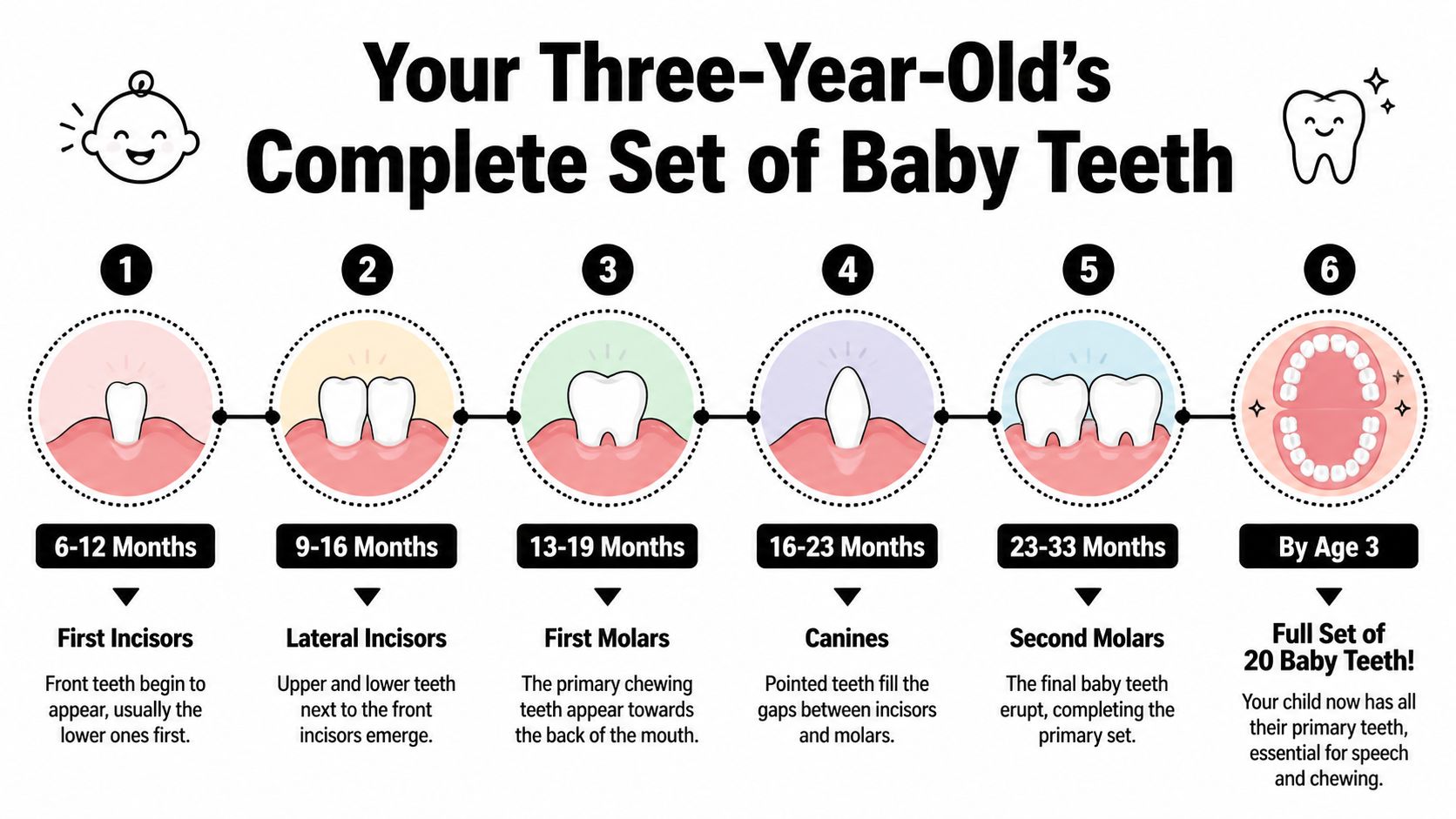
That sounds very exact, but real children don’t read charts. Some finish earlier. Some take longer. What matters most is the general order and whether the mouth looks healthy as those teeth come in.
Most children follow a predictable pattern:
Parents often get nervous when one tooth comes in before its match on the other side. Mild variation can still be normal. The sequence is usually more helpful than the exact day or month.
A full set doesn’t just mean your child can chew more foods. These teeth help with speech, facial development, and holding space for the larger permanent teeth that come later. Baby teeth also tend to look whiter than adult teeth, and small spaces between them are often a good sign because they leave room for future growth.
Practical rule: Spaces between baby teeth are often healthy. Crowding in very small mouths is more likely to need monitoring than gaps are.
Some parents like simple memory tools when they’re trying to make sense of all this. If you enjoy tracking milestones beyond teeth, resources on understanding child development stages can help you place dental growth in the bigger picture of toddler development.
If you want a more detailed look at tooth count and timing, our page on how many baby teeth children have is a helpful next read.
Call for an evaluation if your child’s mouth seems uncomfortable, a tooth looks discolored, the gums are swollen, or the overall eruption pattern seems very delayed. A parent’s instinct matters here. If something looks off to you, it’s worth getting checked.
Three concerns show up again and again with toddlers. Decay, discomfort from the last molars, and oral habits such as thumb-sucking or frequent pacifier use. Each one can look small at first, but each affects the way a child eats, sleeps, and cooperates with brushing.

Tooth decay in toddlers rarely begins with a dramatic hole. Parents are more likely to notice chalky white spots, a small brown area, food packing around back teeth, or a child who suddenly dislikes brushing one area. Since baby teeth are more delicate, changes can progress faster than parents expect.
A common point of confusion is whether weak enamel is always caused by poor brushing. It isn’t. Nutrition can play a role. A 2025 study in Pediatric Dentistry found that toddlers with low vitamin D levels had a 3x higher risk of weak enamel, which was linked with more decay by age 5, and some areas in New Jersey show higher rates of this issue according to this discussion of nutrition and weak enamel in toddlers.
Those final back teeth often arrive when parents think teething is already over. A child may drool more, rub the back of the jaw, wake during the night, or become picky about crunchy foods. Because the molars sit farther back, kids may not be able to point to what hurts. They just seem out of sorts.
Not every habit means a future orthodontic problem. Still, by age three, ongoing pressure from a thumb or pacifier can start changing how teeth sit together. You may notice front teeth that don’t meet well, a bite that looks open, or changes in the shape of the upper arch.
Here’s a simple way to think about common concerns:
| Concern | What parents may notice | Why it matters |
|---|---|---|
| Cavities | White, brown, or rough spots | Can lead to pain and harder brushing |
| Back molar eruption | Fussiness, gum tenderness, chewing changes | Can affect eating and sleep |
| Oral habits | Front teeth shifting or bite changes | May influence future alignment |
If your child seems uncomfortable during brushing or chewing for more than a brief phase, that’s a good reason to schedule an exam.
Daily care is where parents make the biggest difference. That’s true even when your toddler acts like brushing is the most unreasonable request ever made. Because primary teeth have thinner enamel than permanent teeth, they’re more vulnerable to decay, and early home care matters, as explained in this Medical News Today baby teeth overview.

At age three, your child still needs hands-on help. They can practice, but an adult should finish the job.
Many parents do better with a consistent routine than with perfect technique. Same time. Same spot in the bathroom. Same short script. Toddlers respond well to repetition.
Try position changes before buying new gadgets. Some children cooperate better standing at the sink. Others do better lying back with their head in a parent’s lap so the mouth is easier to see.
A few practical tricks often help:
For parents who like extra tips on household habits that can improve oral health, it can also help to keep your child’s toothbrush clean, easy to find, and part of a predictable routine.
This short video can help you picture what calm, guided brushing looks like at home.
A cooperative child doesn’t always have clean teeth, and an uncooperative one doesn’t mean you’re failing. Most parents need practical adjustments, not perfection. If brushing is consistently painful or impossible, that can point to sore gums, a cavity, or sensitivity worth checking.
Brushing matters, but food and drink choices shape your child’s risk every day. The goal isn’t to create fear around eating. It’s to make the mouth a less friendly place for decay and to support stronger enamel as your child grows.
A toddler’s snack pattern often matters as much as the snack itself. Frequent sipping and grazing give teeth fewer breaks. Offering meals and snacks on a routine can be gentler on the mouth than constant nibbling.
These habits usually help:
Parents also ask about enamel. If a child’s teeth seem rough, chalky, or easy to stain, nutrition deserves attention along with brushing. That doesn’t mean every child needs testing. It means diet belongs in the conversation.
Healthy dental habits aren’t only about avoiding problems. They help children eat comfortably, sleep better, and get used to routines that protect them for years.
Fluoride gives enamel extra support in a way your child’s toothbrush can’t fully replace. For some toddlers, especially those with early weak spots, frequent snacking, or a history of difficult brushing, a professional treatment adds another layer of protection.
Parents who want to learn how these visits work can review our information on fluoride treatments for children and adults. In practice, these appointments are usually simple and quick, and they fit naturally into preventive dental care.
If your child already has signs of early wear or possible decay, changing the snack routine can lower stress around future care. It’s much easier to preserve a baby tooth than to restore one after pain starts. That’s why diet, preventive visits, and cleanings and exams belong together.
For many parents, the hardest part is not the exam itself. It’s the uncertainty before the appointment. Will my child cry? Will they sit still? Will the dentist find something serious?
A well-run toddler visit is usually gentle, brief, and very focused. At age three, a child typically has a full set of 20 primary teeth, and an exam at this stage is important for establishing a baseline, checking spacing, evaluating occlusion, and considering preventive fluoride varnish, according to the Delta Dental timeline for primary teeth.

A three-year-old’s appointment usually moves in a simple rhythm.
| Visit stage | What happens |
|---|---|
| Arrival | Your child gets time to settle in and observe the room |
| Exam | Teeth, gums, spacing, and bite are checked gently |
| Preventive care | Cleaning or fluoride may be recommended |
| Parent guidance | You get practical home-care advice based on what your child needs |
Children don’t need to perform perfectly for the visit to be useful. Even a short exam can show a lot about the health of the teeth and gums.
The exam is about more than cavities. A dentist may look at:
Some offices also use digital tools to make exams easier. For example, iTero digital scanning can help capture a clear view of the teeth without the mess and discomfort many parents remember from older dental impressions.
A toddler visit is successful when your child leaves feeling safe and you leave with a clear plan.
That kind of baseline is useful whether your child only needs preventive care now or may need closer monitoring later for alignment, restorative dentistry, or changing bite patterns.
Parents often relax during the exam, then tense up again when they ask the next question. What if you find a cavity? That concern is completely understandable. The good news is that toddler treatment today is built around comfort, short appointments, and preserving trust whenever possible.
Care depends on what’s happening. A small area may need monitoring or preventive support. A cavity may need a tooth-colored filling. A badly damaged tooth may need more involved care. The right plan depends on your child’s age, comfort level, and how much treatment is needed.
What matters most is avoiding the idea that treatment has to be scary. It doesn’t. Children respond well when the room feels predictable and adults around them stay calm.
For anxious toddlers, comfort measures can make needed dental care possible without turning the experience into a struggle. Sedation dentistry is one option some families consider when a child is fearful, very young, or unable to tolerate treatment comfortably. It can help protect both the child’s teeth and the child’s relationship with future dental care.
Dental Professionals of Fair Lawn provides sedation dentistry as part of its broader family care services, along with preventive and restorative treatment options for children and adults.
Some dental visits also raise bigger questions about breathing, jaw growth, and sleep. Emerging 2025 to 2026 data suggests that sleep-disordered breathing in 10 to 15 percent of toddlers can contribute to asymmetric jaw growth and crooked teeth, and that early dental screening can help identify issues sooner, as described in this review of mouth breathing, sleep-disordered breathing, and crooked teeth in children.
Parents might notice open-mouth sleep, noisy breathing, or a child who always seems tired and restless. Those signs don’t automatically mean a dental problem, but they’re worth mentioning. Sometimes the mouth gives early clues about a broader airway issue.
Parents usually want fast, clear answers at this point. These are three of the questions I hear most often about 3 year olds teeth.
| Question | Answer |
|---|---|
| My toddler chipped a tooth or is suddenly crying with mouth pain. Is this an emergency? | It can be. If there’s swelling, bleeding that won’t stop, clear pain with chewing, or your child won’t let you near the area, call right away for guidance. Keep your child calm, offer water, and avoid very hot, cold, or hard foods until they’re seen. |
| Why do baby teeth matter if they’re going to fall out anyway? | Baby teeth help children chew, speak clearly, and hold space for adult teeth. They also affect comfort and confidence. A painful or infected baby tooth can disrupt sleep, meals, and daily routines. |
| When will my child start losing these teeth? | Most children begin losing baby teeth around the early school years. It usually starts with the front teeth, not the back molars. If a baby tooth looks loose much earlier after an injury or decay, it should be evaluated. |
If you’ve been watching a spot, a habit, or a brushing struggle for a while, ask whether it’s getting better, worse, or just staying unresolved. When a concern lingers, an exam is usually more reassuring than more internet searching.
For many families in Fair Lawn, Ridgewood, and Glen Rock, the biggest relief is having one office to call for routine dental care, emergency dentist concerns, dental x-rays when needed, and future care as children grow into orthodontic conversations like Invisalign or Six Month Smiles. That continuity matters.
If you’d like a calm, child-focused evaluation for your toddler, Dental Professionals of Fair Lawn offers new patient exams and family dental care for Fair Lawn, Ridgewood, Glen Rock, and nearby New Jersey communities. If your child has tooth pain, brushing struggles, possible cavities, or you want reassurance that development looks healthy, schedule a visit and get clear answers specific to your child.