How Many Baby Teeth: A Complete Guide
Learn how many baby teeth your child should have. Our pediatric dental team explains the timeline, crucial care tips, and when to see a dentist.
Learn how many baby teeth your child should have. Our pediatric dental team explains the timeline, crucial care tips, and when to see a dentist.

Your baby’s first tooth often appears without much fanfare. One day you’re wiping a gummy smile, and the next you feel a tiny sharp edge against the spoon.
That moment brings a lot of questions. Is this early? Is this late? How many baby teeth are there supposed to be? And if your child seems uncomfortable, is that normal or should you call a dentist in Fair Lawn, NJ?
Parents in Fair Lawn, Ridgewood, and Glen Rock ask these questions all the time. They’re good questions. Baby teeth follow a general pattern, but real children don’t always follow the calendar perfectly, which is why clear guidance matters.
For many new parents, baby teeth can feel confusing fast. The first tooth is exciting, but then the practical concerns start. Your child is drooling more. Sleep is off. Brushing feels awkward. You’re trying to decide whether you need a family dentist near me now, or if it can wait.
In everyday practice, the same concerns come up again and again. A parent notices only a few teeth at the first birthday and worries their child is behind. Another sees teeth coming in quickly and wonders if that’s normal. Someone else spots a dark mark and hopes it’s “just a stain.”
All of that is understandable.
A simple way to think about baby teeth is this. There is a typical pattern, and then there are normal variations around that pattern. Most children follow the general order pretty closely, but the exact timing can shift from child to child.
Practical rule: A teething chart is a guide, not a test your child has to pass.
What matters most is not whether every tooth arrives on the exact same week as a chart. What matters is whether your child’s mouth is developing in a healthy way, whether the teeth are being kept clean, and whether a dentist is monitoring anything that looks delayed, crowded, or uncomfortable.
Parents also get mixed messages online. Some articles give one quick answer and stop there. That’s not very helpful when you’re trying to understand what’s normal for your own child.
If you’re searching for how many baby teeth your child should have, the answer starts with a standard number. Then it gets more personal from there.
Most children grow 20 baby teeth. That full set includes 8 incisors, 4 canines, and 8 molars, with 10 teeth on top and 10 on the bottom.
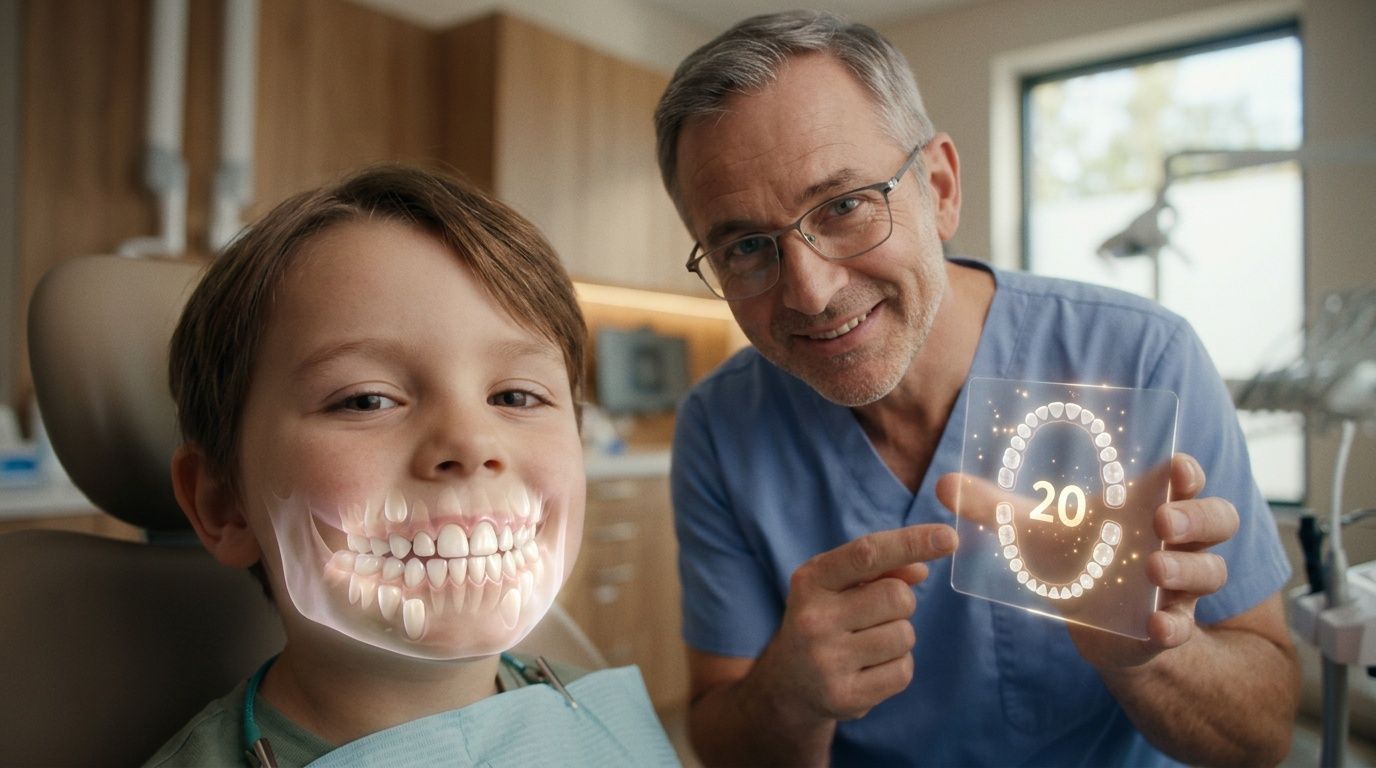
For parents, that number helps because it gives you a clear target. If your toddler has a mouth full of tiny teeth and you are losing count during brushing, the usual end point is 20.
Baby teeth have real jobs to do. They help children bite into food, chew comfortably, form words clearly, and keep the right amount of room open for the permanent teeth that will follow. If you picture them like placeholders in a parking lot, each baby tooth helps guide the next tooth into its proper space.
Here’s the basic breakdown:
That is the standard pattern. Individual children can still vary.
A child may have fewer baby teeth if one or more never formed. This is called primary teeth agenesis, and it has been reported in 1.1 to 10% of children globally, according to a review of primary teeth agenesis published by the NIH.
Some children also develop extra teeth or have teeth that erupt in an unusual position. In a real exam, those situations are less about memorizing a chart and more about checking whether the mouth is developing in a healthy, comfortable way.
If the count seems off, an exam gives you answers faster than watching and wondering.
For families in Fair Lawn, Ridgewood, and Glen Rock, that is often where a local visit becomes helpful. If a parent is worried about crowding, a tooth that seems missing, or a child who is nervous about being examined, we can evaluate what is happening and choose the gentlest next step. Digital tools such as Itero scanning can help us look at spacing without messy impressions, and sedation dentistry may be an option for children who need extra support staying relaxed during care.
A lot of Fair Lawn parents notice the same thing. One week their baby has a gummy smile, and before long there is a tiny front tooth showing up during breakfast.
That change often starts around 6 months, and many children have several baby teeth in place by their first birthday. By about age 3, the full set is usually there. The American Dental Association chart for baby tooth eruption and shedding is a helpful reference if you want to compare your child’s pattern with the usual age ranges.
A visual timeline can make this much easier to follow.
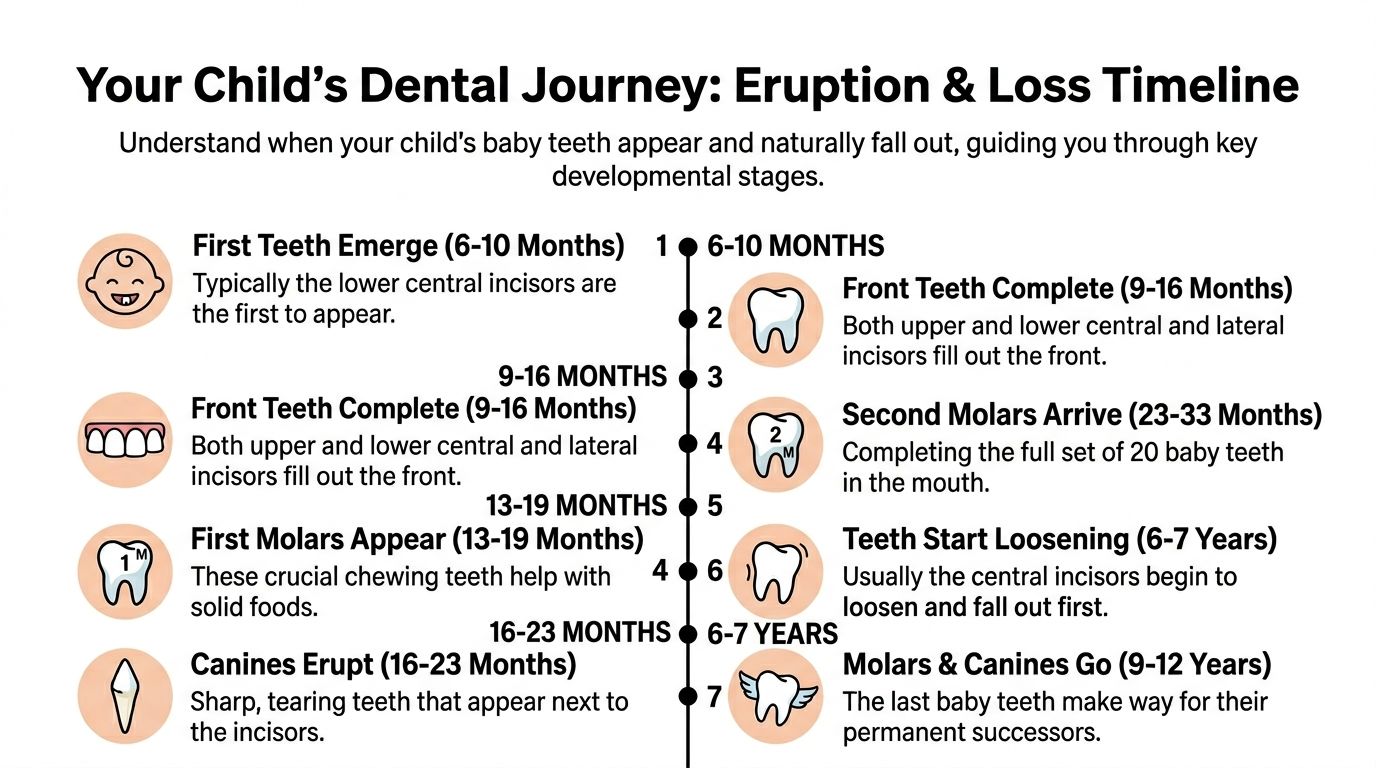
Teeth tend to arrive in a fairly predictable sequence, even when the exact month differs from child to child. The lower central incisors, the two bottom front teeth, often come in first. After that, the other front teeth usually appear, then the first molars, then the canines, and finally the second molars.
You can picture it like rows filling in from the front and then the back, rather than every tooth arriving one by one in perfect symmetry.
| Tooth Type | Upper Teeth Erupt | Upper Teeth Shed | Lower Teeth Erupt | Lower Teeth Shed |
|---|---|---|---|---|
| Central incisors | 8 to 12 months | 6 to 7 years | 6 to 10 months | 6 to 7 years |
| Lateral incisors | 9 to 13 months | 7 to 8 years | 10 to 16 months | 7 to 8 years |
| First molars | 13 to 19 months | 9 to 11 years | 14 to 18 months | 9 to 11 years |
| Canines | 16 to 22 months | 10 to 12 years | 17 to 23 months | 9 to 12 years |
| Second molars | 25 to 33 months | 10 to 12 years | 23 to 31 months | 10 to 12 years |
Some parents prefer to watch a quick visual explanation instead of reading a chart. This video can help.
The shedding phase usually begins around the early school years, often with the same front teeth that arrived first. Back teeth tend to stay longer. It is common for one side to loosen before the matching tooth on the other side.
Pattern matters more than perfect timing.
A child who is a little early or a little late is often still within a healthy range. What gets our attention is a pattern that looks far outside the usual sequence, a tooth that seems stuck, or crowding that makes cleaning hard. If a baby tooth is lost too early, the nearby teeth can start drifting, which is why parents sometimes benefit from learning how space maintainers can help protect room for adult teeth.
For families in Fair Lawn, Ridgewood, and Glen Rock, an exam can turn a confusing chart into a clear plan. If spacing looks tight or your child is anxious about treatment, we can check development gently, use iTero scanning to look at spacing without messy impressions, and talk through comfort options, including sedation dentistry when that level of support makes sense.
A common moment in our Fair Lawn office goes like this. A parent points to a small tooth with a new cavity and says, “It’s okay, that one will fall out anyway.”
I understand the instinct. Baby teeth are temporary, but their job is not small.
Baby teeth help your child bite into food, chew without discomfort, and form certain sounds as speech develops. They also act like natural placeholders, keeping room for the adult teeth growing underneath. If one is lost too early, the neighboring teeth can start shifting into that space, which may create crowding or change the path of the permanent tooth.
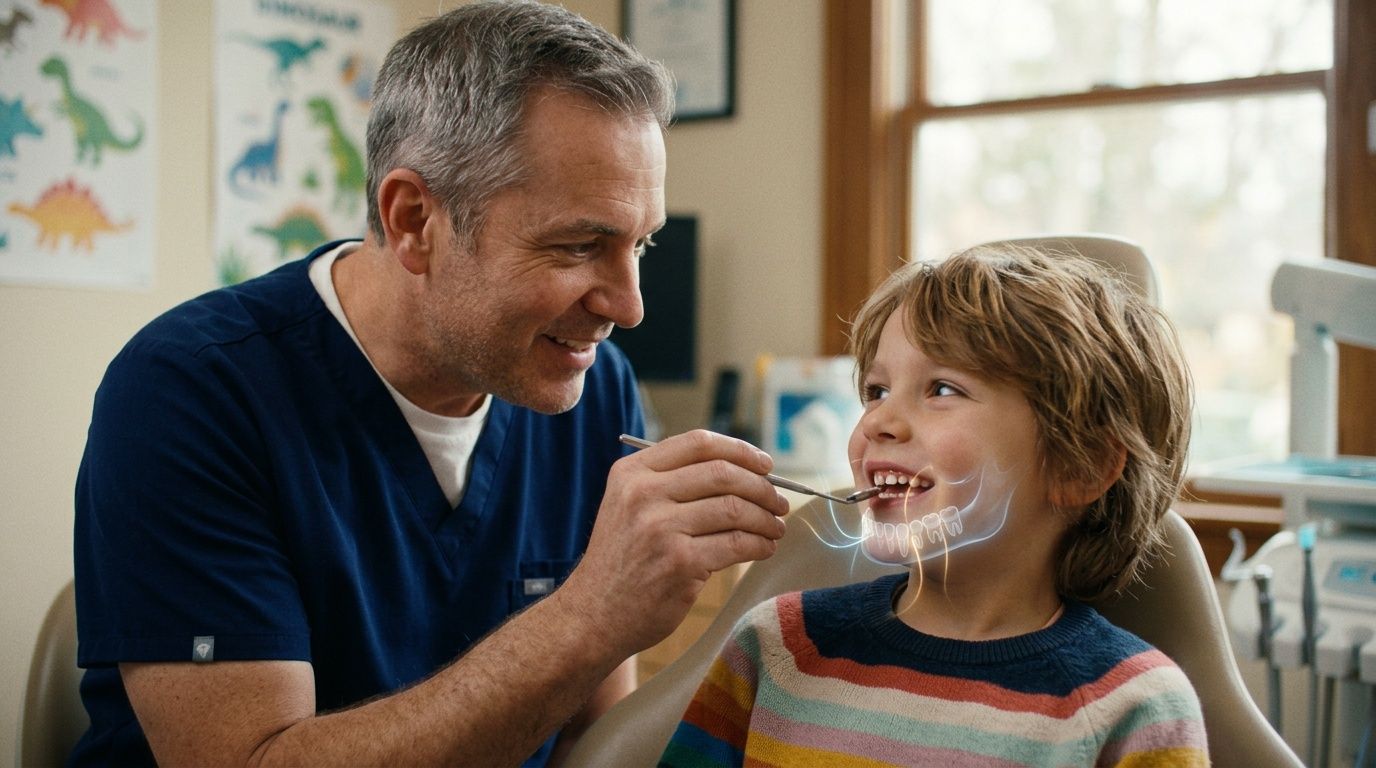
Front baby teeth help with biting and with sounds that need the tongue and lips to meet the teeth correctly. Back baby teeth do the heavy chewing, which matters as children move from softer foods to a wider range of textures.
They also help the jaws develop in a balanced way. A full set of healthy baby teeth gives the mouth a steady framework while your child grows, much like the temporary framing in a house keeps everything in the right place until the final structure is ready.
The permanent teeth are already developing below the gums long before you can see them. Baby teeth guide that process. When one comes out too soon because of decay or injury, the teeth nearby may tip or drift, and the space meant for the adult tooth can shrink.
That is why dentists sometimes recommend space maintainers to preserve room for permanent teeth. For families in Fair Lawn, Ridgewood, and Glen Rock, catching that change early can make future treatment simpler and less stressful.
Healthy baby teeth help build the path for a healthy adult smile.
They also deserve treatment for a more immediate reason. Cavities in baby teeth can hurt, affect eating and sleep, and make children wary of dental care. Early visits let us spot small problems before they become bigger ones, and if a child feels nervous, our Fair Lawn team can talk through gentle options, including iTero scanning for a clear look at spacing and sedation dentistry when added support is appropriate.
A common Fair Lawn parent question sounds like this: “My child is not complaining, so do we really need to come in yet?” In many cases, yes. Baby teeth can develop problems unnoticed, and early care is often simpler for both children and parents.

Tooth decay is one of the most common reasons parents bring young children to the dentist. The CDC explains that cavities in children are common and can affect eating, speaking, learning, and sleep, which is why it helps to spot small changes early in care from CDC guidance on children’s oral health.
The first signs are often easy to miss. You might see a chalky white spot near the gumline, a brown area in a groove, food catching in the same place, or a child pulling away during brushing.
A simple routine at home lowers the risk:
If a cavity does show up, treatment is usually more straightforward when we catch it early. Depending on the tooth and the size of the area, we may recommend a tooth-colored or mercury-free filling. Parents who want a clearer picture of what that process can look like can read our guide on how to treat cavities in baby teeth.
Toddlers fall. School-age kids trip on playgrounds, bump a tooth on a water bottle, or take an elbow during sports. It happens often, and it can feel alarming even when the tooth looks only slightly different.
The key question is not just “Did the tooth chip?” It is also “Will this change the space for the adult tooth that comes later?” Baby teeth hold places in the mouth the way labeled parking spots hold places in a lot. If one spot closes too soon, the next car has a harder time fitting where it belongs.
That is one reason we monitor injuries and early tooth loss closely for families in Fair Lawn, Ridgewood, and Glen Rock. If we need to check spacing, our iTero digital scanner helps us see the mouth in detail without the mess of traditional impressions. That can make follow-up visits easier for children who already feel uneasy after an injury.
Some children are cautious with anything new. Others have had a tough brushing experience at home and arrive already worried. Fear does not mean a child is misbehaving. It usually means the situation feels unfamiliar or too big.
Our job is to slow it down, explain what is happening in child-friendly language, and build trust one small step at a time. Many children do well with gentle coaching and a predictable routine. For children who need more support, sedation dentistry may be an appropriate option to help them receive care safely and with less distress.
Parents do not need a perfect routine. A steady one matters more.
A short, calm visit at the right time can prevent a longer, harder appointment later. That peace of mind matters to parents across Fair Lawn, Ridgewood, and Glen Rock, especially when they know their child’s care is delivered using gentle techniques and modern tools.
The first dental visit should feel simple, not intimidating. The American Academy of Pediatric Dentistry recommends a child’s first dental visit within six months after the first tooth erupts or by the first birthday, as explained in the AAPD policy on establishing a dental home.
Many parents are surprised by how gentle this appointment usually is. For infants and toddlers, the visit often focuses on looking at the teeth and gums, checking growth, reviewing brushing habits, and answering questions about teething, thumb-sucking, or feeding.
A child-friendly team usually uses a tell-show-do approach. That means the child sees an instrument, hears a simple explanation, and then experiences it gently.
That sequence matters. It lowers surprise, and lower surprise usually means lower fear.
If your child needs imaging or a closer look later on, practices that use tools like the iTero digital scanner can make the process more comfortable. Parents also appreciate when the office keeps things upbeat and moves at a pace the child can handle.
A good first visit is less about doing a lot and more about making the child feel safe.
For families looking for a dentist near me or a dentist in Fair Lawn, NJ, that first appointment often sets the tone for years of dental care.
If you’ve been wondering how many baby teeth your child should have, the short answer is usually 20. The more useful answer is whether your child’s teeth are coming in well, staying healthy, and getting the right support as they grow.
Families in Fair Lawn, Ridgewood, and Glen Rock don’t need to wait for a problem to become obvious. A routine exam can answer questions, ease anxiety, and help your child build a healthy relationship with dental care.
If scheduling is the hard part, a tool like this guide to the best shared calendar for families can make it easier to coordinate school, work, and appointments.
If you’re ready to book your child’s visit, contact Dental Professionals of Fair Lawn. Dr. Jody Bardash and the team provide family-friendly dental care for patients in Fair Lawn, Ridgewood, and Glen Rock, with a gentle approach, modern technology, and support for everything from preventive exams to pediatric concerns.