What Is Periodontal Disease Treatment: Discover Solutions
Discover what is periodontal disease treatment. Explore non-surgical & surgical options with Dental Professionals of Fair Lawn, your trusted NJ dentist.
Discover what is periodontal disease treatment. Explore non-surgical & surgical options with Dental Professionals of Fair Lawn, your trusted NJ dentist.
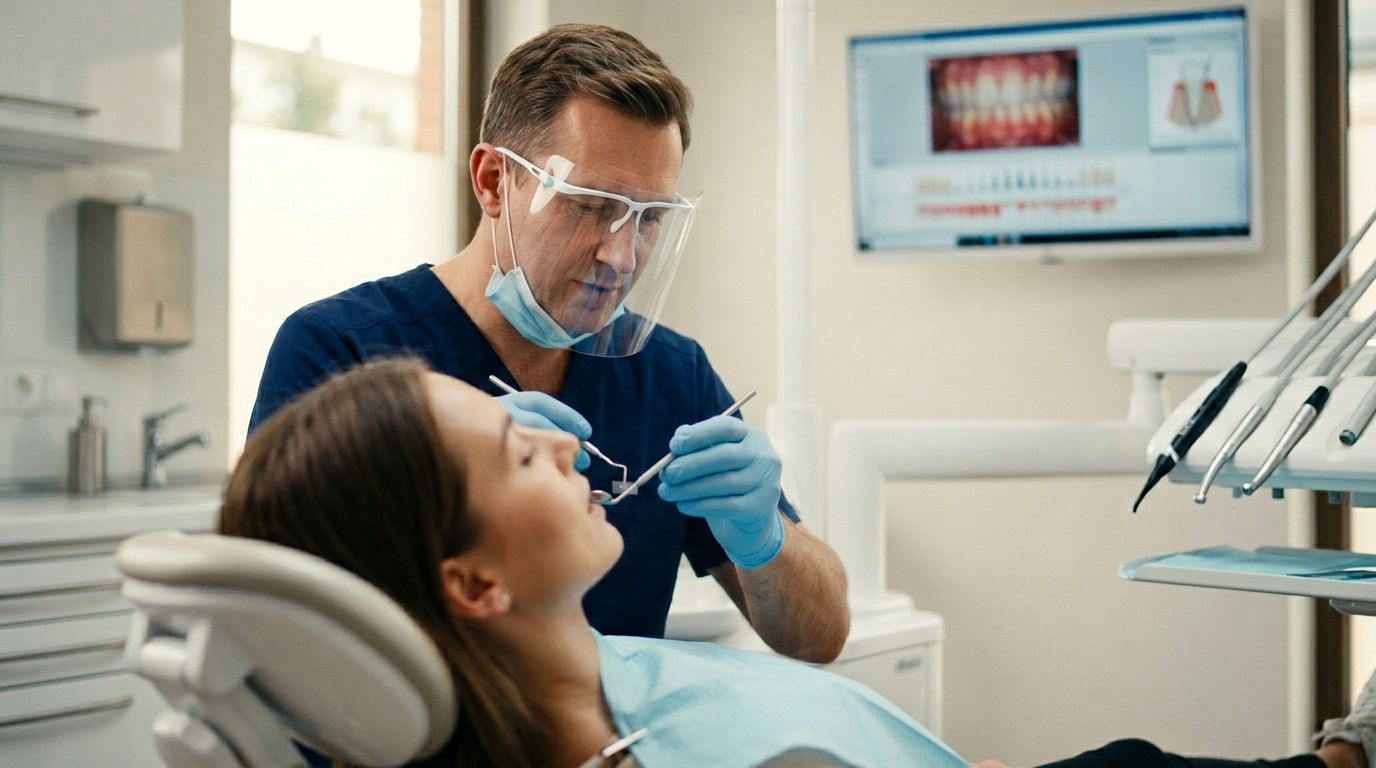
Bleeding when you brush. Breath that never feels fresh. Tender gums that seem a little puffy, even though nothing hurts badly enough to feel like an emergency. That’s often how gum disease starts.
Many people in Fair Lawn wait because the symptoms seem minor. They hope a better toothpaste or a few days of flossing will fix it. Sometimes early irritation does improve with better home care. But once infection moves below the gumline, the problem usually needs professional treatment.
If you’ve been searching for what is periodontal disease treatment, you’re probably not looking for a textbook answer. You want to know what’s happening, what can be done, whether it will hurt, and whether your teeth can be saved. Those are the right questions.
A patient might notice a little pink in the sink one week, then tenderness near one back tooth the next. Another may come in because a spouse mentions bad breath that doesn’t go away. Others say their teeth look “longer” than they used to, or food keeps getting trapped in places that never used to bother them.
Those small changes matter. Gum disease often progresses subtly.

People generally don’t start with, “I think I have periodontitis.” They start with practical concerns:
That’s why local access matters. A community practice can evaluate the gums, take the right images, explain options clearly, and help patients move from diagnosis to treatment without bouncing between multiple offices unless a referral is necessary.
A simple rule: bleeding that keeps happening is a reason to schedule an exam, not a reason to brush less.
In Fair Lawn, Ridgewood, and Glen Rock, patients often want a dental office that can address gum infection and also plan for the future. That may mean keeping natural teeth healthy. It may also mean discussing restorative dentistry, dental implants near me searches, or cosmetic improvements once the gums are stable.
For practices trying to communicate complex care in a patient-friendly way, resources on Dental Practice SEO can also help explain why clear, local education matters so much. Patients don’t search for jargon. They search for answers nearby.
The earlier gum disease is treated, the more conservative the treatment usually is. That can mean a deep cleaning instead of surgery, or maintenance instead of rebuilding tissue that has already been lost.
Good periodontal care should feel calm, specific, and understandable. Patients need to know what’s wrong, what works, and what the next step is.
Gum disease is an infection and inflammatory condition that affects the tissues holding teeth in place. It usually starts with plaque, a sticky bacterial film that collects around the gumline. If that film isn’t removed well enough at home and professionally, the gums react.
At first, the response may be mild. The gums look redder, feel swollen, or bleed during brushing. That early stage is gingivitis.

Gingivitis is the warning light. The irritation is in the gum tissue, but the deeper support around the tooth hasn’t been destroyed yet.
A useful way to think about it is this. Plaque acts like a film that keeps re-forming. If it stays in place, the gums remain irritated. If it’s removed thoroughly and consistently, the tissue often calms down.
Periodontitis begins when the problem goes deeper. The attachment around the tooth weakens, the gum pulls away, and spaces called pockets can form. Bacteria collect in those areas, where a toothbrush and floss often can’t fully reach.
That’s when the issue changes from surface inflammation to structural damage. Bone support can be lost. Teeth may loosen. Chewing can feel different.
Gum disease doesn’t only affect the visible gumline. In advanced cases, it affects the support system underneath the tooth.
A house foundation is a useful comparison. The crown of the tooth may still look serviceable for a while, but if the support underneath is breaking down, the whole structure becomes less stable.
Periodontal disease affects approximately 42.2% of U.S. adults aged 30 and older, and the prevalence rises to 70.1% in adults 65 and older, according to the National Institute of Dental and Craniofacial Research.
That matters because many adults assume gum disease is unusual or only happens if someone “neglects” their mouth. In reality, it’s common, and it can affect patients who brush every day but still need more targeted care.
| Sign | What it can mean |
|---|---|
| Bleeding when brushing or flossing | Inflamed gum tissue |
| Persistent bad breath | Bacterial buildup below the gumline |
| Gum recession | Loss of tissue support |
| Tooth sensitivity near the roots | Exposed root surfaces or recession |
| Loose teeth or bite changes | Advanced support loss |
The main point is simple. Gingivitis may be reversible. Periodontitis is managed, controlled, and stabilized. The sooner treatment starts, the more options patients usually have.
For many patients, treatment starts without surgery. That’s good news, because early and moderate cases often respond well to targeted cleaning below the gumline and close follow-up.
The core non-surgical treatment is scaling and root planing, often called a deep cleaning. It’s different from a routine cleaning because it reaches into infected pockets and removes hardened buildup and bacterial toxins from the root surfaces.
“Scaling” removes deposits from above and below the gumline. “Root planing” smooths the root surface so the gum has a cleaner surface to heal against.
A regular cleaning is designed for maintenance. A deep cleaning is designed to treat active disease.
Patients often ask whether this works. Non-surgical periodontal treatment can be highly effective, with success rates around 80 to 90% in controlling gum disease, and success for single-rooted front teeth can reach 85%, according to this review on success rates of periodontal treatment.
It is often a relief to learn that deep cleaning is usually very manageable. The area is numbed. Treatment may be done in sections so the mouth doesn’t feel overwhelmed. Afterward, mild tenderness, temperature sensitivity, or temporary soreness can happen, but patients generally return to normal quickly.
What matters more than bravado is precision. The infection has to be disrupted thoroughly, and the gums need time to respond.
Clinical reality: the goal isn’t to “scrape hard.” The goal is to remove what’s causing inflammation while keeping the process controlled and comfortable.
Not every case is treated the same way. Some mouths respond well to mechanical cleaning alone. Others need added help.
A non-surgical plan may include:
At a practical level, one option patients may review is the office’s information on scaling and root planing, which outlines how deep cleaning fits into periodontal therapy.
Here’s the honest trade-off. Non-surgical treatment works very well when disease is caught before deep structural destruction takes over. It works less predictably when pockets are very deep, molars have difficult root anatomy, or patients can’t maintain home care.
A few things don’t solve periodontal disease on their own:
After treatment, the gums are rechecked. Bleeding, pocket depth, and tissue tone tell us whether the disease is settling down. If the gums respond well, maintenance becomes the focus. If they don’t, a more advanced phase may be necessary.
That step is important because good periodontal treatment isn’t one procedure. It’s diagnosis, treatment, and reassessment.
Some patients need more than deep cleaning. That usually happens when the pockets remain too deep, bone loss is substantial, root surfaces are hard to access, or gum recession has exposed vulnerable areas.
In those cases, surgery isn’t a failure of earlier care. It’s the next logical step.

For Stage III periodontitis, initial treatment begins with oral hygiene instruction, risk factor review, and scaling and root planing, followed by reevaluation. When inflammation persists, surgical access may be needed. According to Dimensions of Dental Hygiene, advanced access can reduce subgingival bacterial load by over 90% and stabilize disease in approximately 80% of treated sites in this treatment pathway, as described in these periodontal therapy guidelines.
That tells patients something important. Surgery is usually recommended for a reason. It gives the clinician access that non-surgical instruments alone may not provide.
Not every advanced case needs the same procedure. The treatment depends on what has been damaged.
If deep pockets remain around teeth, the gum tissue may be gently opened so the roots and underlying surfaces can be cleaned directly. After the area is treated, the gum is repositioned to reduce pocket depth.
This approach is often chosen when the goal is infection control and easier long-term maintenance.
If bone support has been lost, rebuilding support may be part of the plan. Bone grafting is used to encourage the body to rebuild in areas where teeth or future implants need more stability.
Guided tissue regeneration may also be recommended in selected defects. The aim is to support regrowth in the right area rather than letting soft tissue collapse into the space too quickly.
When gums have receded, root surfaces may become sensitive and harder to protect. A soft tissue graft can thicken the tissue and cover exposed areas.
That can improve comfort and make the tooth easier to maintain.
Advanced periodontal care and implant planning often overlap. A patient may have one tooth that can be saved and another that cannot. Another patient may need bone grafting now so a dental implant can be placed later with better long-term support.
That’s where a complete office matters. A single treatment plan can consider infection control, gum stability, bone support, appearance, and future restorations.
Patients who want to understand one modern approach often read about laser treatment for gum disease pros and cons, especially when they’re comparing traditional and laser-assisted options.
Surgery for periodontal disease should have a clear purpose. Better access, cleaner root surfaces, improved maintenance, or preparation for reconstruction.
The biggest misunderstanding about advanced gum treatment is that surgery alone “fixes” the problem. It doesn’t. Surgical care can clean, reshape, and rebuild. But daily plaque control and maintenance visits determine whether those results last.
For severe disease, the best outcomes usually come from a combination of:
That’s how advanced periodontal treatment becomes restorative, not just reactive.
Periodontal treatment isn’t only about stopping infection. It creates the conditions for a mouth that feels stable, looks healthier, and functions the way it should.
When gums are inflamed, cosmetic dentistry and restorative dentistry become harder to plan well. Margins change. Tissues bleed. Patients often focus on the color or shape of teeth when the essential first step is creating healthy support.

A patient who wants teeth whitening, veneers, bonding, or a smile refresh often needs gum inflammation controlled first. A patient considering dental implants near me searches needs healthy surrounding tissue and a stable hygiene routine. Even orthodontic care like Invisalign or Six Month Smile moves more predictably in a healthier periodontal environment.
That’s why periodontal care sits at the foundation of so many other dental services.
Here’s what patients often gain once the gums are stable:
Some patients do everything right and still show a stubborn inflammatory response. In those cases, the body’s reaction can become part of the problem.
Adjunctive care may include host modulation therapy using low-dose doxycycline. This approach targets the inflammatory response rather than directly attacking bacteria, helping inhibit the enzymes that break down gum and bone tissue. It’s described in this periodontal disease management presentation.
That matters because treatment isn’t always just about removing buildup. Sometimes the body needs help calming the destructive part of its own response.
Some gum disease cases persist not because the patient failed, but because the inflammatory process remains too active.
A quick visual overview can help patients see how periodontal therapy supports long-term oral health.
Patients don’t usually say, “I want shallower pocket depths.” They say they want to eat comfortably, smile without embarrassment, and stop worrying that their teeth are getting worse.
That’s a reasonable goal. Treating periodontal disease can protect teeth, support future restorations, and restore confidence in a smile that feels clean, solid, and worth showing.
Most periodontal treatment journeys start with uncertainty. A patient calls because their gums bleed, or because another dentist mentioned bone loss, or because they searched for a dentist in Fair Lawn NJ who can handle more than a routine cleaning.
The first visit should answer questions before it creates more anxiety.
At the exam, the team checks the gums carefully, reviews symptoms, and looks for signs such as pocketing, inflammation, recession, mobility, and areas that trap plaque easily. Imaging may also be part of the evaluation when support loss or future restorative planning is a concern.
The important part isn’t just collecting information. It’s translating findings into a plan that makes sense.
A patient should leave knowing:
Many adults avoid gum treatment because they associate it with pain, noise, or long appointments. Sedation dentistry can make a major difference for anxious patients or for those receiving more involved care.
That can be especially helpful when someone has postponed treatment for a long time and now needs several procedures. Instead of forcing themselves through it with tension and dread, they can complete needed care in a more controlled state.
If fear has delayed your care, say that clearly at the first visit. It changes how the appointment should be planned.
Once the gums have responded and infection is under control, maintenance becomes the long game. Periodontal maintenance visits are different from routine cleanings because they focus on keeping treated sites stable and catching relapse early.
That ongoing relationship matters. Access to a full-service local dental office helps patients stay on schedule and avoid gaps in care. As broader research on dental workforce shortages notes, many communities still face barriers to care. The presence of a local practice can help bridge that gap for families around Bergen County, as discussed in this article on access challenges in dental care.
Periodontal disease responds best to consistency. The office that diagnoses the condition should also be able to monitor healing, adjust the plan, and coordinate related services such as restorative work, tooth extraction when needed, emergency dentist visits for acute issues, or planning for implants.
That kind of continuity makes treatment feel less fragmented and far easier to maintain.
If your gums bleed, feel tender, look swollen, or seem to be pulling away from your teeth, don’t wait for the problem to become obvious. Gum disease is easier to control when it’s treated early, and even advanced cases often have meaningful treatment options.
Patients in Fair Lawn, Ridgewood, and Glen Rock often want one thing most of all. A clear answer from a local office that can diagnose the issue, explain the options, and help them move forward without confusion.
If you’re trying to make dental appointments easier to keep once care is scheduled, practical resources on strategies to reduce no-show appointments can also help patients and families stay consistent with treatment plans.
A periodontal consultation gives you a starting point. It can show whether you need a deep cleaning, closer maintenance, surgical treatment, or a broader restorative plan. It can also help you understand how sedation, laser dentistry, and long-term follow-up fit into your care.
The most important step is the first one. Schedule the evaluation before more support is lost.
If you’re ready to get answers and protect your smile, schedule a consultation with Dental Professionals of Fair Lawn. Patients in Fair Lawn, Ridgewood, and Glen Rock can reach out for a personalized periodontal evaluation, discuss comfort options including sedation dentistry, and get a treatment plan built around lasting gum health.