Toddler Tooth Decay Treatment in Fair Lawn, NJ
Worried about your child's teeth? Learn about toddler tooth decay treatment options in Fair Lawn, NJ, and how our compassionate team can help.
Worried about your child's teeth? Learn about toddler tooth decay treatment options in Fair Lawn, NJ, and how our compassionate team can help.

You're brushing your toddler's teeth before bed, and you notice something that wasn't there before. Maybe it's a chalky white line near the gums. Maybe it's a tan or brown spot on a front tooth. Maybe your child pulls away when the brush touches one side of the mouth, and now you're wondering if it hurts.
That moment can feel surprisingly heavy. Parents often tell me their first thought is, “Did I miss something?” Their second thought is usually, “How on earth will my child sit still for dental treatment?” Both reactions are normal.
The good news is that toddler tooth decay treatment isn't one-size-fits-all. Some spots can be managed early and conservatively. Some cavities need a filling or crown. And for very young or uncooperative children, there are also lower-stress options that many parents haven't heard much about yet.
If you've noticed discoloration and aren't sure what it means, this guide on baby teeth brown spots can help you compare what you're seeing at home before your child is examined.
A worried parent in Fair Lawn might notice a mark on a toddler's tooth during breakfast. At first, it looks like a stain from berries or juice. By evening, it's still there. The child seems fine, then suddenly resists brushing that area. That's often when the concern shifts from “Maybe it's nothing” to “I need a dentist near me who sees young children.”
That concern makes sense. Tooth decay in very young children can move faster than many parents expect, and it doesn't always start with a dramatic hole in the tooth. Sometimes the earliest sign is subtle. Sometimes the first clear clue is behavior, like chewing on one side, refusing a cup that's too cold, or becoming fussy at bedtime.
Parents are usually trying to solve several problems at once:
A small spot doesn't always mean a small problem, but it also doesn't always mean your child needs drilling right away.
That middle ground matters. Many families searching for a dentist in Fair Lawn, NJ are not just looking for treatment. They're looking for someone who can explain what's happening in plain language and offer a realistic plan for a child who may be scared, wiggly, or too young to understand what's going on.
If you've found a suspicious spot, the most helpful first move is to stop guessing and get it checked. A clear exam helps answer the questions that keep parents up at night. Is this an early area that can be strengthened? Is the tooth already cavitated? Is your child at risk for pain or infection if you wait?
For families in Fair Lawn, Ridgewood, and Glen Rock, early evaluation matters because there are usually more options when decay is caught sooner. The goal isn't just to “fix a cavity.” It's to protect comfort, function, and your child's trust in dental care from the very beginning.
Early childhood tooth decay starts in baby teeth, often long before a child can explain that something feels wrong. A toddler may keep eating, playing, and smiling while the enamel is already weakening. That is part of what makes this diagnosis so upsetting for parents. The problem can look small from the outside and still deserve careful attention.
Baby teeth do important work every day. They help your child bite and chew, shape certain speech sounds, and hold space for the adult teeth that will come later. If a tooth breaks down too early, the effect is not limited to that one spot. Eating can become uncomfortable, brushing can turn into a struggle, and infection can develop if decay keeps moving deeper.
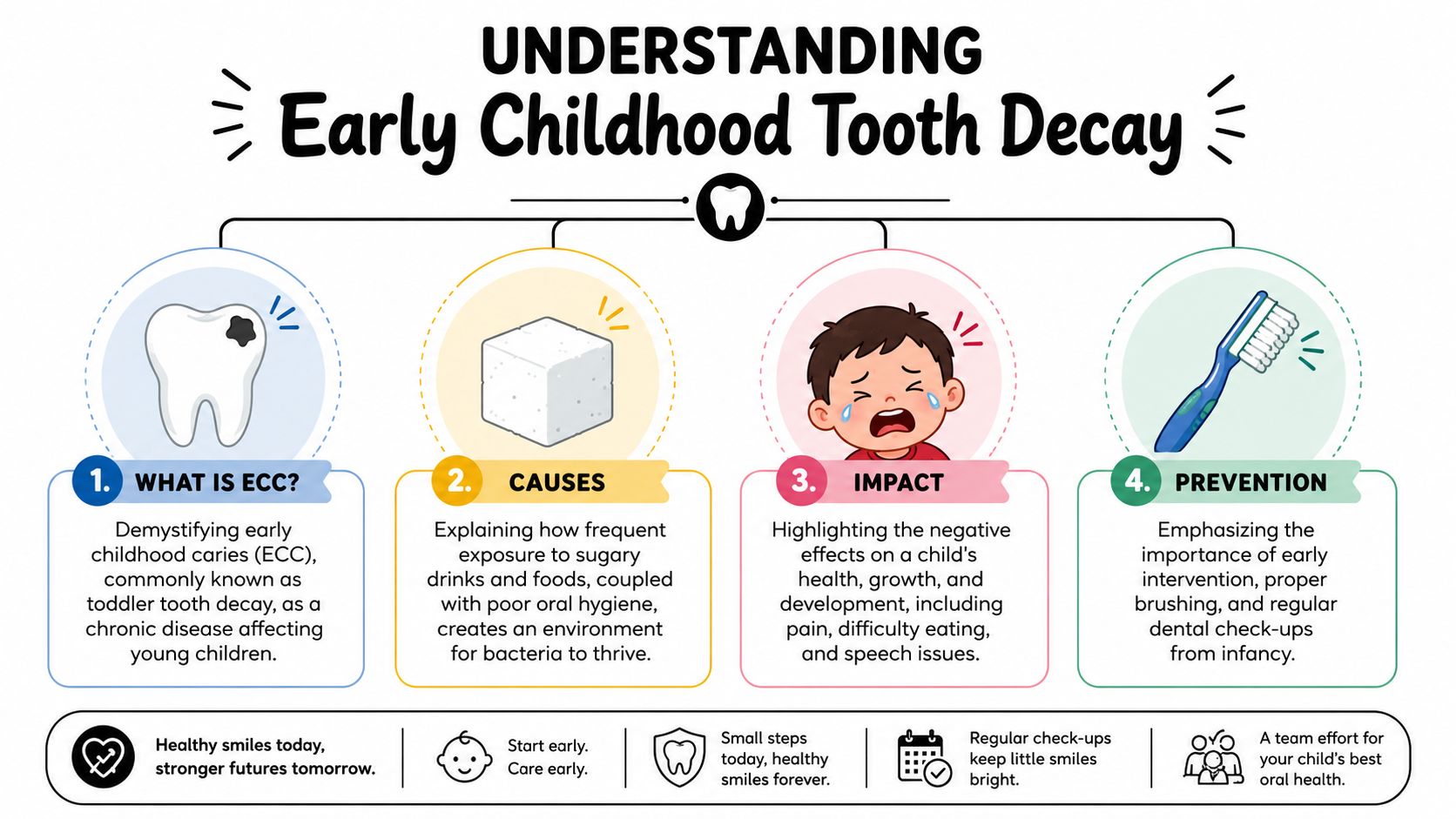
Cavities form through a repeated cycle. Plaque sits on the teeth. Bacteria in that plaque feed on sugars and starches from foods and drinks. Then those bacteria produce acid, and the acid pulls minerals out of the enamel.
That process works a lot like a sidewalk wearing down after many rainy, freezing days. One storm does not usually create a deep crack. Repeated exposure does.
Here is the same process in plain terms:
| What is happening | What it means for your toddler's teeth |
|---|---|
| Plaque builds up | Sticky bacteria stay on the tooth surface, especially near the gums and between teeth |
| Frequent carbohydrates reach the plaque | Milk, juice, crackers, snacks, and sweets give the bacteria fuel |
| Acid attacks the enamel again and again | The outer layer softens, first showing as a chalky area, then possibly becoming a hole |
The timing matters as much as the amount. A few sips of juice over an hour can expose teeth to acid longer than drinking it quickly with a meal. Falling asleep with milk or juice on the teeth can also raise risk because saliva flow drops during sleep, and saliva normally helps wash acids away.
Toddler teeth are smaller, and the enamel is thinner than it is on permanent teeth. Once a weak spot forms, there is less tooth structure for decay to travel through before it reaches the inner part of the tooth. That is one reason a white spot can turn into a brown area or cavity faster than parents expect.
Behavior plays a role too. Toddlers often graze, resist brushing, or clamp their mouths shut when a sore area is touched. None of that means you caused the problem. It means toddler dentistry has to account for real-life behavior, not just the cavity itself.
Parents often picture one standard solution: numb the tooth, place a filling, and move on. For older children, that may be realistic. For a very young, anxious, or highly uncooperative toddler, the plan sometimes needs to be more flexible.
Dentists choose care based on two things at the same time. One is the tooth. The other is the child in front of us.
That can include:
This wider range of options matters for families who have been told their toddler is "too wiggly" or "too scared." A good treatment plan should protect the tooth and protect your child's sense of safety.
Most parents don't miss obvious holes. What they miss are the earlier signs that don't yet look like a classic cavity. The visual changes usually happen in stages, and knowing those stages can help you decide how quickly to call an emergency dentist or schedule a new patient exam.
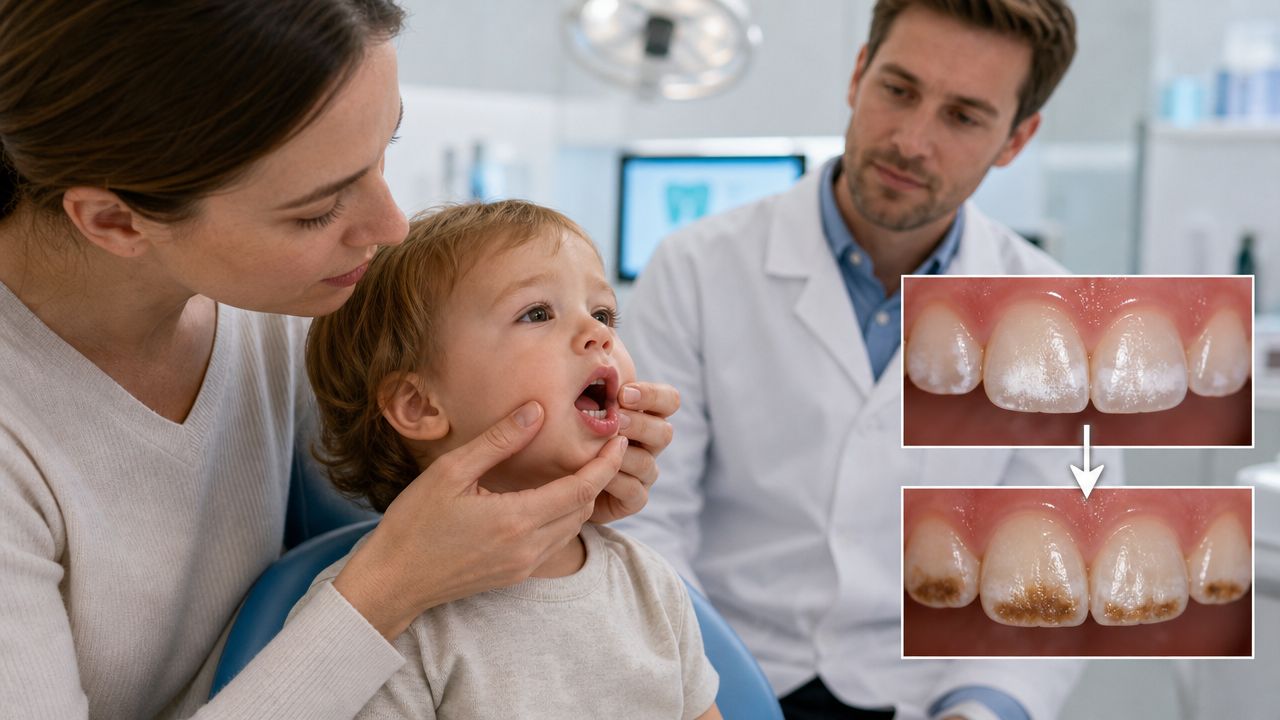
The earliest changes often appear as white, dull, chalky spots, especially near the gumline. These areas can look dry or flat instead of shiny. Parents sometimes think it's milk residue or a brushing artifact.
At this stage, the enamel is weakening, but the tooth surface may still be intact. That's why prompt care matters. Early lesions are the point where fluoride-based treatment and better plaque removal have the best chance of helping.
When the tooth stays under acid attack, the color often deepens. You may notice a yellow, light brown, or darker brown patch. This doesn't always mean there's a large hole yet, but it usually means the area has progressed beyond the earliest stage.
A toddler may also start showing small behavior clues:
Brown doesn't automatically tell you how deep the decay is. A dentist still needs to check whether the surface is intact, softened, or already broken open.
Once the enamel breaks, you may see a pit, groove, or actual hole. Food can catch there. The edge may feel rough if you gently look with clean hands and good light. At this point, home care alone won't repair the damaged structure.
Call promptly if your child has any of the following:
| Sign | Why it matters |
|---|---|
| Facial swelling | Can suggest a spreading dental infection |
| Pain that wakes them up | Often means the tooth is more deeply involved |
| A pimple on the gum | May indicate drainage from infection |
| Trouble eating or drinking | Comfort and hydration become the priority |
If you don't see those signs, it still makes sense to schedule care soon. A tooth doesn't need to be causing dramatic pain to deserve treatment. In many toddlers, the goal is to act before pain starts.
Seeing a dark spot on a baby tooth can make parents assume the next step is drilling. In many cases, treatment is more flexible than that. We choose care the way you would choose the right tool for a home repair. A small surface problem needs a different approach than a deeper weak spot, and a toddler who cannot comfortably cooperate may need a different plan than an older child.
One option families can discuss at Dental Professionals of Fair Lawn is a step-by-step approach that starts with the least invasive treatment likely to help, while still protecting the tooth and your child's comfort.
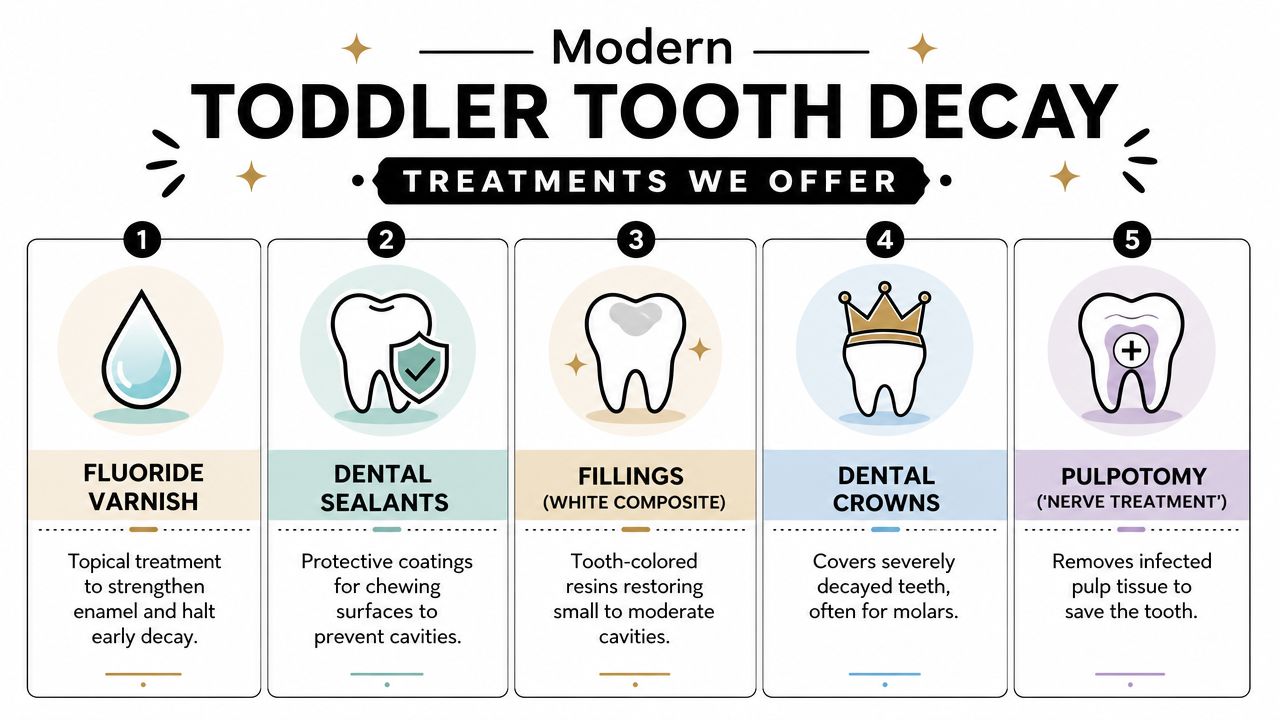
If the enamel is still intact, the goal is often to harden and protect the tooth before a true hole forms. That can be a relief for parents, because early treatment may be quick and gentle.
A dentist may recommend:
This stage can be confusing. Parents sometimes hear "watch it" and worry that nothing is being done. Monitoring is active care. It means the tooth is being checked on a schedule, with a clear plan for what would make us treat it more aggressively.
Silver diamine fluoride, or SDF, is one of the most helpful tools for very young children and children who are too anxious or wiggly for a traditional filling. It is brushed onto the decayed area to help stop the cavity from progressing.
That makes SDF especially useful when the main problem is timing. A toddler may be too young to sit through a filling today, but the tooth still needs help now. SDF can buy that time while reducing the chance that a small cavity turns into a painful one.
The tradeoff matters. The decayed part usually turns black after treatment. For many families, that color change is acceptable if it helps avoid drilling, eases discomfort, and keeps the situation from getting worse while a child matures.
For an anxious or uncooperative toddler, SDF can be the most practical first step. It treats the disease even if your child is not ready for a full repair yet.
A quick visual overview may help you picture where each treatment fits.
Once decay has created a cavity, the tooth often needs its shape rebuilt. A tooth-colored filling works well when the damaged area is still fairly small and enough healthy tooth remains to support the repair.
A pediatric crown is often a better choice for larger cavities, especially on baby molars that do a lot of chewing. A crown works like a helmet over the tooth. It covers and protects the weaker structure instead of asking a small filling to hold together a tooth that has lost too much support.
If decay has reached the nerve area, pulp therapy may be recommended to remove infected tissue and keep the tooth functional until it is ready to fall out naturally. In some cases, extraction is the safest option, but only after we look carefully at whether the tooth can be saved and whether treatment is realistic for your child.
For toddlers who are very young, highly fearful, or unable to tolerate treatment safely, the plan may also include sedation options for pediatric dentistry. That is not about forcing a child through care. It is about matching the treatment to the child so decay can be handled with as little stress and discomfort as possible.
You may be picturing the hardest version of the appointment already. Your toddler sees the chair, starts crying, turns away, and will not open at all. That fear is common, especially when a child is very young, sensitive, or has had a rough medical visit before.
A good pediatric dental visit is built around the child in front of us, not around a one-size-fits-all script. Some toddlers can handle an exam and treatment in one visit. Others need a slower path. The goal is safe care, less fear, and a plan your child can get through.
For toddlers, cooperation is a developmental skill, not a character test. A two-year-old with a sore tooth may not be able to sit still long enough for even simple treatment. That does not mean anyone has failed. It means the visit has to match your child's age, comfort level, and attention span.
The appointment often starts with small, predictable steps. We may name a tool in child-friendly words, let your child see it first, and keep the visit short enough that things do not unravel. Many children do better when the pace feels familiar and no one rushes them.
Common approaches include:
Even a brief, calm exam can tell us a lot.
Parents often ask whether sedation is the only way to treat a toddler who will not cooperate. Usually, it is one option among several. The right choice depends on how much decay is present, whether the tooth is painful or infected, how long the visit needs to be, and what your child can tolerate safely.
Sometimes the first step is not a filling that day. It may be a visual exam, photos, fluoride, or a simpler treatment that buys time. For some children, Silver Diamine Fluoride can slow decay while they mature enough for more traditional repair. For others, the amount of treatment needed is too great to divide into short visits, and sedation becomes the kindest and safest way to complete care.
A helpful parent overview of sedation options for pediatric dentistry can make that conversation easier to understand before the appointment.
Sedation should support humane care. It should never feel like punishment for a scared child.
If you are unsure what to ask, start here:
| Question | Why it helps |
|---|---|
| Can my child's treatment be done in short stages, or does it need to happen in one visit? | Clarifies whether pacing is realistic |
| Is there a temporary or less invasive option that can help first? | Opens discussion about treatments such as SDF |
| What signs would mean we should not wait? | Helps you watch for pain, swelling, or infection |
| How should I prepare my toddler before the appointment? | Gives you a practical plan for the day of the visit |
One practical step at home is cleaning feeding items carefully, especially if your child still uses bottles or training cups. Some parents find this guide from BacteriaFAQ.com on bottle hygiene useful while tightening routines before treatment.
When parents understand why a plan is being recommended, the visit usually feels less overwhelming. That sense of calm matters. Young children notice it right away.
You may be reading this at night, after spotting a brown line, a white chalky patch, or a small hole in your toddler's tooth and wondering what to do before morning. Start with the goal. Keep the area clean, keep your child comfortable, and prevent the problem from spreading while you arrange care.
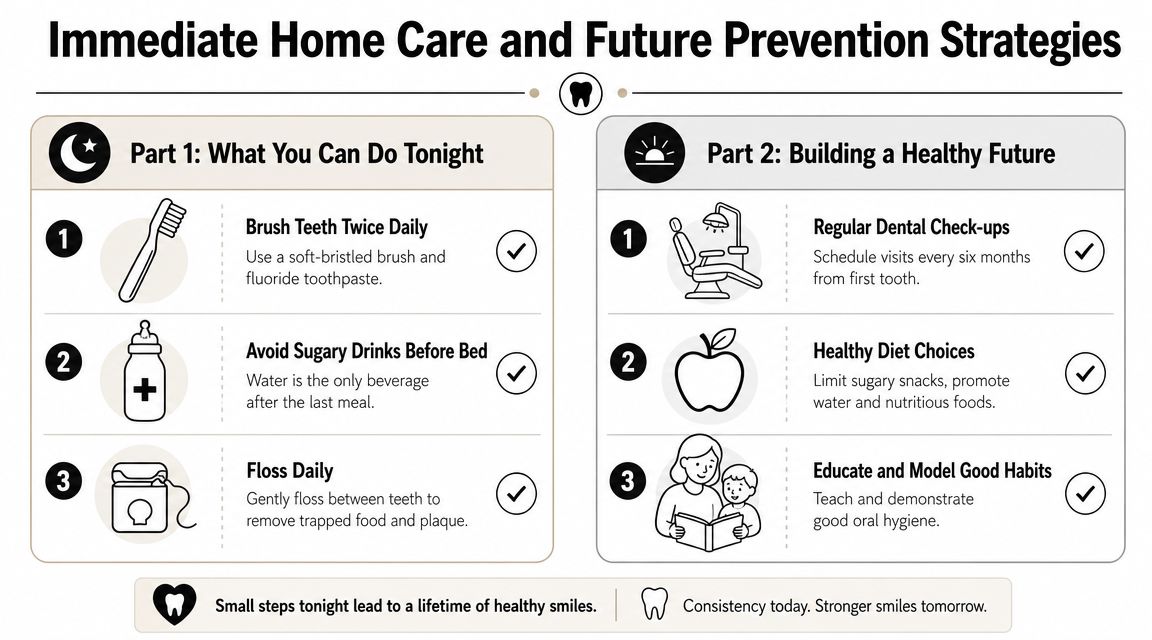
A decayed tooth is a little like a rough spot on a wall. Food and plaque cling to it more easily than they do to a smooth surface. Gentle brushing matters, even if your toddler protests, because it clears away the sticky film that keeps feeding the cavity.
Use a soft child-sized toothbrush and brush around the tooth carefully. If the area is tender, go slowly and keep your voice calm. Toddlers often resist more when they sense a parent is scared, so a steady routine helps.
A few simple changes tonight can also lower the strain on that tooth:
Do not put aspirin on the gum or tooth. It can irritate the tissue and does not treat the cause.
Prevention usually works best when families treat it like handwashing. Small daily steps, repeated consistently, protect much better than occasional big efforts after a problem appears.
Brush twice a day with fluoride toothpaste in the amount your dentist recommends for your child's age. For toddlers, parent brushing is still the main job. A child may want to help, and that is great for learning, but they usually cannot clean thoroughly on their own yet.
It also helps to simplify how sugar shows up during the day. A cookie with lunch is less harmful than constant sipping or grazing over hours, because teeth get a chance to recover between eating times. Try to keep drinks simple between meals, especially in cups your child carries around.
Regular dental visits matter because toddler decay can change quickly. Early spots may be managed with fluoride or SDF in some children, while deeper areas may need a filling, crown, or another treatment plan. That range is especially important for very young children or toddlers who cannot comfortably cooperate for long. Prevention is not separate from treatment. It gives your child the best chance of needing the least invasive option possible.
If your toddler is teething and chewing on everything, choose clean, easy-to-wash comfort items and avoid anything coated in sweet gels or dipped in food. The goal is to soothe sore gums without keeping sugar on the teeth.
When a toddler has a cavity, families don't just need a procedure. They need a plan, a calm environment, and a dental team that can meet their child where they are that day. Some children walk in curious and cooperative. Others arrive tired, scared, or firmly against opening their mouths. Both are normal.
For families looking for a dentist in Fair Lawn, NJ, that first visit should feel organized and low-pressure. The appointment may include a conversation about what you've noticed at home, an exam to see whether the spot is early or advanced, and a practical discussion of treatment choices. If your child needs restorative dentistry, sedation support, or urgent tooth extraction, those next steps should be explained clearly and without alarm.

Parents in Fair Lawn, Ridgewood, and Glen Rock are often trying to find a long-term dental home, not just solve a single emergency. That usually means looking for an office that can handle:
Some parents also like having trusted outside resources for day-to-day questions at home. If you're sorting through comfort items for younger children, this curated guide to infant teething toys can be a helpful starting point.
Dr. Jody Bardash and the team serve families in Fair Lawn and nearby New Jersey communities with a broad range of preventive, restorative, emergency, cosmetic, and sedation services. That matters because children's needs can change quickly. A child who starts with a simple evaluation may later need monitoring, fluoride, a filling, or a more supportive treatment setting.
If you're searching for a dentist near me because you've just noticed a suspicious spot, don't wait for the problem to become dramatic before reaching out. Earlier evaluation usually means more flexibility, more comfort, and a clearer path forward for your child.
If you're concerned about a spot, cavity, or possible pain in your child's mouth, contact Dental Professionals of Fair Lawn to schedule an evaluation. The office serves families in Fair Lawn, Ridgewood, Glen Rock, and nearby communities with preventive care, restorative treatment, emergency dental care, and sedation options when needed.