TMJ Injections Near Me: A Guide to Relief in Fair Lawn, NJ
Searching for "tmj injections near me"? Our Fair Lawn, NJ dentists explain treatment options to relieve jaw pain. Learn about candidacy, costs, and recovery.
Searching for "tmj injections near me"? Our Fair Lawn, NJ dentists explain treatment options to relieve jaw pain. Learn about candidacy, costs, and recovery.
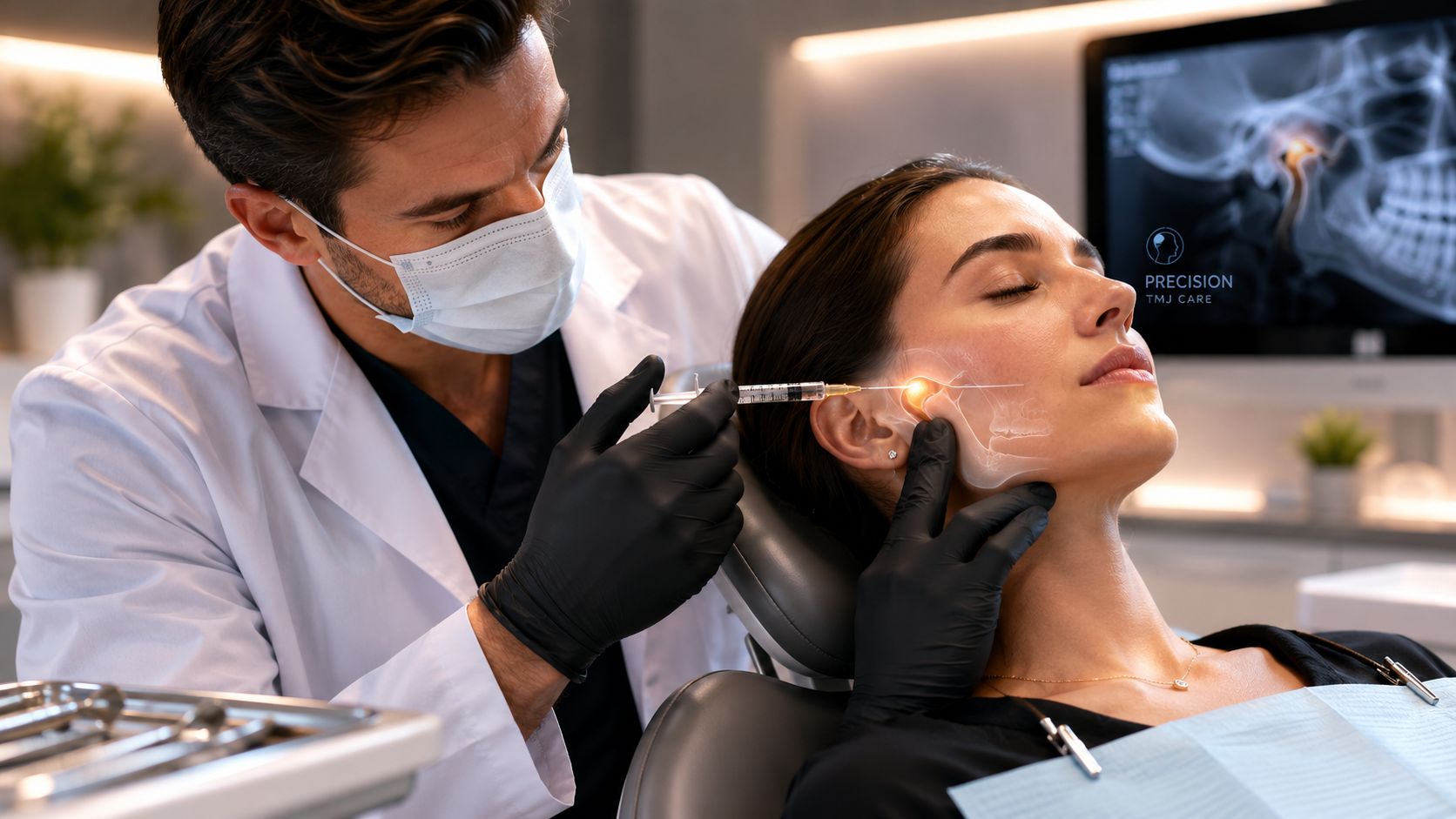
Jaw pain rarely stays in one part of your day. It shows up at breakfast when chewing feels uneven, during work when a tension headache starts behind your temples, and again at night when your jaw feels tired, tight, or stuck. Many people in Fair Lawn start by hoping the clicking will go away on its own. Then they find themselves searching for TMJ injections near me because the problem keeps interrupting sleep, meals, and concentration.
That search usually comes after frustration. You may have tried softer foods, over-the-counter pain relief, or being more aware of clenching. Sometimes those steps help. Sometimes they don't. What matters is getting a clear diagnosis first, then choosing the least invasive treatment that matches the source of the pain.
For patients in Fair Lawn, Ridgewood, and Glen Rock, jaw pain can come from overworked muscles, an inflamed joint, or a combination of both. That's why the right plan isn't just “get an injection.” It's understanding what's driving your symptoms and whether an injection belongs in your care plan at all. Some patients also compare TMJ care with other chronic pain injection options to better understand how targeted injections are used in pain management more broadly.
A typical TMJ patient doesn't walk in saying, “I have temporomandibular dysfunction.” They say their jaw clicks every morning. Or they can't open wide enough to bite a sandwich comfortably. Or their headaches keep returning and they're starting to wonder if the problem is their jaw.
That pattern matters. TMJ problems often feel scattered at first, even though the cause is connected. A sore jaw, facial tension, ear-area discomfort, and clenching during sleep can all belong to the same picture.
Some people live with symptoms for months because they assume a little popping is normal. Others notice the pain only after stress, long workdays, or a bad night of grinding. Then the flare-ups get more frequent.
Common complaints include:
Jaw pain often isn't a single symptom problem. Patients usually feel it in the joint, the muscles, and the way everyday activities become harder.
In Fair Lawn, the next step shouldn't be guessing. It should be a focused evaluation that looks at how your jaw moves, where the tenderness is coming from, whether clenching is part of the picture, and what treatment is appropriate now.
For local patients, that's often the biggest relief at the start. Not the injection itself. The diagnosis.
The temporomandibular joint, or TMJ, is the hinge that connects your lower jaw to your skull. You use it constantly. Talking, chewing, yawning, swallowing, and even holding tension in your face all involve that system. When the joint or surrounding muscles stop working smoothly, the result is called a temporomandibular disorder, or TMD.
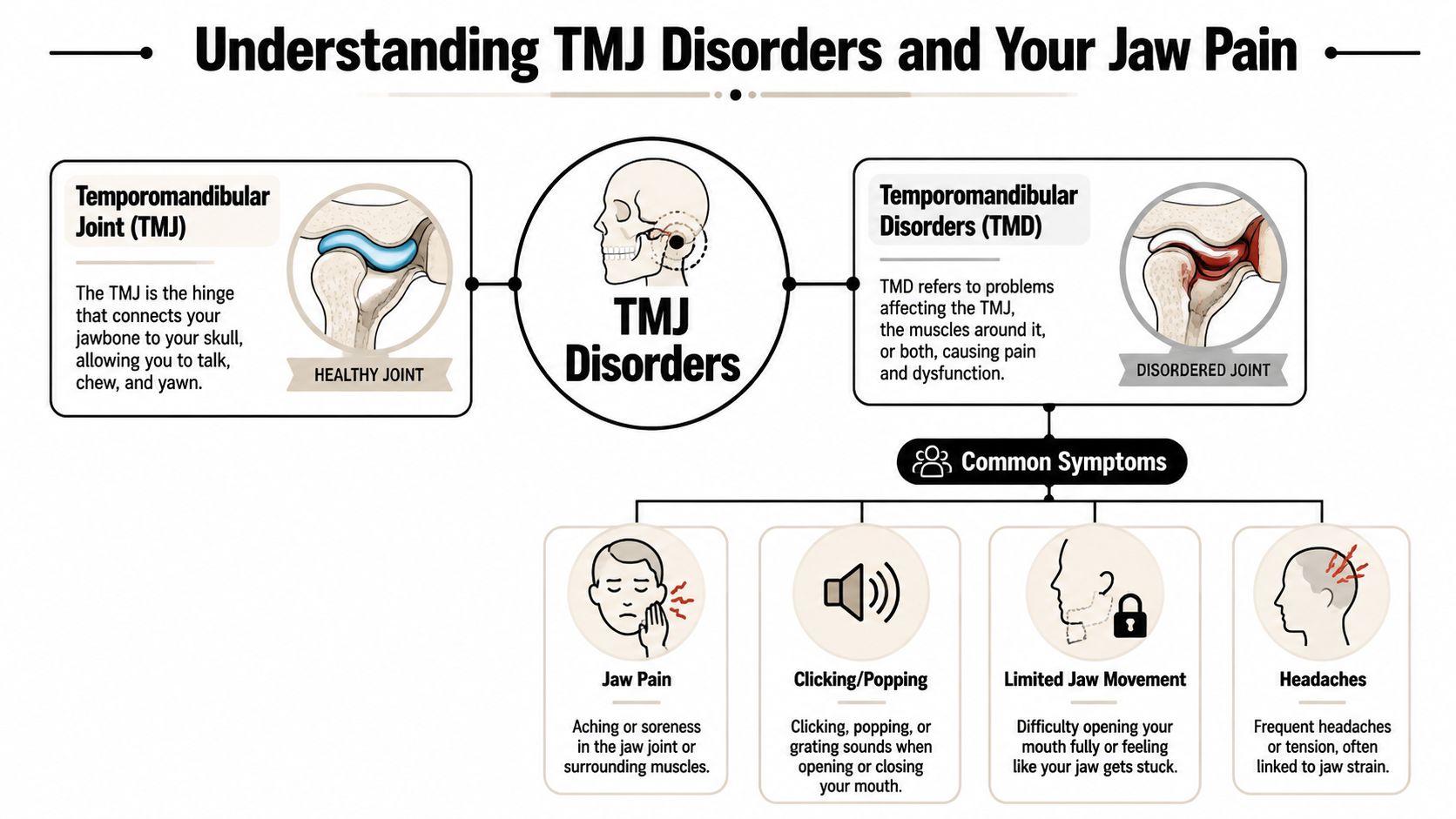
Your jaw joint has to glide and hinge in a coordinated way. The muscles around it also have to work in balance. If the muscles are overactive, the joint is inflamed, or the movement pattern is off, pain follows.
That's why TMD can feel different from one person to the next. One patient mainly feels muscle tightness and clenching. Another feels joint pain right in front of the ear. A third notices locking or difficulty opening.
TMD doesn't always announce itself with dramatic pain. It often starts with signs people dismiss.
You might notice:
A proper exam helps separate muscle-driven symptoms from joint-driven symptoms. That distinction changes treatment.
If you want a deeper look at warning signs before booking, this guide on how to know if you have TMJ disorder is a useful starting point.
A patient with muscle clenching may respond to one type of care. A patient with joint inflammation may need something different. Even when two people both search for TMJ injections near me, they may not need the same injection, or any injection at all.
The most effective TMJ care starts by identifying the pain generator. Is it the muscle, the joint, the bite pattern, or a combination?
That's why imaging, bite analysis, and a careful jaw exam matter. The goal isn't just to confirm that you hurt. It's to find out why.
Not everyone with TMD should start with injections. That's an important point, and it's one many patients appreciate once they understand the full treatment picture. The National Institutes of Health notes that TMD treatment should begin with an accurate diagnosis, and that reversible care such as counseling, medication, physical therapy, and oral appliance therapy plays a central role in management, with injection therapy being one option among several for selected cases in the NIH review on TMD treatment.
TMJ injections tend to make sense when symptoms are persistent, clearly localized, and not responding enough to conservative care. That often includes people who have already tried a night guard, behavior changes, jaw rest, or physical therapy but still have meaningful pain or restricted function.
In practice, candidates often include patients who have:
Good TMJ care differs from procedure-first marketing. If the problem is mild, recent, or clearly tied to habits like clenching or posture, conservative treatment is usually the smarter first move.
That may include a custom night guard, changes in chewing habits, stress reduction, or physical therapy. For patients curious about how muscle-relaxing products work in general, this explainer on muscle-relaxing injectables gives helpful background on the broader category.
Practical rule: If a provider recommends injections before establishing whether the pain is muscular, joint-based, or both, slow down and ask more questions.
A careful recommendation sounds measured. It doesn't promise a cure. It explains why this particular injection fits this particular problem, and why another patient might need a different path.
That's the standard patients should expect from any dentist near me search, especially when the concern is chronic jaw pain and not just a cosmetic request.
TMJ injections aren't one treatment. They're a category of treatments. Major clinical references now describe multiple approaches, including trigger-point injections, steroid injections, botulinum toxin A, hyaluronic acid, and PRP, with each aimed at a different pain source in the Duke Health overview of TMJ disorder treatments.
That matters because a patient with clenched, overloaded muscles needs different care than a patient with an inflamed joint.
Some injections target muscle hyperactivity. Others target joint inflammation. Others aim to improve lubrication inside the joint. The right fit depends on what the exam shows.
Here's the practical comparison patients usually want:
| Injection Type | How It Works | Primary Target | Typical Duration of Relief |
|---|---|---|---|
| Botulinum toxin A | Reduces contractile activity at the neuromuscular junction | Overactive jaw muscles such as the masseter and temporalis | Often temporary, with one clinical dental source reporting 3 to 4 months of effect in this TMJ Botox overview |
| Corticosteroid | Helps control inflammation and pain inside the joint | Inflamed TMJ joint | Varies by patient |
| Hyaluronic acid | Lubricates the joint and may reduce inflammation | Joint mechanics and irritated articulation | Varies by patient |
When clenching and muscle overuse are the main drivers, botulinum toxin is often the best-known option. It's typically placed into the masseter and temporalis muscles, which are the jaw elevator muscles responsible for much of the clenching force. In a clinical office setting, treatment is commonly completed in about 30 minutes according to this clinical TMJ Botox description.
Patients usually ask what it helps with most. The answer is muscle-related symptoms. Jaw tension, clenching discomfort, temple headaches, and bruxism-related soreness are common reasons to consider it. The goal is symptom relief, not structural correction.
If you're also exploring facial injectables and how this category of treatment is used in dentistry, the page on Botox and dermal fillers in New Jersey gives additional context.
Steroid injections are different. They're used when the joint itself appears inflamed and painful. This is less about relaxing muscle force and more about calming irritation within the TMJ.
For the right patient, that can make opening easier and chewing less painful. But it has to be the right diagnosis. Steroid in a muscle-driven case won't solve the underlying clenching pattern.
Hyaluronic acid is considered when the joint needs better lubrication and support for smoother movement. Patients with mechanical irritation may be candidates depending on exam findings.
This option tends to come up less often in general searches, but it's important because it shows how much TMJ treatment has evolved. A modern TMJ practice doesn't think in one-size-fits-all terms. It looks at the anatomy, symptoms, and behavior patterns before recommending a procedure.
Patients are usually less worried about the diagnosis than the unknowns around the appointment itself. They want to know how long it takes, what it feels like, and what the rest of the day will look like.
This visual gives a quick overview before the details.

The first part of the visit confirms that the planned injection still matches the current symptoms. Jaw pain can shift. A patient who was mainly muscular at one visit may report new joint sensitivity later, or the reverse.
During this phase, the dentist reviews symptoms, checks range of motion, palpates the muscles and joint area, and decides whether to proceed as planned or adjust the approach.
For most TMJ injections, the appointment is done in the office. The area is prepared, landmarks are identified, and the injection is delivered into the intended target rather than broadly into the jaw area.
Most patients describe the sensation as brief and manageable. A small pinch is common. Anxiety is often worse than the actual experience.
Patients usually feel better once they know the injection is targeted and quick, not a long surgical procedure.
This short video can also help make the visit feel more familiar before you come in.
Aftercare is usually simple. Patients may be asked to avoid rubbing the area, follow specific muscle-use instructions, and watch for temporary soreness. Normal daily activity is often possible shortly afterward, depending on the injection type and the treatment plan.
Recovery expectations usually include:
The biggest misconception is that recovery means bed rest or major downtime. For most patients, that isn't the case. The actual recovery process involves tracking whether the treatment changed the symptom pattern in the way it was supposed to.
TMJ injections can be helpful, but they work best when expectations are realistic. They're tools. Useful ones. Targeted ones. Still, they're not magic.
Clinical data also shows that outcomes vary. In one pediatric TMJ arthritis series summarized by Aetna, about 50% of patients had significant improvement in maximal interincisal opening and TMJ effusion after ultrasound-guided injection, while follow-up and repeat treatment were sometimes needed, as described in the Aetna clinical policy summary.

No honest TMJ discussion should skip the trade-offs.
The right expectation is improvement, not perfection. Good TMJ treatment aims to reduce pain and improve function while continuing to manage the habits or inflammation that caused the problem.
Finding a provider for TMJ care isn't just about locating someone who offers injections. It's about choosing someone who can determine whether injections are appropriate in the first place.
A qualified TMJ provider should be able to do more than administer a product. The provider should evaluate jaw movement, understand muscular versus joint pain, and offer conservative options when those are the better fit.
Look for these signs:
TMJ symptoms don't always stay isolated. Clenching can wear teeth. Bite changes can affect comfort. Some patients who come in for jaw pain also need restorative dentistry, cosmetic dentistry, or help with oral appliances.
That's why a broader care model matters. Dental Professionals of Fair Lawn provides family, cosmetic, restorative, implant, orthodontic, TMJ/TMD, and related dental services in one setting, which can make care more coordinated for patients in Fair Lawn, Ridgewood, and Glen Rock. Dr. Jody Bardash also brings 30+ years of experience to patient care, according to the practice profile on the website.
The practical point is simple. Choose a provider who can treat the jaw problem in context, not in isolation.
Most patients ask practical questions right before they're ready to schedule. That's normal. Clear answers help people move forward with less stress. Good service pages also work that way, which is why many practices study FAQ page strategies for service businesses to organize the information patients need.
They are generally well-tolerated. Patients usually describe a brief pinch or pressure rather than significant pain. The exact feel depends on the injection type and the area being treated.
It depends on the diagnosis and the injection used. Some treatments work gradually as inflammation settles or muscle activity changes. Relief isn't always immediate, so follow-up matters.
Usually, no. They're better understood as a targeted treatment for pain control and better function. If clenching, grinding, stress, or joint irritation continues, ongoing management may still be needed.
Coverage varies by plan and by the reason for treatment. The best step is to contact your insurer and ask about TMJ-related evaluation and injection benefits. A dental office can often help you understand what documentation may be needed.
If the pain is severe, your jaw suddenly locks, or you can't function normally, urgent evaluation makes sense. If the issue is chronic tension, clicking, or recurring discomfort, a scheduled TMJ consultation is usually the right starting point.
If you're dealing with jaw pain, headaches, clicking, clenching, or limited opening, the next step is a focused evaluation with Dental Professionals of Fair Lawn. A careful exam can determine whether you need conservative treatment, an oral appliance, or a targeted injection approach. Schedule a consultation to get answers and start moving toward steadier, more comfortable jaw function.