New Jersey Oral Surgery and Dental Implants: Achieve Your
Get expert New Jersey oral surgery and dental implants in Fair Lawn. Learn about costs, All-on-4, & recovery. Schedule your consult today!
Get expert New Jersey oral surgery and dental implants in Fair Lawn. Learn about costs, All-on-4, & recovery. Schedule your consult today!
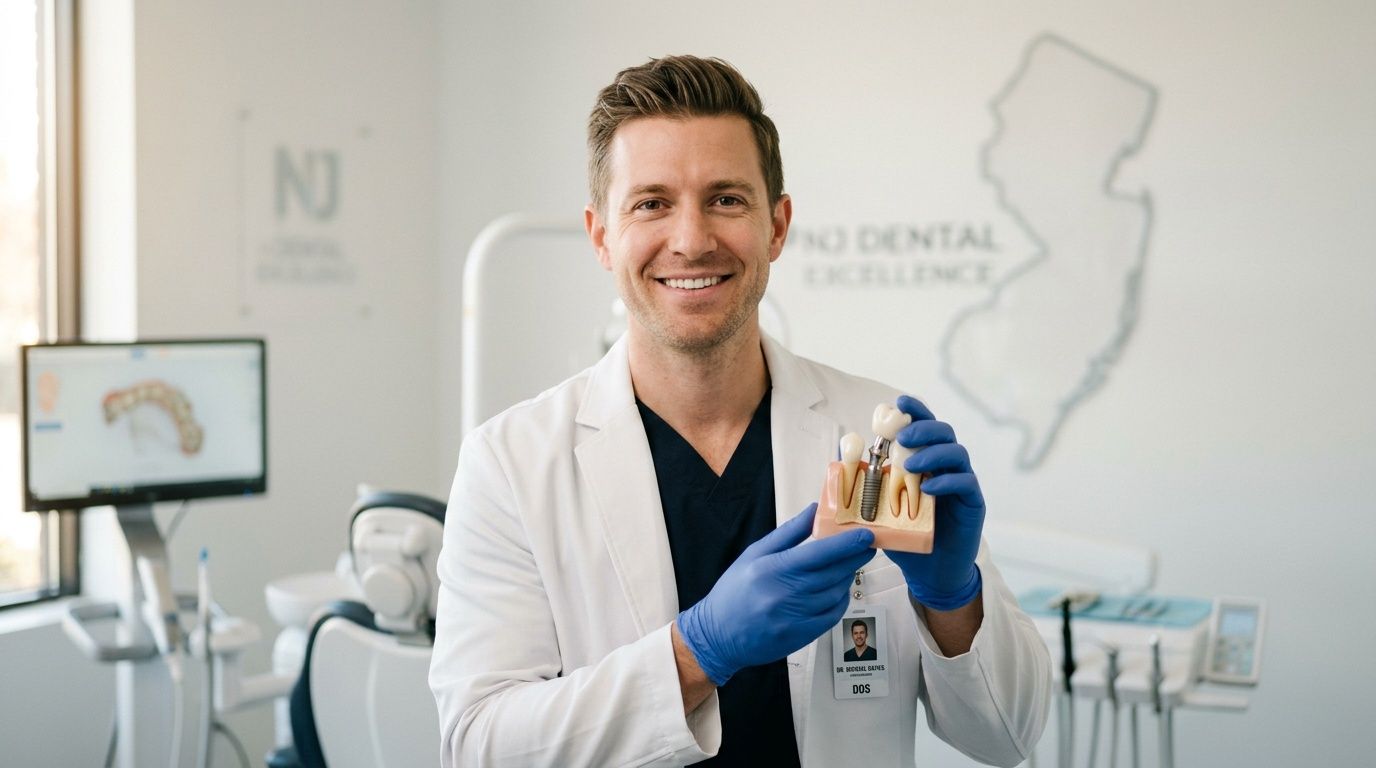
If you're searching for a dentist near me because a missing tooth is making meals awkward, your denture feels loose, or you're tired of hiding your smile in photos, you're not alone. Many people in Fair Lawn reach this point after months or even years of trying to “work around” a dental problem that really needs a permanent solution.
What often surprises patients is how much one missing tooth can affect daily life. Chewing shifts to one side. Speech can feel a little off. Confidence diminishes. Then the internet search begins for new jersey oral surgery and dental implants, tooth extraction, or dental implants near me, usually with a mix of hope and worry.
The good news is that modern oral surgery and implant dentistry can be far more comfortable, precise, and predictable than commonly anticipated. With the right planning, many patients can move from pain, frustration, or embarrassment to a smile that feels stable, natural, and easy to trust again.
A lot of people wait longer than they want to before asking for help. They smile with their lips closed. They cut food into very small bites. They avoid crunchy favorites. Some tell me they keep postponing care because they’re afraid oral surgery will be painful or complicated.
That hesitation makes sense. Dental treatment is personal, and it can feel overwhelming when you’re not sure what the process involves.

In Fair Lawn, Ridgewood, and Glen Rock, the concerns are usually very practical at first.
Then there’s the emotional side. A smile affects how you feel at work, at family events, and even in routine conversations. Patients looking for a cosmetic dentist near me are often also looking for function, comfort, and reassurance.
Many people don't need a perfect smile. They need a smile that feels dependable again.
When you need oral surgery or implants, convenience matters, but trust matters more. You want clear answers, a calm environment, and a plan that fits your life. You also want a practice that understands that families in Fair Lawn aren't only comparing procedures. They're comparing comfort, timing, affordability, and whether they feel heard.
That’s why local, integrated care is so valuable. If you need an exam, dental x-rays, restorative treatment, cosmetic dentistry, or emergency dental services, it helps when your care can be coordinated in one familiar office rather than scattered across multiple locations.
Here in the Fair Lawn community, patients often start with one problem, such as a broken tooth or failing bridge, and discover they have several workable options. Once the problem is explained in plain language, the fear level usually drops. People begin to see a path forward.
Missing teeth, infected teeth, bone loss, and unstable dentures are different problems, but they share one thing. They don’t usually improve on their own. Good treatment starts with identifying what’s happening under the surface and matching the right solution to your goals.
For some people, that means saving a tooth. For others, it means a carefully planned extraction followed by a stronger long-term replacement. The point isn't to rush into surgery. The point is to restore comfort, function, and confidence in a way that makes sense for your mouth and your life.
People often hear the phrase oral surgery and think it only means pulling teeth. It’s much broader than that. In New Jersey, oral surgery includes dental implant placement, wisdom teeth removal, jaw realignment, and treatment for TMJ disorders, infections, sleep apnea, and facial injuries, as described in this overview of New Jersey oral surgery and dental implants.
That matters because many dental problems overlap. A patient may come in for a painful tooth and also need evaluation of bone support, gum health, bite alignment, or a long-term replacement plan.

A dental implant is best understood as a bionic tooth root. Instead of sitting on top of the gums like a removable denture, the implant is placed in the jawbone and becomes the foundation for a replacement tooth.
The implant itself is typically titanium. Over time, your bone bonds with it through a natural healing process called osseointegration. That’s the step that gives implants their stability and helps them feel more like your own teeth.
Patients can get confused here, so it helps to separate the parts:
| Part | What it does |
|---|---|
| Implant post | Sits in the jawbone and acts like the root |
| Abutment | Connects the implant to the visible tooth |
| Crown | The custom tooth you see above the gumline |
A bridge fills a space by attaching to neighboring teeth. A denture replaces missing teeth with a removable appliance. Both can be useful treatments in the right case.
An implant works differently because it replaces the missing root as well as the visible tooth. That root-level support is a major reason implants are often chosen when patients want a fixed, long-lasting solution.
Practical rule: If a treatment replaces only the part you see, ask what will support the bone underneath over time.
One of the most important reasons implants changed restorative dentistry is that they help stimulate the jawbone. When a tooth is lost, the bone in that area no longer receives the same kind of functional stimulation. Over time, that can affect the shape of the jaw and even facial contours.
That’s why implant planning isn't only about filling a gap. It’s also about preserving the support system below the gumline.
Even when someone is excited about implants, we still look carefully at whole-body health, medications, bone quality, and healing factors. This is especially important for patients who take medications that affect bone metabolism. If that topic applies to you, a plain-language resource on an alternative to Fosamax can help you prepare thoughtful questions for both your physician and your dental team.
The term sounds intimidating, but the actual experience is usually much calmer than people expect. With modern imaging, careful diagnosis, and anesthesia options, treatment can be planned with a high level of detail before the procedure even begins.
Patients seeking a dentist in Fair Lawn, NJ for extractions, implant placement, or related restorative care usually feel more confident once they understand the vocabulary. Oral surgery isn't a single scary event. It’s a category of precise treatments designed to remove disease, restore function, and support a healthier smile.
Not every missing-tooth problem needs the same answer. One patient has a single gap after a cracked molar. Another has several failing teeth. Someone else is tired of a denture that shifts while talking. The right treatment depends on how many teeth are missing, how much bone support is available, and what kind of result the patient wants day to day.
A big part of modern implant planning is accuracy. Computer-guided implant surgery uses CT 3D imaging and software to plan implant position with sub-millimeter accuracy, helping reduce the risk of human error and damage to nearby structures, according to this explanation of guided dental implants in New Jersey.
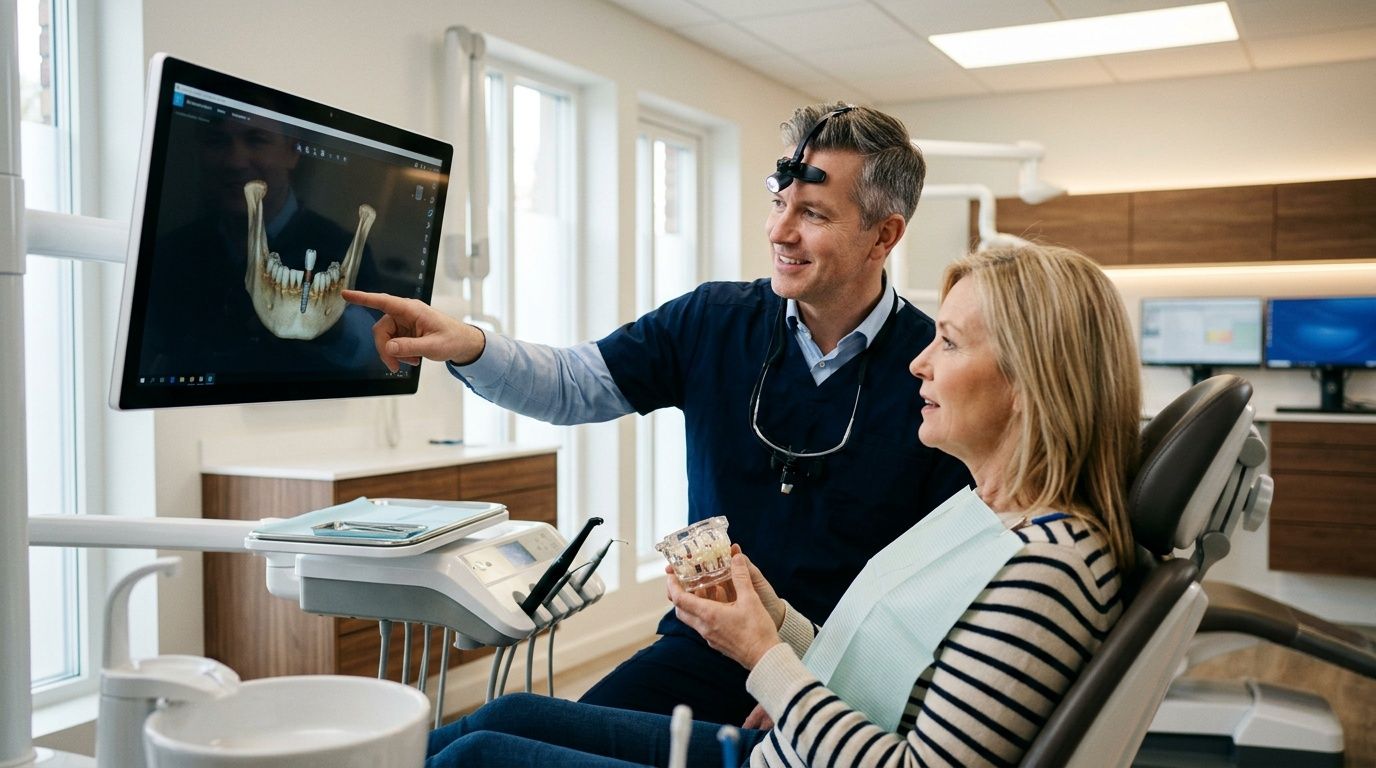
When one tooth is missing, a single implant is often the cleanest solution. It replaces the space without relying on the teeth next to it for support.
That matters because healthy neighboring teeth may not need to be reshaped the way they would for some bridge designs. For a patient with one failed tooth and otherwise healthy teeth, that can be a very appealing option.
A single implant is often a good fit when:
If several teeth are missing in one area, a larger implant-supported restoration may make more sense than placing an individual implant for every space. In these cases, implants act as anchors for a bridge.
This approach can provide strong support while reducing the bulk or movement patients sometimes dislike with removable appliances. It also allows treatment to be adapted to the shape of the bite and the amount of available bone.
When most or all teeth in an arch need to be replaced, the All-on-4 treatment concept is often part of the conversation. Instead of a traditional denture resting mainly on the gums, this approach uses implants to support a full arch of teeth.
For patients who are researching All-on-4 implant supported dentures, the appeal is easy to understand. The prosthesis is fixed, the smile can look more natural, and chewing confidence is often much better than with a loose denture.
People sometimes assume full-arch treatment is only for severe cases. In reality, it’s often considered by patients who are tired of repeated repairs, multiple failing teeth, or a denture that never feels secure.
Many patients become discouraged too early. They hear “bone graft” or “sinus lift” and assume they’ve become a difficult case.
That’s not the right way to think about it.
These procedures are often what make implants possible for people who lost bone after years of missing teeth, gum disease, or long-term denture wear. A graft can help rebuild support where the jaw has thinned. A sinus lift can create the room needed for implant placement in the upper back jaw.
A preparatory procedure isn't a setback. It's often the step that opens the door to a stronger long-term result.
| Situation | Often considered | Main advantage |
|---|---|---|
| One missing tooth | Single implant | Replaces the tooth without depending on neighbors |
| Several missing teeth | Implant-supported bridge | Restores a larger area with fixed support |
| Most or all teeth missing | All-on-4 style full-arch solution | Replaces an entire arch with implant support |
| Bone support is limited | Bone grafting or sinus lift first | Builds the foundation for future implants |
This short video gives a visual sense of how full-arch implant treatment is discussed in practice.
Advanced implant care isn't only about the final crown or bridge. It starts with diagnosis. Digital imaging, facial analysis, bite evaluation, and guided surgical planning all help match the implant position to both function and appearance.
Dental Professionals of Fair Lawn offers implant-related services including All-on-4, bone grafting, sinus lift procedures, facial scanning, and photogrammetry as part of treatment planning and restoration. For patients in Fair Lawn who want fewer surprises and a clearer roadmap, that kind of integrated planning can make the process easier to understand.
A lot of patients in Fair Lawn arrive with the same worry. They know something is wrong, but they do not know what the process will feel like, how long it will take, or whether implants are even realistic for them. The first goal is simple: replace uncertainty with a clear plan.
The implant process usually happens in stages, not all at once. Some people need only a consultation and a single implant. Others need treatment in phases, especially if infection, bone loss, or an older failing tooth changes the order of care. A plan is personalized to your teeth, gums, jawbone, bite, comfort needs, and budget.

Patients often ask, “Am I even eligible for implants?” In many cases, yes. The answer depends less on age alone and more on the condition of the gums, the amount of available bone, how the bite fits together, and whether healing is likely to go well.
Limited bone does not always rule implants out. It may mean we change the sequence, add grafting, or consider a different implant approach. That is why the first visit matters so much.
This appointment gives us the map before we start the trip. We examine the teeth and gums, review symptoms and health history, study the bite, and take imaging so we can see the support under the surface.
That visit often clears up a lot of confusion. A tooth that feels hopeless may still be saved. A tooth that has broken near the gumline may be a better candidate for extraction and replacement. A space that has been empty for years may need grafting first so the new implant has a stable foundation.
Patients who are thinking ahead about comfort sometimes read general information on numbing cream with lidocaine before their consultation, then ask which numbing methods make sense in a dental setting.
Bone planning works like checking the soil before planting a tree. The visible part matters, but the strength of the root support matters more.
There’s a planning principle known as the 3/2 rule. It states that implant length should be approximately two-thirds the available jawbone height, helping support stability and osseointegration, as explained in this discussion of the 3/2 rule for dental implants.
You do not need to remember that formula. What matters is the reason behind it. Implant placement depends on bone height, width, angle, spacing, and the future position of the final tooth. Careful planning protects chewing comfort, gum health, and how easy the area will be to clean for years to come.
After the exam and imaging, we build the sequence around what will give you the healthiest result. That may involve one implant, an implant-supported bridge, a full-arch case such as All-on-4, or preparatory treatment first.
Some people can move quickly. Others benefit from a phased approach with time for healing between steps. If a tooth needs to come out first, we decide whether extraction, grafting, implant placement, and the final restoration should happen together or in separate visits.
A good plan usually balances four priorities:
If questions about affordability come up during planning, many patients also appreciate reviewing ways to pay for dental implants before they commit to the next step.
The day of surgery is usually calmer than patients expect. For a single implant, the appointment is often shorter than people assume, while larger cases such as several implants or full-arch treatment naturally take longer. The exact timing depends on how many implants are being placed, whether a tooth is removed the same day, and whether grafting is part of the visit, as explained by the American Academy of Implant Dentistry in its overview of the dental implant procedure.
During surgery, the implant is placed into the jaw in the position that was planned from the imaging and bite analysis. Some patients leave with a temporary tooth or temporary bridge. Others heal with the implant covered by the gum or with a healing cap in place.
Healing is the quiet part of treatment, but it is doing the heavy lifting. Over time, the bone bonds with the implant through osseointegration, creating the support the final crown or bridge depends on.
This stage can feel slow. That is normal. An implant is not just filling a space. It is becoming part of the foundation that will support biting forces every day.
Once healing is confirmed, we move to the visible part of the smile. That may be a crown, a bridge, or a full-arch prosthesis, depending on the original plan created at our Fair Lawn office.
For many patients, this is the moment when the whole journey finally makes sense. The bite is refined, the shape of the tooth is adjusted, and the smile starts to feel familiar again. Not borrowed. Yours.
The conversation often starts the same way. A Fair Lawn patient sits down, knows a tooth needs attention, and asks two questions before anything else. Will this hurt, and how am I supposed to pay for it?
Those are reasonable questions. They should be answered clearly before treatment is scheduled, not while you are already tense in the chair.

Good oral surgery is not only about the procedure itself. It is also about how carefully the visit is prepared. Before treatment, we review your health history, your anxiety level, the length of the appointment, and whether the plan involves a simple extraction, a single implant, or a larger case such as full-arch care.
That matters because comfort is built in layers. Topical numbing can reduce the pinch of an injection. Local anesthesia numbs the deeper tissues so the procedure can be done safely and comfortably. Some patients also do better with sedation, especially if they have dental fear, a strong gag reflex, or difficulty sitting through longer visits.
Patients who want to understand the difference between surface numbing and dental anesthesia sometimes review general information about numbing cream with lidocaine before discussing what is appropriate for oral surgery. It helps set expectations. Surface numbing affects the outer tissue. Local anesthesia is what blocks feeling in the treatment area.
A calmer visit usually begins with plain answers.
Will I feel pain during treatment?
The goal is thorough numbness and close monitoring throughout the appointment. Pressure is different from pain, and many anxious patients feel relieved once they understand that distinction.
What if I am very nervous?
Say that early. Anxiety is part of treatment planning, not a side issue. The right comfort approach can change the whole experience.
What if the appointment is long?
Some cases can be staged over separate visits. Others are easier with sedation or with breaks built into the schedule.
A good comfort plan works like a road map. If you know what each step is for, the day feels more predictable and less overwhelming.
Cost worries can delay care just as much as fear. Dental implants are a larger investment than a filling or a simple extraction because they involve several parts and several stages. In many cases, the fee reflects the implant itself, the connector piece, the final tooth, imaging, surgical planning, and follow-up visits. If grafting, extractions, or temporaries are needed, those may affect the total.
That is why a price range by itself only helps so much. Two patients replacing one missing tooth can have very different treatment plans. One may have strong bone and a straightforward timeline. Another may need site development first, which changes both the sequence and the cost.
As noted earlier in this guide, implant treatment is widely used because it is designed to restore function as well as appearance. The important question is not only what you will pay today. It is also what the treatment is expected to support over the coming years, including chewing comfort, bite stability, and confidence when you smile.
Patients deserve more than a single number on a page. A useful financial discussion should explain:
That last point matters more than many people expect. Full treatment is often phased, so the financial conversation should match the clinical sequence. If your plan includes extraction, healing, implant placement, and the final crown months later, the cost discussion should reflect that timeline clearly.
If you want a practical overview before your consultation, this guide on how to pay for dental implants can help you compare budgeting and financing options in a more organized way.
An implant is replacing more than a visible tooth. It is restoring part of the chewing system. That is why some patients who have spent years repairing the same area, replacing removable appliances, or avoiding one side of the mouth decide that a longer-lasting solution makes better sense for them.
At our Fair Lawn office, that conversation is part of the full patient journey. We talk about comfort before surgery, the likely timeline, the steps that may affect cost, and whether advanced options such as full-arch implant treatment are appropriate. Clear answers lower stress. They also help patients make decisions they can feel good about long after the appointment is over.
Recovery is usually smoother when patients know what normal healing looks like. Most post-surgical discomfort is manageable with good instructions, rest, and careful follow-through. Problems tend to happen when people return to hard foods too quickly, skip oral hygiene guidance, or assume they can treat an implant site like any other area of the mouth right away.
The first priority after surgery is protecting the area so your body can heal without unnecessary irritation.
The details vary by procedure, but the basics are familiar. Keep the area clean as instructed. Choose softer foods at first. Avoid chewing directly on a new surgical site unless you've been told it’s appropriate. Give yourself permission to take it easy.
Patients often do best when they keep the plan simple:
People are often unsure how to clean around a healing implant or extraction site. The answer depends on the stage of healing and the exact treatment performed. This is one reason individualized instructions matter so much.
Long-term success depends on daily care. Implants don't get cavities, but the gum and bone around them still need healthy conditions. Once the final restoration is placed, home care and routine professional maintenance become part of protecting your investment.
Healing well isn't about doing something fancy. It's about doing the small instructions consistently.
Patients searching for dentist near me, emergency dentist, cosmetic dentist near me, or dental implants near me often discover that experience alone isn't the only factor they care about. They want a provider who explains options clearly, offers modern diagnostics, and can coordinate related care under one roof.
That matters because implant cases are rarely just about one screw in one spot. You may also need gum evaluation, restorative planning, cosmetic input, bite adjustment, or replacement of an older crown or bridge.
Dr. Jody Bardash brings 30+ years of experience to patient care, along with a practice model that includes preventive, restorative, cosmetic, orthodontic, implant, periodontal, TMJ/TMD, sleep apnea, and emergency services. For families in Fair Lawn, Ridgewood, and Glen Rock, that breadth can simplify care because treatment decisions are made with the whole mouth in mind, not in isolation.
The New Jersey State Oral Health Plan 2023-2028 identifies access gaps for underserved residents and emphasizes the need for expanded care networks and alternative payment options, as outlined in the New Jersey State Oral Health Plan 2023-2028. For patients, that means affordability and financing aren't side issues. They are part of whether care happens at all.
In a local practice setting, financing options can help bridge that gap for people who need treatment but can't comfortably pay the full amount at once. That doesn't solve every access challenge statewide, but it does make real treatment more reachable for many families.
By the time a patient is ready to move forward with oral surgery or implants, they usually want three things. They want to know they’re safe. They want to know the plan makes sense. And they want to feel that the outcome is worth the effort.
That’s why clear communication matters so much. You should leave your consultation understanding what the problem is, what the options are, what the timeline may look like, and how the office will support you through recovery and maintenance.
If you’ve been putting this off because the process seemed too complicated, too uncomfortable, or too expensive to even ask about, a consultation can replace guesswork with specifics. Sometimes that’s the step patients need most.
If you're ready to explore new jersey oral surgery and dental implants with a team that serves Fair Lawn, Ridgewood, and Glen Rock, contact Dental Professionals of Fair Lawn to schedule a consultation. Whether you need a single tooth replacement, guidance after a tooth extraction, help with dentures, or a full-arch implant discussion, the first visit can give you clear answers and a practical plan for a healthier, more confident smile.