How Much Is All on 4 Dental Implants? a NJ Cost Guide
Considering All-on-4? Learn how much is All on 4 dental implants in NJ. Our Fair Lawn guide covers costs, financing, and what to expect at your consultation.
Considering All-on-4? Learn how much is All on 4 dental implants in NJ. Our Fair Lawn guide covers costs, financing, and what to expect at your consultation.
All-on-4 dental implants in New Jersey typically range from $20,000 to $40,000 per arch, and a full-mouth restoration often lands in the broader $36,000 to $60,000 range nationally. If you're in the Fair Lawn area and wondering what that includes, the answer depends on your teeth, your bone support, your final prosthesis material, and whether you're rebuilding one arch or both.
If you're reading this, there's a good chance you're tired of making food choices based on what your teeth or dentures can handle. Many people reach this point after years of broken teeth, advanced wear, gum disease, or a denture that never felt secure in the first place. They want a fixed solution, but they also want an honest answer to the question that matters most first. How much is All on 4 dental implants, and what are you really paying for?
That question deserves a straight answer, not a vague estimate.
Patients in Fair Lawn, Glen Rock, and Ridgewood often start by searching for a dentist near me, dental implants near me, or a dentist in Fair Lawn, NJ because they're looking for local care they can trust. They aren't just comparing prices. They're trying to understand whether this treatment will finally let them eat comfortably, smile freely, and stop worrying about loose teeth or removable appliances.
A patient sits in my Fair Lawn office and tells me the same story I hear often. Meals have become a negotiation. Photos are uncomfortable. A denture may work well enough at home, but not in a restaurant, at a family event, or during a long conversation. By the time someone asks about All-on-4, the question is rarely cosmetic alone. It is about eating, speaking, comfort, and feeling like yourself again.
That is why the cost question comes up early. It should.
All-on-4 replaces a full upper or lower arch with a fixed set of teeth supported by four implants. For the right patient, it can provide far more stability than a removable denture and reduce the daily compromises that come with loose teeth, sore spots, and adhesive.
This treatment is a major investment, and patients deserve a clear explanation of what they are paying for.
Earlier in this article, I covered the typical New Jersey price range for a single arch. The more useful question for someone in Fair Lawn is what that number includes locally. At Dental Professionals of Fair Lawn, that discussion starts with the clinical work behind the final smile. The exam, imaging, implant planning, surgery, temporary teeth when appropriate, the design of the final prosthesis, and follow-up visits all affect the fee. So do extractions, bone conditions, and the materials selected for the final teeth.
A low quote can leave out important parts of treatment. I advise patients to ask direct questions. Is imaging included? Are temporary teeth included? How many follow-up visits are covered? What happens if extractions are needed? Those details matter just as much as the headline number.
People seeking a cosmetic dentist near me or dental implants near me are usually trying to solve a daily problem, not just collect estimates. They want to know whether they will be able to chew comfortably, speak without worrying, and stop planning their lives around a removable appliance.
A proper consultation should give you more than a price.
It should tell you whether damaged teeth can be saved, whether tooth extraction is the healthier path, whether your bone support is adequate for All-on-4, and what kind of final result is realistic for your mouth. Some patients need preparatory treatment before implants. Others are good candidates for a more direct path. The right plan depends on your health, your anatomy, and your goals.
Many people wait years before taking this step. That is common, and it is understandable. The right starting point is not pressure. It is an honest local evaluation and a clear breakdown of the full investment in your new smile.
A patient in Fair Lawn will often ask me the same practical question first. “If I've lost most of my teeth, do I really need an implant for every tooth?” The answer is no.
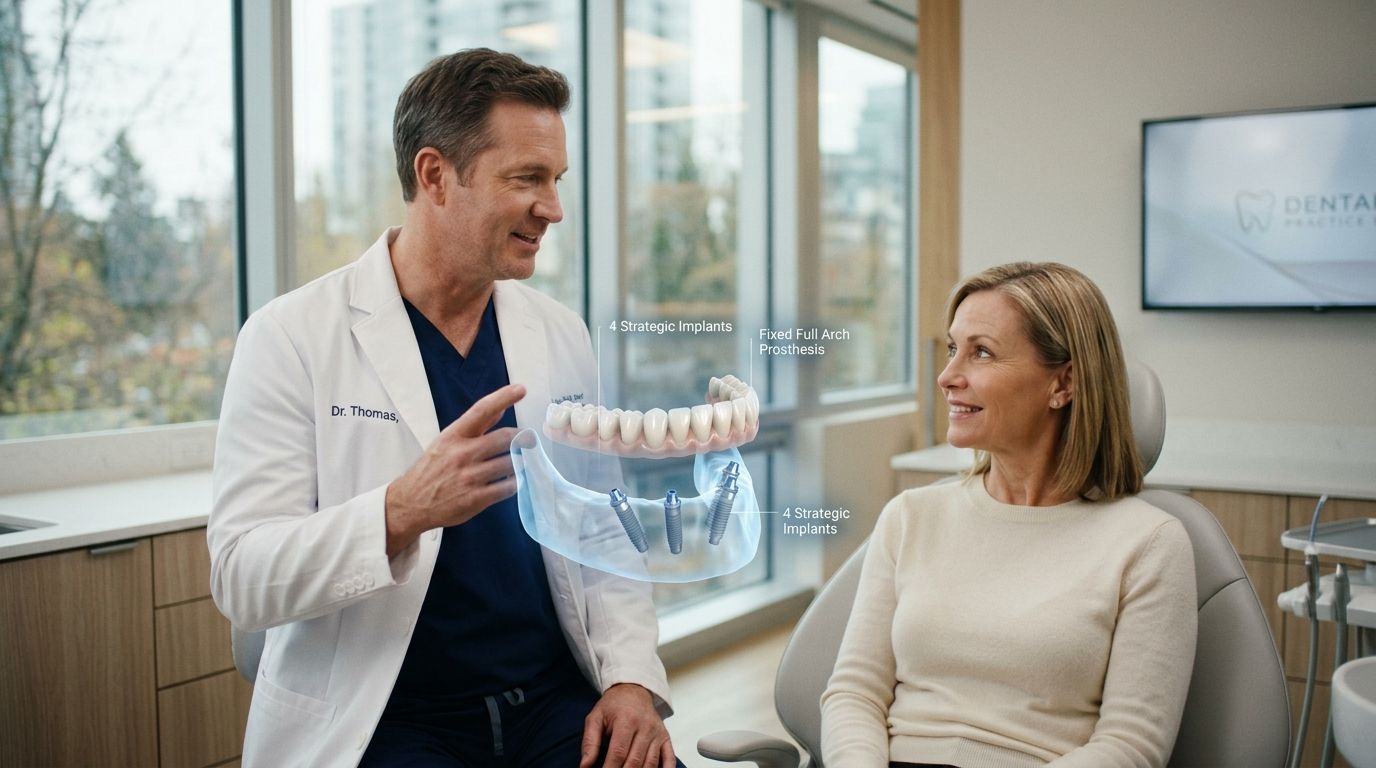
All-on-4 replaces a full upper or lower arch by securing one set of fixed teeth to four dental implants placed in the jaw. Instead of rebuilding the arch tooth by tooth, the treatment uses four support points to hold a full prosthesis in place. For the right patient, that means fewer implants, a fixed result, and a treatment plan that is often more efficient than replacing each missing tooth separately.
The design matters as much as the number of implants.
In many All-on-4 cases, the back implants are placed at an angle so they can engage stronger bone that is still available in the jaw. I explain this carefully in consultations because patients sometimes assume angled implants are a compromise. They are not. They are a deliberate surgical approach that can improve support and, in some cases, reduce the need for more involved grafting procedures.
That does not mean every patient can skip grafting. Some still need additional treatment because of bone loss, sinus anatomy, gum disease, or long-term denture wear. The point is that All-on-4 is designed to make better use of the bone many patients still have.
After treatment, patients rarely focus on the implant positions. They focus on daily life.
A fixed full-arch prosthesis is designed to stay in place, so patients often notice:
A good All-on-4 case restores more than teeth. It restores support for the lips and cheeks, improves chewing, and gives patients a more secure bite.
That distinction matters for people who have spent years repairing one failing tooth after another. At a certain point, a series of fillings, crowns, extractions, and temporary fixes may cost time, money, and comfort without giving you a dependable long-term result.
All-on-4 is not a one-size-fits-all procedure. A safe plan starts with imaging, an exam, a review of your medical history, and a close look at your bite, gum health, and bone levels. Some patients are candidates for extractions and implant placement in a shorter timeline. Others need periodontal treatment, healing time, or modifications to the plan before surgery.
At Dental Professionals of Fair Lawn, that early planning matters because it affects both the outcome and the price you will see later. The main question is not only whether All-on-4 works. It is what your mouth needs for it to work well and last.
For patients comparing this to cosmetic options such as teeth whitening, Invisalign, or Six Month Smiles, the difference is straightforward. All-on-4 is meant for rebuilding a full arch where teeth are missing, failing, or no longer predictable to save. It is a functional and cosmetic treatment at the same time.
Online pricing for All-on-4 often creates more confusion than clarity. A quote may list a cost per arch, while a patient in Fair Lawn is trying to answer a simpler question. What will my full treatment cost, and what does that fee include?
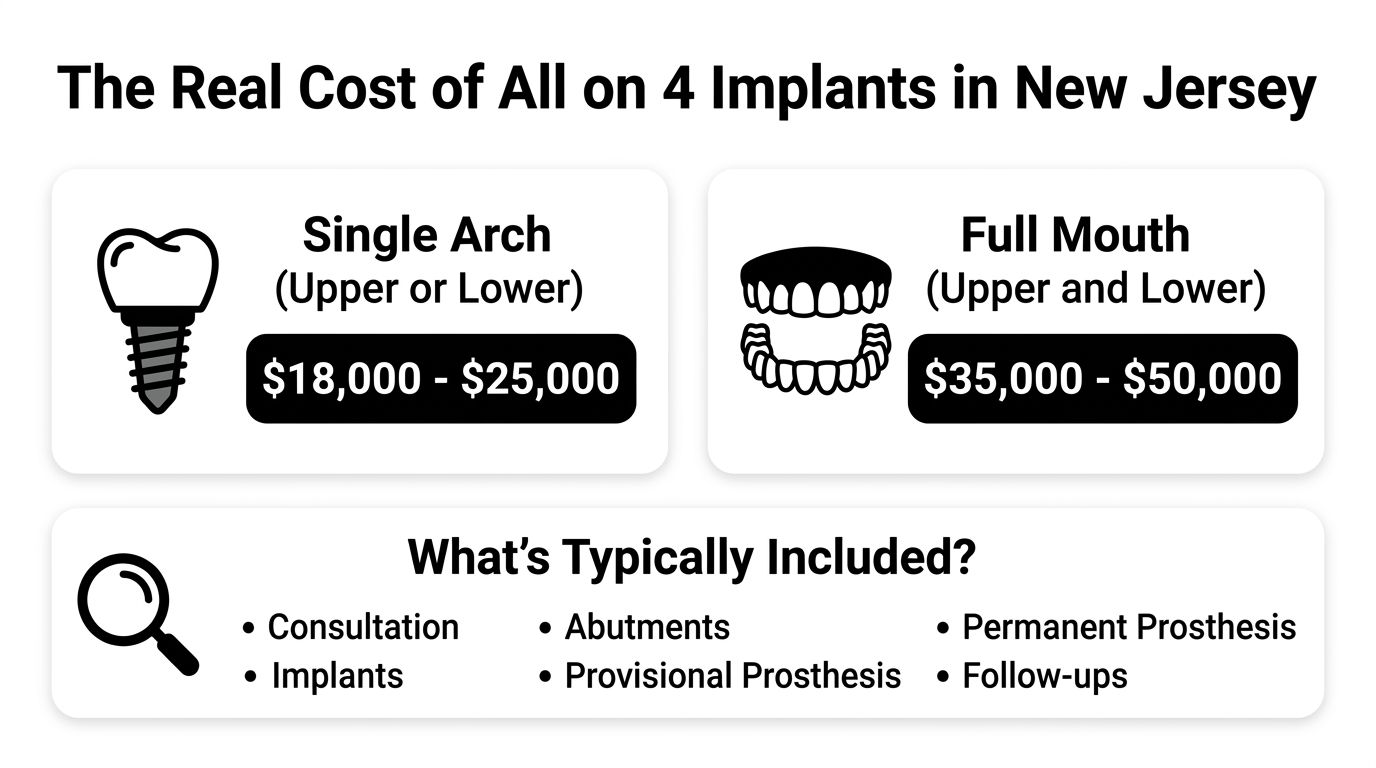
In New Jersey, All-on-4 fees are often higher than the broad national numbers patients see online. The reasons are practical. Surgical overhead, local lab costs, the materials used for the prosthesis, and the amount of pre-treatment needed all affect the final figure.
For a single arch, many patients will see estimates that start in the lower end of the full-arch implant range and rise as complexity increases. If both arches need treatment, the total can increase substantially. That is why I encourage patients to focus less on a headline number and more on a written plan that explains each part of the case.
At Dental Professionals of Fair Lawn, the most useful conversation is not, "What is the average price online?" It is, "What is included in my treatment here in New Jersey, for my mouth, with my goals?"
A clear All-on-4 estimate should spell out the treatment components. In many cases, patients are paying for far more than four implants and a set of teeth.
A quote may include:
Some offices separate parts of this fee. Others bundle more of it together. That difference matters.
For example, one estimate may sound lower at first, but it may leave out sedation, extractions, bone reduction, the temporary prosthesis, or the final material upgrade. Another estimate may look higher because those items are already built in. Patients deserve to know which situation they are looking at before they compare numbers.
Here is a practical way to read a quote:
| Treatment scope | Typical cost context | What patients should clarify |
|---|---|---|
| One arch | Varies based on materials, surgery, and what is included | Are temporary teeth and the final prosthesis both included? |
| Full mouth | Higher total because both arches are being restored | Will upper and lower treatment be done together or in phases? |
| Sedation and related items | May be billed separately in some cases | Is anesthesia included in the written fee? |
A short video can also help make the pricing and treatment flow easier to understand.
A good estimate should be specific and easy to follow. It should show whether the fee is for one arch or two, whether temporary teeth are part of the plan, what material is planned for the final restoration, and how follow-up care is handled.
That level of detail helps patients in Fair Lawn compare options fairly. It also prevents the common problem of choosing a low number first, then discovering later that several necessary parts of treatment were never included.
Two patients in Fair Lawn can need the same All-on-4 treatment and still receive different fees. The reason is usually clinical. Bone shape, bite forces, existing dental disease, healing goals, and prosthetic choices all change the amount of work involved.
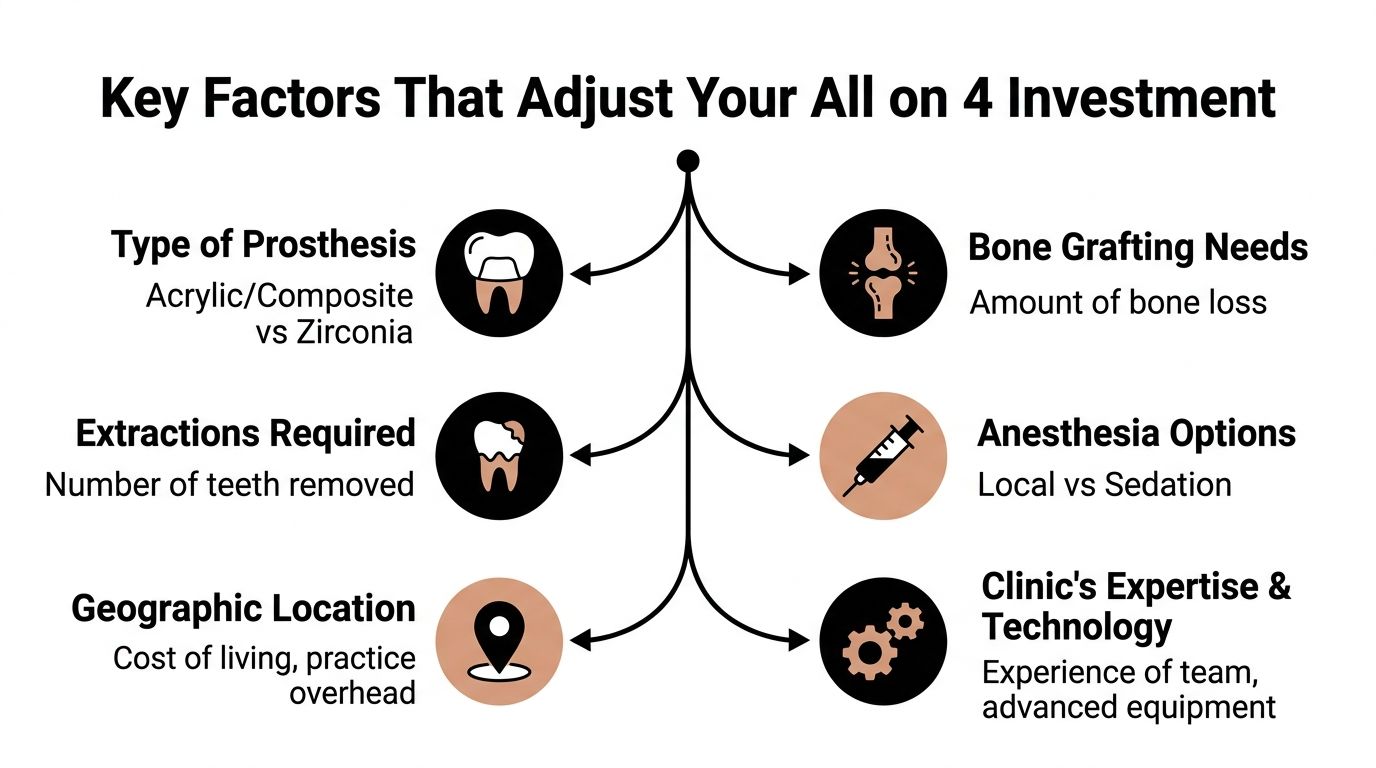
The prosthesis matters as much as the implants themselves. An acrylic restoration is often the more budget-conscious option and can serve many patients well, especially during an initial phase or when lowering upfront cost is a priority. Zirconia usually costs more, but many patients choose it for its strength, wear resistance, and more refined appearance.
I tell patients to ask a simple question early. What material are my final teeth made from, and is that version included in the written fee? "All-on-4" describes the treatment approach. It does not tell you whether the final bridge is acrylic, zirconia, reinforced, or built in stages.
Some cases are straightforward. Others require additional treatment before the implants can be placed safely and predictably.
Factors that often change the investment include:
These details matter in real life. A patient who has active infection, broken teeth, and an uneven bite usually needs a broader surgical and prosthetic plan than someone already wearing a stable denture with healthy underlying tissue.
The upper jaw and lower jaw can present different challenges. The amount of available bone, smile line, lip support, and bite pressure may not match from one arch to the other. That is one reason a full-mouth case is not always just a one-arch fee multiplied by two.
At Dental Professionals of Fair Lawn, local planning makes a difference. We look at what is happening in your mouth, what needs to happen first, and which parts of treatment are being done now versus later. That gives patients a clearer New Jersey cost picture instead of a generic online estimate that leaves out half the work.
A lower starting number can still become the more expensive path if it leaves out needed surgery, sedation, temporary teeth, follow-up adjustments, or the final prosthesis you want. A higher estimate may reflect a more complete plan from the beginning.
That is why I encourage patients to compare fees by treatment steps, not by headline price alone. The key question is what care is included, what problems are being corrected, and what result you can expect to live with every day.
Many Fair Lawn patients reach this point after living with a denture that shifts at dinner, rubs by the end of the day, or makes certain foods feel off-limits. The decision usually comes down to two very different ways of living with missing teeth.
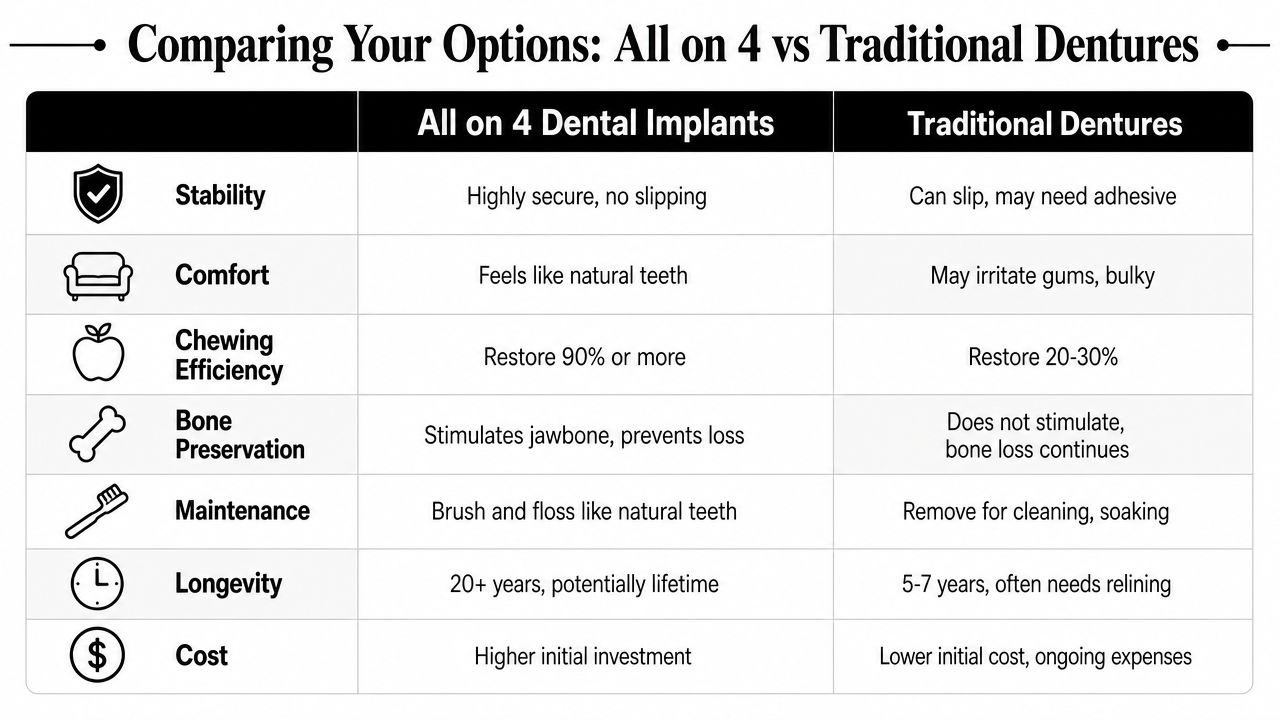
Traditional dentures rest on the gums. All-on-4 is supported by implants placed in the jawbone. That difference affects how stable your teeth feel when you talk, chew, laugh, and go through a normal day.
Here is what patients usually want to compare first:
| What matters day to day | All-on-4 | Traditional dentures |
|---|---|---|
| Stability | Fixed in place | May move during eating or speaking |
| Comfort | Feels more secure | Can create sore spots |
| Cleaning | Similar to caring for fixed teeth | Removed for cleaning and soaking |
| Confidence | No adhesive routine | Often requires more day-to-day management |
The practical trade-off is simple. Dentures usually cost less up front and avoid implant surgery. All-on-4 asks for a larger investment and a surgical process, but it gives many patients a more fixed, natural-feeling routine.
A removable denture can be a good choice for someone who wants a non-surgical option or needs a lower initial cost. It still has limits. Over time, many denture wearers deal with adjustments, sore spots, relines, replacement appliances, and the inconvenience of taking teeth in and out every day.
All-on-4 is built around a different goal. The aim is to provide a fixed full-arch restoration that stays anchored and functions more like permanent teeth. The better question may be this: which option fits the way you want your mouth to feel every morning, every meal, and every conversation?
A lower upfront fee can still lead to more ongoing maintenance, more frustration, and a result that feels less secure.
Traditional dentures may still be the right answer for patients who prefer removable teeth, want to avoid surgery, or need a shorter-term solution. All-on-4 often makes more sense for patients who want stronger bite function, better stability, and fewer daily compromises.
In my office, that conversation is rarely theoretical. Some patients first come in because a denture cracked, a loose tooth became painful, or they need urgent care before they can even think clearly about long-term treatment. Once the immediate problem is handled, we can compare whether continued denture treatment or implant support makes better sense clinically and financially.
For patients weighing the financial side, it helps to look at both the treatment fee and the years that follow. Resources on how to pay for dental implants can help you organize that decision, and broader guidance on managing healthcare costs may also be useful if you are comparing larger out-of-pocket expenses.
A patient in Fair Lawn will often sit down in my office and ask two questions after we discuss All-on-4. Can I afford this, and will insurance help at all? Those are the right questions to ask early, because the financial plan should be as clear as the clinical plan.
Dental insurance rarely pays for a full-arch implant case from start to finish. Some plans may help with specific parts of treatment, such as extractions, scans, sedation, or sections of the final prosthetic work. The details depend on your policy, annual maximum, waiting periods, and whether implant treatment is excluded.
That is why benefit verification matters. At Dental Professionals of Fair Lawn, we review what your plan may contribute and show you where out-of-pocket costs are likely to fall before treatment begins.
Financing often fills the gap between what insurance may cover and what you want to do now, rather than delaying care for another year or two.
Patients usually handle this investment better when they break it into parts instead of looking at one large number.
Start with insurance. Then review monthly payment options. If you have pre-tax funds available, check whether they can be used for any portion of care. If timing is tight, ask whether treatment can be staged safely without compromising the result.
If you want to review managing healthcare costs, that can help you sort out how health savings tools and larger medical expenses fit together before your consultation.
You can also read our guide on ways to pay for dental implants before you come in. Patients who do that tend to ask better questions and feel less blindsided by the numbers.
The most useful financial conversation is not only about price. It is about what the fee includes in this office, here in New Jersey.
Ask these questions:
I encourage patients to ask for clarity in plain language. A lower quote can look attractive until you realize it leaves out pieces that still have to be paid for later. Clear financial planning reduces stress and helps you make a decision based on the full picture, not a partial number.
The first appointment is usually less dramatic than patients expect. Patients often come in carrying years of frustration, but the visit itself is calm. The goal is to understand what's happening in the mouth, what can be saved, what can't, and whether a fixed full-arch plan is the right path.
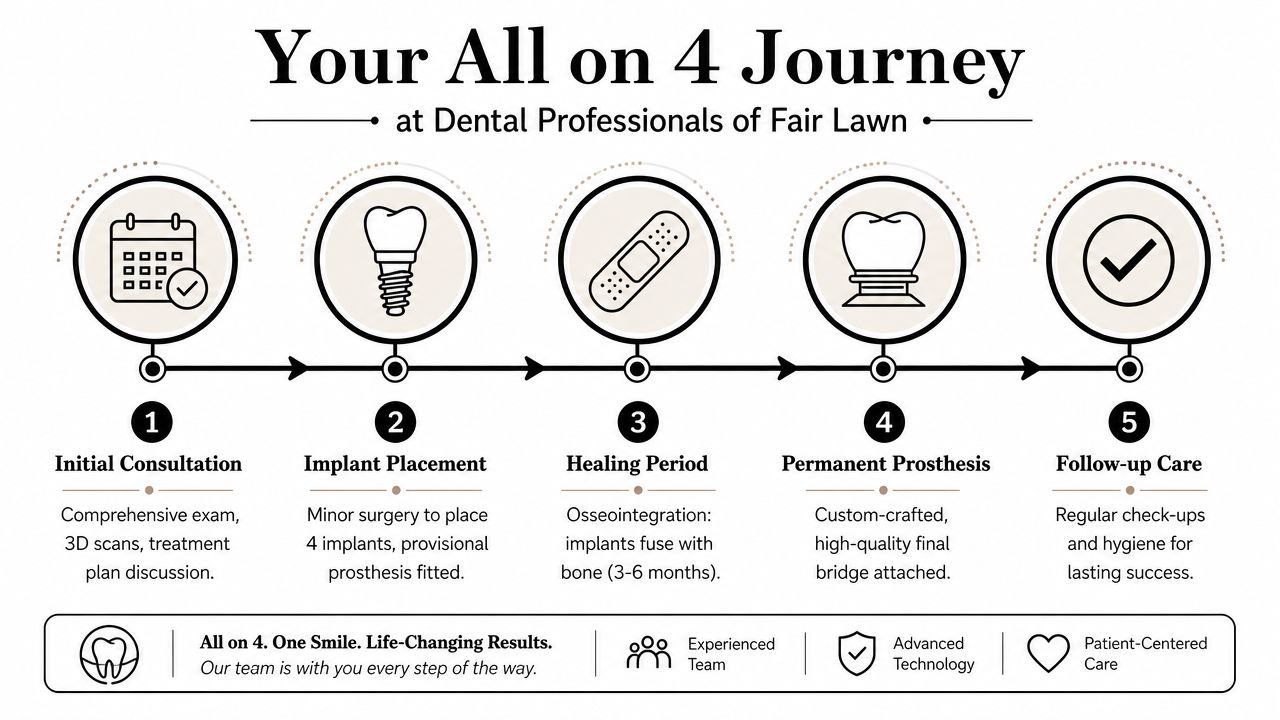
Dr. Jody Bardash begins with a detailed exam, imaging, and treatment planning. That planning may include digital records, facial analysis, and a close review of bite support, bone levels, gum health, and smile goals. If a patient first came in searching for a dentist in Fair Lawn, NJ because of pain, failing teeth, or difficulty chewing, the path to a long-term solution starts here.
Some patients need preliminary treatment. That might mean periodontal care, extractions, or stabilizing infection before surgery. Others are ready to move directly into implant planning.
Once the plan is finalized, implant placement is scheduled. Sedation options are discussed in advance for patients who feel anxious or who want a more relaxed experience. That's especially helpful for anyone who has delayed care because of dental fear.
In many cases, patients leave surgery with a temporary set of teeth, so they don't go through healing without a smile. The temporary phase lets the implants heal while preserving appearance and basic function.
Most anxiety comes before the first appointment. Once patients understand the sequence, the process feels far more manageable.
Healing takes time because the implants need to integrate with the bone. During that phase, the temporary prosthesis does important work, but it isn't the finish line. The final prosthesis is custom-made after healing so the bite, fit, and appearance can be refined.
One option patients in Fair Lawn can review is the practice's All-on-4 implant supported dentures service, which outlines the fixed full-arch approach and how it fits into broader implant care.
Long-term success depends on maintenance. That means routine checkups, professional hygiene visits, and home care. Patients who already value regular dental care, from new patient exams to dental x-rays and preventive visits, usually adapt well because the habit is already there.
This is also why full-arch implant treatment belongs inside a complete dental practice, not as a one-time procedure detached from future care. If something changes, if a bite needs adjustment, or if other restorative or cosmetic needs come up later, the patient already has a dental home.
Patients usually expect this to be the hardest part. In practice, the procedure itself is controlled with local anesthesia, and sedation can be arranged based on the treatment plan and your comfort level.
After surgery, soreness, swelling, and fatigue are normal for the first several days. What matters is preparation. Clear instructions, the right medications, and a realistic recovery plan make a big difference. I tell patients in Fair Lawn to plan for rest, soft foods, and a lighter schedule at the start.
Dental anxiety should be discussed early, not saved for the day of surgery.
Recovery happens in stages. The first stage is the short recovery from the procedure, when tenderness and swelling improve. The second stage is the healing inside the bone, which takes longer and determines how stable the implants become over time.
Many patients return to desk work and regular errands within a few days, but chewing has to be handled carefully while healing continues. That timeline varies from person to person. Bone quality, general health, smoking, and how closely instructions are followed all affect the pace.
The implants themselves are meant to serve as a long-term foundation. The attached teeth can also last for many years, but they are still dental restorations, which means wear, bite pressure, and maintenance matter.
This is one of the trade-offs patients should understand. All-on-4 is fixed and far more stable than a removable denture, but it is not maintenance-free. Professional cleanings, routine exams, home care, and occasional repairs or replacement of worn components are part of owning this type of restoration.
A clear treatment plan should spell out what is included before treatment starts. That is one of the biggest differences between a generic price quote and a real case review.
In our Fair Lawn office, patients usually want to know whether the quoted fee includes imaging, extractions if needed, sedation, the temporary set of teeth, the final prosthesis, and follow-up visits. Those details matter more than a broad national average because two treatment plans with similar sticker prices can cover very different services.
Ask direct questions. If a fee seems low, find out what is not included.
Often, yes. Failing teeth, gum disease, broken dental work, bone loss, and years of denture frustration are common reasons people start asking about All-on-4 in the first place.
The right answer depends on diagnosis, not guesswork. Some patients are ready for treatment after imaging and an exam. Others need periodontal care, extractions, or a broader plan before implants make sense. The goal is not to force every patient into the same solution. The goal is to choose a treatment that fits the health of the mouth, the budget, and long-term expectations.
If you're ready to stop guessing about costs and start getting real answers, schedule a consultation with Dental Professionals of Fair Lawn. Patients in Fair Lawn, Glen Rock, and Ridgewood can get a clear evaluation, a personalized treatment plan, and a straightforward discussion of whether All-on-4 is the right fit for their smile, comfort, and budget.