Fastest Way to Straighten Teeth: Options in Fair Lawn
Find the fastest way to straighten teeth in Fair Lawn, NJ. Compare Invisalign, braces & veneers. Get timelines, costs, and risks. Contact us for a consultation.
Find the fastest way to straighten teeth in Fair Lawn, NJ. Compare Invisalign, braces & veneers. Get timelines, costs, and risks. Contact us for a consultation.
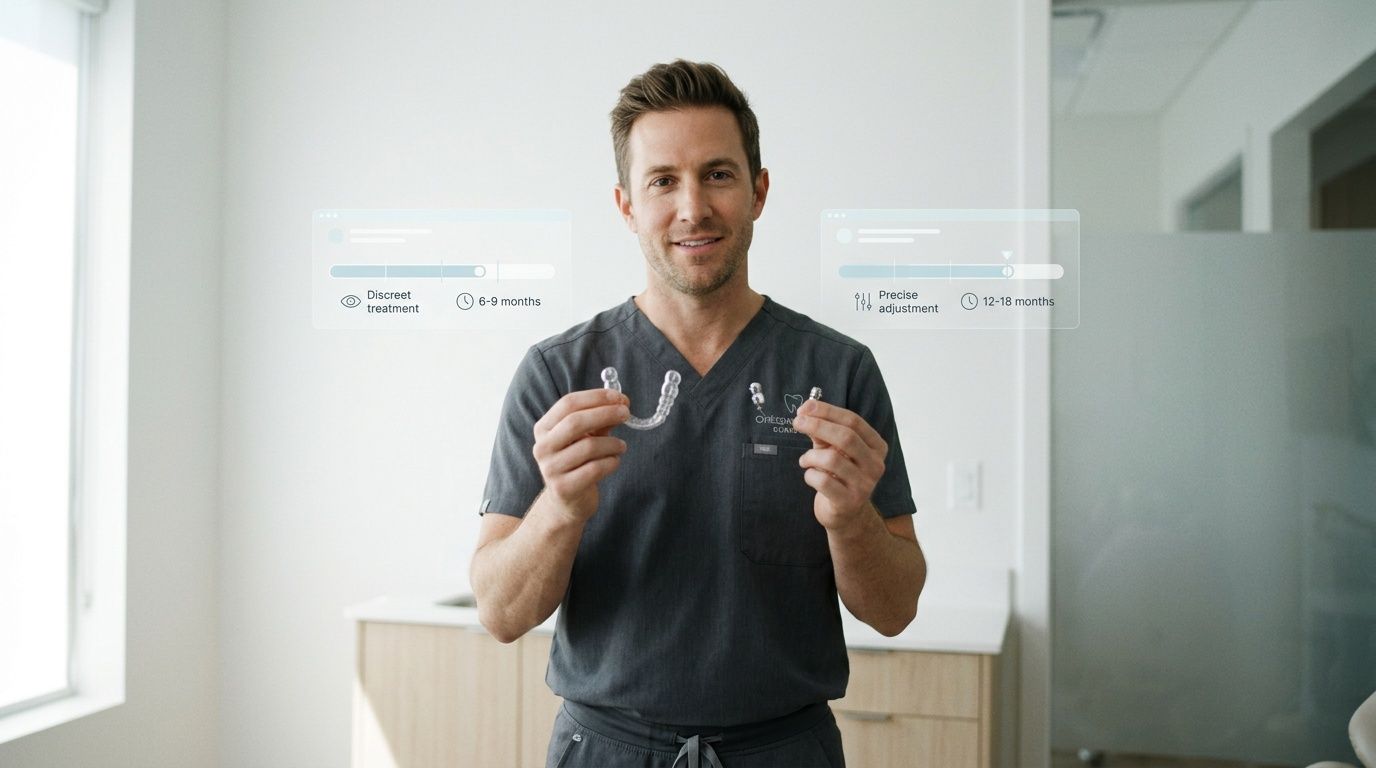
If you're looking in the mirror before work, tilting your head a little, wondering whether now is finally the time to fix crowded or uneven teeth, you're not alone. Many people in Fair Lawn, Ridgewood, and Glen Rock start the same way. They have a wedding coming up, a reunion on the calendar, a graduation, a new job, or they’re just tired of smiling with their lips closed in photos.
Most patients asking about the fastest way to straighten teeth want a simple answer. The truth is more useful than simple. The fastest option depends on what you're trying to fix, how visible you want treatment to be, how much daily discipline you're comfortable with, and whether you want a cosmetic shortcut or real orthodontic correction.
In consultation, that’s usually where the conversation starts. One person wants the front teeth to look better quickly. Another wants to correct crowding but keep treatment discreet. Someone else asks whether veneers would be faster than Invisalign. Those are all reasonable questions, but they don’t have the same answer.
A patient sits down and says, “I have a wedding in six months. Can you straighten my teeth before then?” That is a fair question, and it comes up often. The answer depends on what needs to change, how quickly the teeth can move safely, and whether the goal is a fast cosmetic improvement or a correction that also holds up well over time.

Speed matters, but it is only one part of the decision. In practice, the best treatment plan balances four things. Time, cost, how much tooth movement is needed, and whether the result is meant to be a short-term cosmetic fix or true orthodontic treatment. That distinction matters. A smile can look straighter quickly without correcting the bite, and that may be appropriate in some cases. In others, it leaves the underlying problem untouched.
Patients usually arrive asking for the fastest way to straighten teeth, but the better question is more specific. Do you want the front teeth to look better soon? Do you want to correct crowding throughout the arch? Do you want the result to be as conservative as possible? Do you want the shortest path, even if it means a cosmetic restoration instead of moving teeth?
Here is how I frame the trade-offs in consultation:
That is why quick does not always mean simple.
Many people also do their homework before scheduling a visit. If you want to see how local dental information is published online and why some resources show up more often than others, Rankai's guide for dental SEO offers useful background.
A local consultation still matters more than any online summary. A patient in Fair Lawn with minor spacing may be a candidate for a relatively fast, conservative option. A patient with crowding, bite imbalance, gum concerns, or past dental work may need a very different plan. The right starting point is an exam, imaging, and a clear conversation about what will be fastest, what will last, and what is not worth rushing.
Straight teeth are often treated like a purely cosmetic goal. They aren’t. A straighter smile can improve appearance, but alignment also affects how teeth meet, how evenly they wear, and how easy they are to clean.
When teeth are crowded, rotated, or spaced irregularly, brushing and flossing become harder. That can make routine dental care less effective. When the bite is off, certain teeth can take more force than they should, which may contribute to chipping, wear, or strain over time.
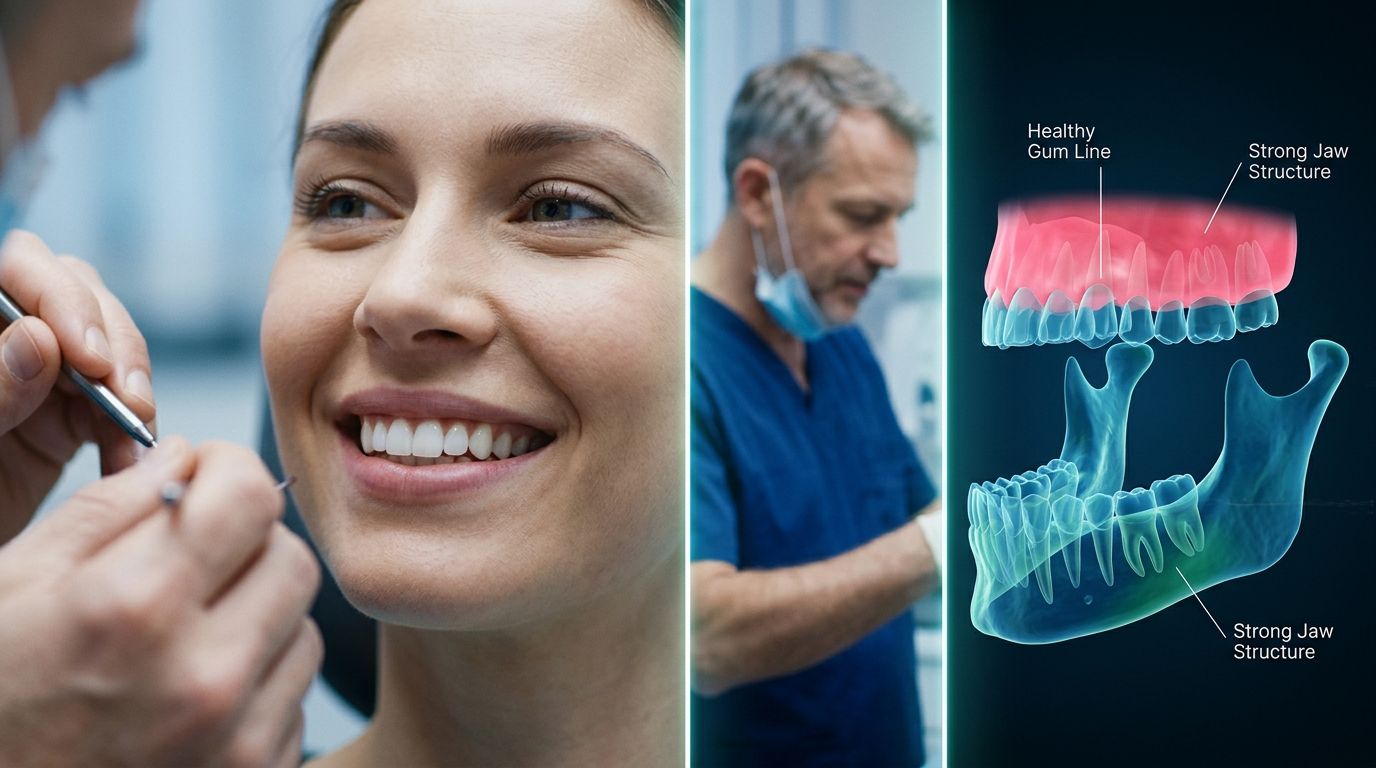
For many patients, the clearest explanation is often necessary. Some treatments focus mainly on the front teeth. That can be useful if the main concern is how your smile looks in photos or conversation. Other treatments address the entire bite, including the way upper and lower teeth fit together.
A front-tooth cosmetic correction can be a smart choice in the right case. But if someone has a deeper bite issue, jaw discomfort, or tooth wear, limiting treatment to what shows when you smile may leave the underlying problem in place.
A smile can look straighter and still function poorly if the bite was never corrected.
Not every alignment issue causes symptoms, but these are some of the problems we often evaluate together:
For some patients, this connects directly to other treatment areas. A person considering cosmetic dentistry may also need restorative dentistry if older fillings or worn edges are involved. Someone with bite strain may also need evaluation for TMJ or TMD symptoms. Straightening teeth isn’t isolated from the rest of oral health.
When alignment improves, many patients notice practical benefits in daily life:
That’s why the fastest way to straighten teeth isn’t always the one with the shortest calendar time. Sometimes the better choice is the one that gives you a healthier bite and fewer long-term compromises.
A patient sits down and says, “I want straighter teeth fast.” My first response is usually another question. Do you mean the fastest cosmetic change, or the fastest path to a healthy, stable result?
Those are not always the same treatment.
Some options move visible front teeth quickly. Others take longer but correct the bite more fully and tend to hold up better over time. The right choice depends on how much movement is needed, how disciplined you can be with home care, and whether speed matters more than long-term control.
| Method | Best fit | Appearance | Typical timeline | What to know |
|---|---|---|---|---|
| Clear aligners | Mild to moderate crowding or spacing, patients who want removable treatment | Nearly invisible | Often faster for simpler cases, with timing varying by complexity, as outlined in this overview of tooth straightening methods | Requires disciplined wear every day. Good cosmetic appeal, but compliance affects speed |
| Six Month Smiles | Adults focused mainly on cosmetic straightening of the front teeth | Less noticeable than traditional braces | Around six months in selected cosmetic cases | Usually improves the front smile more than the overall bite |
| Self-ligating braces such as Damon | Patients needing broader tooth movement with a fixed-braces approach | Visible, though some options are less noticeable | Often efficient for cases that need stronger control | Useful when aligners are unlikely to stay on track or when movements are more complex |
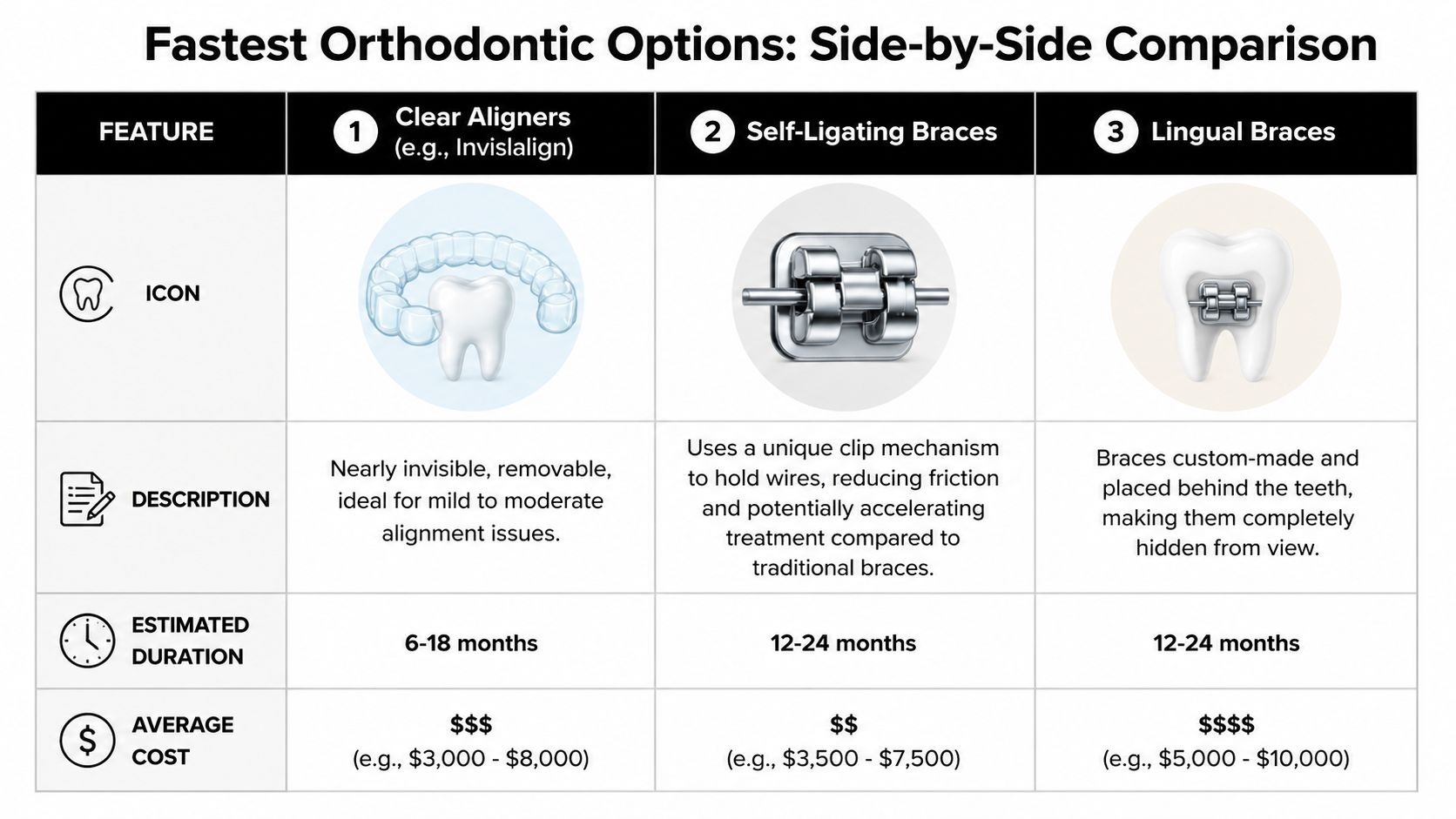
Clear aligners are often the first option adults ask about, and for good reason. They are discreet, removable, and efficient for many mild to moderate alignment problems.
They also come with a trade-off. Aligners only work if they are worn as prescribed. A patient who keeps them in consistently can move through treatment efficiently. A patient who removes them for long meals, coffee, or social events can turn a short plan into a much longer one.
Clear aligners are often a good fit for patients who:
Digital scanning helps here. It lets us map tooth movement in advance, review likely staging, and show patients where the plan is straightforward and where it may become less predictable. That use of technology also matters for improving dental patient experience, especially when patients want a clearer picture of timing and daily expectations before starting.
Six Month Smiles appeals to a very specific patient. The usual goal is not a full bite correction. The goal is to improve the visible front teeth on a shorter timeline.
That can be a smart choice for the right case. If the bite is already fairly stable and the main concern is crowded, spaced, or uneven front teeth, short-term braces can produce a noticeable cosmetic improvement quickly. If back teeth, jaw position, or bite imbalance are part of the problem, the same “fast” option may leave the larger issue untouched.
This is one of the biggest consultation points I discuss with patients. Fast cosmetic straightening can look great in photos and still fall short if the teeth are difficult to keep stable afterward.
For readers comparing fixed options built around shorter treatment windows, rapid braces treatment information can be a helpful reference.
Self-ligating braces, including Damon-style systems, use a bracket design that reduces the need for elastic ties. In practice, that can mean less friction in some stages of treatment and better control for movements that aligners do not always handle as predictably.
These braces are often a better tool when the case involves more than simple front-tooth alignment. Rotations, vertical changes, arch development, and bite correction usually need more direct mechanical control. In those cases, a fixed appliance may be the faster route to the finish because the treatment is working all the time, not only when the patient remembers to wear it.
Braces often make more sense when:
This is also where patients should be careful with unsupervised “fast” options online. Mail-order trays and DIY approaches can promise speed, but they do not replace an in-person evaluation of roots, bone support, bite forces, or gum health. Straight teeth that look better for a short time but create instability, gum problems, or a worse bite are not a good bargain.
| Priority | Often points toward |
|---|---|
| Lowest visibility | Clear aligners |
| Fast cosmetic change in front teeth | Six Month Smiles |
| More fixed control for broader movement | Damon or other self-ligating braces |
| Easier brushing and flossing during treatment | Clear aligners |
| Less reliance on daily self-discipline | Fixed braces |
The fastest option is only the best option if it matches the biology and the goal. In practice, the strongest results come from choosing the method that balances speed, cost, permanence, and how much treatment your bite needs.
A common consultation goes like this. A patient wants the health and stability of real orthodontics, but asks whether there is any safe way to shorten the timeline. In some cases, yes. The answer depends on biology, the type of tooth movement needed, and how much treatment is being done.
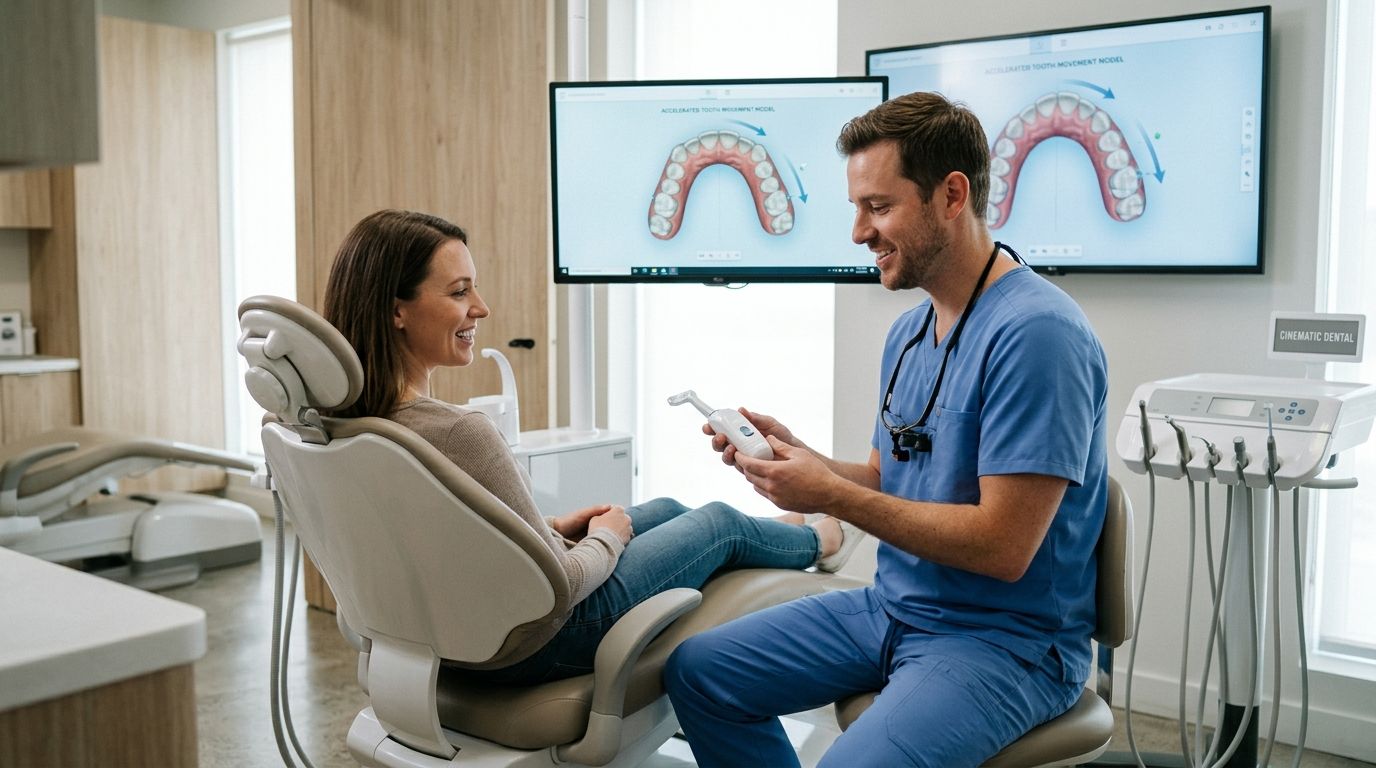
One option with meaningful clinical interest is Propel, which uses micro-osteoperforations, often called MOPs. These are small perforations placed near the teeth being moved to stimulate a local healing response. The goal is faster bone remodeling so teeth can respond more efficiently to orthodontic forces.
According to this clinical review of Propel and accelerated aligner treatment, micro-osteoperforations can increase bone turnover by 2 to 2.3 times. The same source reports that some appropriate cases have finished much sooner than expected.
That kind of acceleration is not automatic, and it is not for every patient. I look at gum health, bone support, bite complexity, and the predictability of the planned movement before recommending it.
Acceleration methods can shorten treatment in the right case, but they do not turn a complex orthodontic problem into a simple one. A patient with severe crowding, difficult root movement, or a bite that needs careful coordination still needs controlled treatment. The accelerator supports the process. It does not replace sound mechanics.
That distinction matters.
Patients usually benefit most from acceleration when:
For patients comparing fast options, this is often the middle ground. You keep the long-term advantages of true tooth movement while trying to reduce treatment time in a measured, supervised way. That is very different from cosmetic masking, such as porcelain veneers for smile enhancement, which can change appearance quickly but does not reposition teeth or roots.
A lot of modern dental technology is built around making treatment more predictable and easier to experience. For a broader patient-friendly look at that trend, improving dental patient experience offers a useful overview of how technology can reduce friction in care.
Here’s a brief visual overview of one acceleration approach patients often ask about:
Patients also ask about vibration devices and light-based systems. These tools are marketed as ways to help teeth move faster or make aligner treatment more efficient. In practice, the evidence is mixed, and the benefit is less predictable than many ads suggest.
A systematic review in Progress in Orthodontics examining photobiomodulation and other noninvasive methods found that study results vary, and treatment decisions still need to be based on case selection rather than marketing claims. That matches what I tell patients in the chair. If an adjunct has a role, it should fit the mechanics of the case and the health of the tissues.
Acceleration can be worthwhile, but it adds its own considerations. Some methods involve extra procedures, extra appointments, or extra cost. The trade-off can be reasonable for a patient who wants a shorter timeline and is a strong candidate. It is not a shortcut around poor aligner wear, untreated gum inflammation, or a difficult bite.
The fastest route is only useful if the result is stable and healthy. In my view, that is the right standard. A few months saved matters less than finishing with teeth that look good, function well, and stay where we put them.
Some of the fastest smile transformations don’t move teeth at all. They mask the appearance of crookedness instead. That’s where veneers and bonding enter the conversation.
This is why the phrase “instant orthodontics” can be misleading. Veneers and bonding can change what the front of the teeth looks like very quickly, often in a very short cosmetic treatment sequence, but they aren’t orthodontics. They don’t reposition roots, and they don’t correct the way teeth bite together.
For the right patient, these treatments can be useful. A person with minor visual irregularities, small gaps, worn edges, or a tooth shape issue may be better served by cosmetic dentistry than by months of tooth movement.
Bonding can sometimes smooth or reshape a smile conservatively. Veneers can create a dramatic change in color, contour, and apparent alignment. For the patient whose concern is appearance alone, that can be appealing.
But the trade-offs have to be discussed clearly.
Veneers can make teeth look straighter, but they don’t solve bite imbalance, grinding patterns, or root position. They also require a permanent decision. Enamel removal is irreversible, and once that path is chosen, the teeth will need ongoing maintenance over time.
According to this discussion of veneers versus orthodontic correction, veneers may debond or fracture in 10 to 20% of cases within 5 to 10 years. That same source points out the central difference: orthodontic treatment repositions the teeth and roots for a more lasting alignment, while veneers mainly change the visible surface.
That distinction matters.
Patients benefit from a direct answer. If you want the fastest visible change, veneers may be faster than aligners or braces. If you want the teeth straightened, veneers are not the fastest way to straighten teeth because they do not straighten teeth.
That doesn’t make veneers wrong. It means they belong in the cosmetic category, not the orthodontic category.
For patients considering surface-level smile changes as part of a broader plan, porcelain veneers in New Jersey can be reviewed alongside orthodontic options so the decision is made with the full picture in mind.
The right choice usually becomes clearer when you stop asking, “What’s fastest?” and start asking, “Fastest for what outcome?”
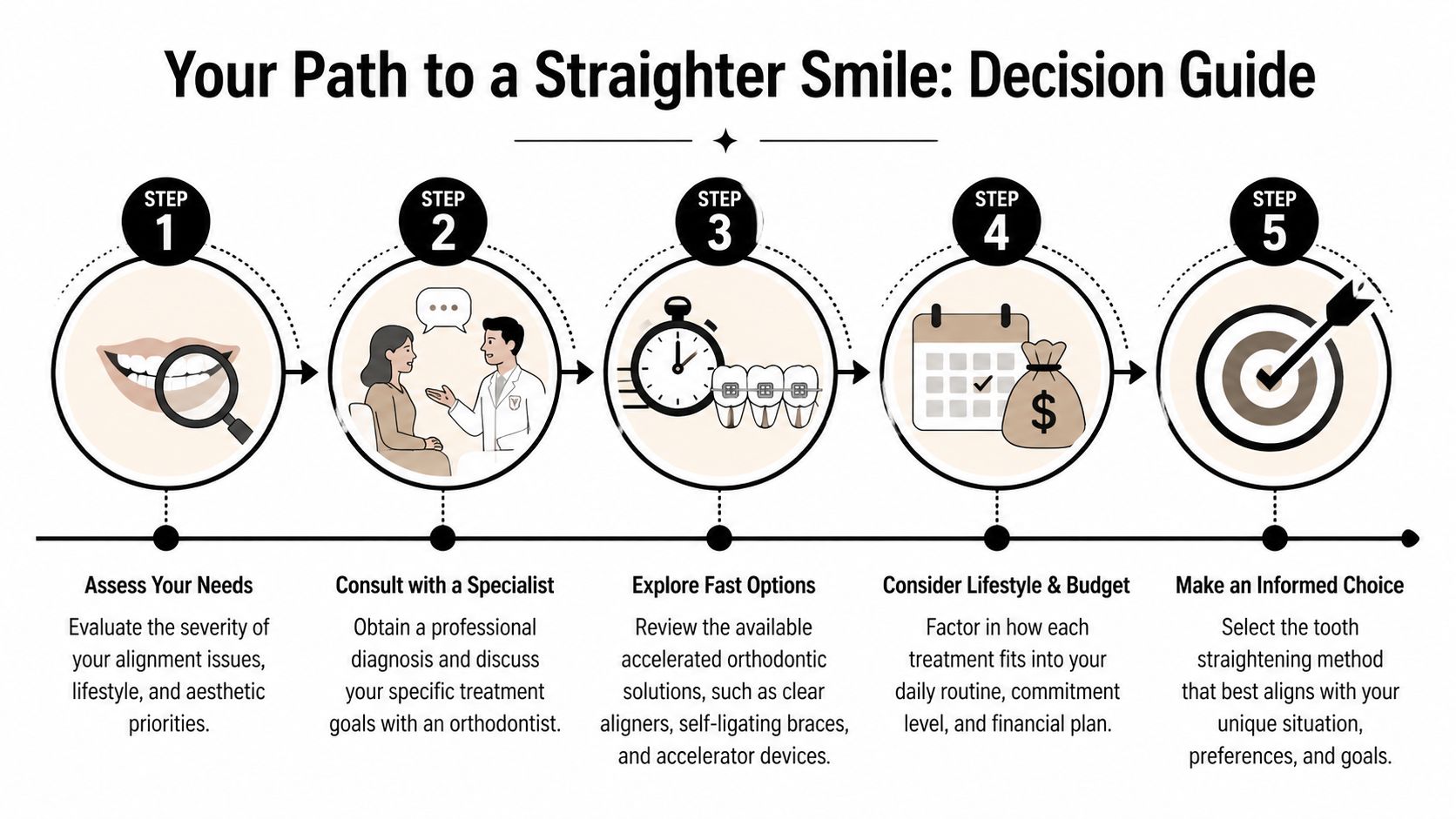
If your main concern is discretion and you’re willing to wear trays as directed, clear aligners are often a strong fit. They move teeth with impressive precision. Modern aligners can achieve about 0.1 to 0.2 mm of tooth movement every two weeks, and comparative data in this review of aligner movement precision reports Invisalign reduced crowding by 5.2 mm in 6 months in measured anterior alignment comparisons.
If your main concern is your front teeth before an upcoming event, a short-term cosmetic braces approach may make more sense than full extensive treatment.
If your concern is bite function, rotations, or more complex movement, a fixed system may be the more dependable path, even if it doesn’t sound as sleek at first glance.
Patients usually land in one of these categories:
You want the least visible option
Clear aligners are usually the first place to look.
You want front-teeth improvement on a shorter cosmetic timeline
Short-term braces may be more aligned with that goal.
You want the most thorough correction
A full orthodontic plan with either aligners or braces is usually more appropriate than a cosmetic-only approach.
You want the fastest visible result no matter what
Then you need to decide whether you mean actual tooth movement or cosmetic camouflage.
Choose based on the problem you want solved, not just the calendar.
DIY and mail-order aligner systems often sound simple because they promise speed and convenience. The issue is supervision. If tooth movement isn’t tracked carefully, what looks like a shortcut can turn into delays, poor tracking, or a bite that needs correction later. When patients want fast treatment, professional diagnosis and monitoring matter more, not less.
A first visit for tooth straightening shouldn’t feel confusing or rushed. It should feel organized, calm, and specific to your goals.
Most consultations begin with a conversation about what’s bothering you. Some patients say they hate one crooked front tooth. Others mention crowding, bite discomfort, old dental work, or a timeline tied to a life event. All of that helps shape the recommendation.
At the visit, the exam typically includes a close look at tooth position, bite relationship, gum health, and any signs of wear or clenching. Digital imaging helps show what’s happening beyond what you can see in the mirror. If orthodontic treatment is being considered, digital scanning can create a 3D model of the teeth and help map possible tooth movement with much greater clarity than old-style impressions.
That planning step is where many patients finally understand their options. A case that seems simple cosmetically may reveal a bite issue. Another case that looks severe at first glance may, in fact, be very manageable with the right appliance.
This is also when treatment choices are narrowed down. Dr. Bardash reviews what’s clinically appropriate, what would be cosmetic only, and where speed can safely be increased. If you’re anxious about dental treatment, comfort options including sedation can be discussed so the process feels manageable from the beginning.
Patients from Fair Lawn, Ridgewood, and Glen Rock also often ask practical questions at this stage:
Those questions should be answered clearly before anything starts. Good orthodontic planning isn’t just about moving teeth. It’s about making sure you understand why a specific option fits your mouth, your timeline, and your priorities.
No. Adults straighten their teeth every day. The deciding factors are usually gum health, bone support, bite condition, and the type of movement needed, not age alone.
Not necessarily. Some soreness is normal when teeth begin to move or when appliances are adjusted, but modern systems are generally more comfortable than many patients expect. Comfort also depends on the appliance chosen and how the treatment is paced.
Yes. Retention is part of treatment, not an optional extra. Teeth have a natural tendency to shift after movement, so retainers help protect the result once alignment is complete.
Sometimes, but only if your goal is cosmetic masking rather than true tooth movement. Veneers can improve the look of mild irregularity, but they don’t correct the bite or reposition roots.
That’s common. A consultation is the right place to ask every question, talk through comfort concerns, and understand the timeline before making any decision.
If you're searching for a dentist near me in Fair Lawn, NJ, and you want a clear, honest recommendation on the fastest way to straighten teeth, schedule a consultation with Dental Professionals of Fair Lawn. You’ll get a personalized evaluation, a realistic timeline, and guidance on whether Invisalign, Six Month Smiles, braces, or cosmetic treatment makes the most sense for your smile and long-term oral health.