Emergency Dental Care Weekends in Fair Lawn, NJ
Get immediate emergency dental care weekends in Fair Lawn, NJ. Find urgent treatment and pain relief when you need it most. Call us now for help.
Get immediate emergency dental care weekends in Fair Lawn, NJ. Find urgent treatment and pain relief when you need it most. Call us now for help.
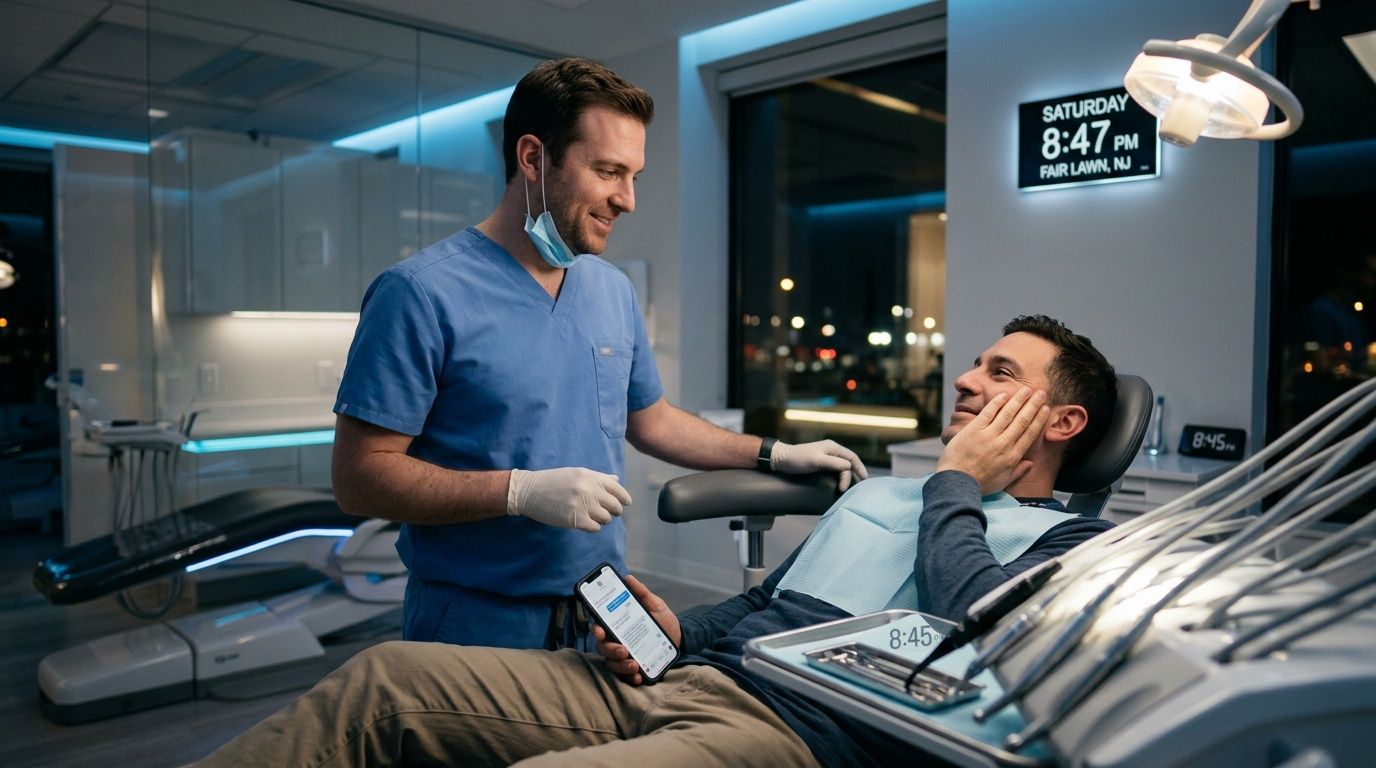
Saturday morning tooth pain has a way of making everything feel urgent. You wake up hoping it will pass, then the ache sharpens when you drink coffee, bite down, or even breathe in through your mouth. By afternoon, many people are asking the same questions: Can this wait until Monday? Should I go to the ER? Is there an emergency dentist near me in Fair Lawn who can fix this?
That uncertainty is part of what makes weekend dental problems so stressful. Dental emergencies don't follow office hours, and they're common enough that many people end up seeking hospital care when a dental office would be the more useful place to start. The CDC reported that tooth disorders accounted for an annual average of 1,944,000 emergency department visits during 2020 to 2022 in the U.S., which shows how often people need help when regular care isn't available on time (CDC data brief on tooth-disorder ED visits).
In Fair Lawn, Ridgewood, and Glen Rock, the better first move for most tooth-related emergencies is usually prompt dental evaluation, not waiting it out and not guessing. Emergency dental care weekends should give you clarity, pain relief, and a practical plan.
A common weekend call sounds like this: “My tooth started hurting last night, now my cheek feels sore, and I don't know if I should go to the hospital.” Sometimes it's a cracked molar after dinner. Sometimes it's a crown that came loose while chewing. Sometimes a parent is trying to decide whether a child's dental injury needs immediate care or careful home monitoring.
What matters most in those first moments is knowing that your problem is real, and that you're not overreacting by looking for help.
Many people assume severe tooth pain is something to endure until Monday. In practice, that often leads to a longer, rougher weekend, and sometimes to a hospital visit that doesn't solve the dental problem itself. Weekend access exists because the need is real, not because it's just convenient.
The reason this matters goes beyond comfort. When dental pain hits after hours, patients often turn to settings that can address general medical risk but not the tooth itself. For practices serving Fair Lawn and nearby communities, weekend emergency care fills that access gap by moving patients toward definitive treatment instead of temporary relief alone.
A weekend dental visit should help you make a decision quickly: treat now, stabilize safely, or go straight to the hospital if the problem involves breathing, major trauma, or uncontrolled bleeding.
That same pressure is why clinics are increasingly using tools that help patients communicate symptoms clearly before arrival. If you're interested in how practices organize those first contacts, this overview of a digital assistant for clinics gives a useful look at how after-hours triage can guide people toward the right next step without adding more confusion.
If you're in Fair Lawn and your pain is escalating, the first goal isn't to diagnose yourself perfectly. It's to decide whether you need immediate dental care, home support until your visit, or emergency medical help.
That decision gets easier when you focus on symptoms, not fear.
Not every dental problem needs a same-hour appointment. Some do. The key is separating true emergencies from problems that are urgent but reasonably stable for a short period.

These symptoms usually deserve prompt attention from an emergency dentist in Fair Lawn:
Some issues may be manageable until the next available dental visit if you're otherwise stable:
Go to the hospital ER if the situation involves your overall safety, not just the tooth.
Act fast: trouble breathing, trouble swallowing, major facial injury, heavy uncontrolled bleeding, or swelling that seems to be spreading beyond the mouth needs medical evaluation right away.
A helpful rule is this: if the problem threatens your airway, involves significant trauma, or you can't control the bleeding, think medical emergency first. If the problem is centered on the tooth, gum, crown, filling, or bite, an emergency dentist is usually the more direct path.
When you're waiting for a weekend dental visit, the goal at home is simple: reduce pain, protect the tooth, and avoid making the problem worse.

Start with gentle basics. Rinse with warm water. Floss carefully around the area in case food is packed between the teeth. If your cheek feels swollen, use a cold compress on the outside of the face in short intervals.
Don't place aspirin directly on the gum or tooth. That can irritate soft tissue and won't treat the source of the pain.
Rinse your mouth to clear debris. If there's bleeding, use clean gauze with firm pressure. If the edge is sharp, cover it temporarily with dental wax if you have it, or avoid chewing on that side until you're seen.
Save any broken piece you can find. Bring it with you.
Keep the crown if you have it. Don't force it back into place if it doesn't seat easily. A loose crown can sometimes be temporarily protected, but a poor fit can create more irritation or damage.
If the exposed tooth is sensitive, avoid hot, cold, and sticky foods.
Handle the tooth by the crown, not the root. If it's dirty, rinse it gently. Don't scrub it. Keep it moist while you seek care.
This short video walks through basic emergency response for common tooth injuries and weekend pain:
A lot of weekend problems get worse because patients try to “fix” them at home.
Pain relief at home is a bridge, not the treatment. If symptoms are building, use home care while you arrange evaluation, not instead of it.
It's Saturday night, your tooth is throbbing, and the swelling seems worse than it was this afternoon. In that moment, the decision matters. The right place depends on whether the problem is primarily dental or whether it has become a broader medical risk.

| Where to go | Usually the right choice for |
|---|---|
| Hospital ER | Difficulty breathing, trouble swallowing, severe facial trauma, suspected jaw fracture, uncontrolled bleeding, infection with fever or swelling spreading into the face or neck |
| Emergency dentist in Fair Lawn | Toothaches, pressure from a dental infection, broken teeth, lost crowns or fillings, injuries to teeth, painful wisdom teeth, urgent extractions, root-related pain |
The difference is practical. A hospital is equipped to stabilize medical emergencies. A dental office is equipped to identify which tooth is causing the problem, take dental X-rays, numb the area, drain certain infections, repair damage, or remove the source of pain if that is the right next step.
That distinction matters on weekends. Many dental problems feel severe, but they still need dental treatment to improve.
Go to the ER if you have swelling that is making it hard to breathe or swallow, bleeding that does not stop with pressure, significant facial injury, or a possible broken jaw. Those are medical emergencies first.
The ER may also be appropriate if you have a dental infection and you feel systemically ill, especially with fever, facial swelling that is spreading, vomiting, dehydration, or weakness. In those situations, the immediate priority is protecting your airway and overall health.
If the pain is coming from a tooth, a filling, a crown, a cracked tooth, or a localized gum swelling, an emergency dentist is usually the better first call. That includes many cases patients assume belong in the hospital.
Emergency departments often help with short-term pain control and antibiotics when infection is suspected, but they usually do not provide the dental procedure that ends the problem. The American Dental Association describes referral efforts designed to move dental patients from ERs into dental offices, because dental settings are better matched to these complaints (ADA emergency department referral programs).
If you want a more symptom-based local guide, this article on whether you should go to the ER for tooth pain breaks down the decision in more detail.
Ask two questions.
Is there a medical danger right now? If yes, go to the ER.
If not, is the problem centered on a tooth, gum area, crown, filling, or dental injury? If yes, call an emergency dentist in Fair Lawn.
Patients often worry about choosing wrong. In practice, the clearest dividing line is this: the ER handles threats to your health and safety, while a dental office handles the tooth and the tissues around it. For a painful but contained dental problem, seeing a dentist usually gives you the best chance of leaving with the cause identified and a treatment plan started that same weekend.
Weekend emergency care should feel calm, clear, and focused. If you call our Fair Lawn office on a Saturday with a swollen gum, a broken tooth, or pain that kept you up the night before, the visit is built around one goal. Find the cause, control the immediate problem, and tell you exactly what can be done today.

The first phone call matters. A short, accurate description helps us judge urgency and prepare the room, imaging, and materials for the problem you are coming in with. That saves time once you arrive, which matters when you are in pain.
Be ready to tell us:
As noted earlier, hospital ERs usually do not provide the dental procedure that ends the problem. A weekend dental visit is different. We use that call to prepare for treatment, not only to document symptoms.
Bring the basics that help us move quickly:
If you are looking for weekend emergency dental treatment in Fair Lawn, it helps to know this before you come in. Some problems can be fully treated that day. Others are better handled in two steps: stabilize the tooth now, then complete the final treatment shortly after.
A weekend appointment is not limited to a quick look and a prescription. Depending on the problem, we can often examine the area, take focused images, numb the tooth, and treat the source of pain the same day.
Common same-day care includes:
That last point matters. In some cases, the weekend visit solves the problem. In others, the right move is to reduce pain, protect the tooth, and avoid rushing into the wrong procedure.
Some treatment is better finished after the emergency has settled, especially when the tooth needs more planning, more time, or a specialist.
These situations often include:
| Problem | Weekend goal | Follow-up need |
|---|---|---|
| Broken crown or large fracture | Protect the tooth, reduce pain, stabilize structure | Final crown or restorative completion |
| Tooth needing specialist evaluation | Diagnose the cause, relieve pain, prevent worsening | Endodontic, surgical, or other specialty follow-up |
| Missing or non-restorable tooth | Remove the pain source and protect the area | Replacement planning such as bridge or implant |
| Complex cosmetic or full reconstruction issue | Stabilize the urgent concern | Restorative planning |
A good emergency visit answers two questions before you leave. What did we handle today, and what still needs to be completed?
Patients usually feel much less overwhelmed once those answers are clear. On a stressful weekend, that clarity is part of the treatment.
The weekend visit solves the immediate problem. Your part starts after you get home.

Relief can be misleading. A tooth may feel much better after pressure is reduced, the area is protected, or infection is brought under control, but the underlying problem may still be there. That is why weekend emergencies sometimes return a few days later, often at a worse time and with fewer simple options.
Before you leave, you should know three things clearly: what we treated, what still needs attention, and how soon you need to be back. If any part of that is unclear, ask before the visit ends. Patients do better when the plan is specific.
Follow the instructions you were given. Take medications exactly as directed. Keep the area clean, avoid chewing on the treated side if we told you to, and watch for warning signs such as increasing swelling, fever, uncontrolled bleeding, or pain that suddenly worsens instead of improving.
Just as important, do not treat the emergency visit as the finish line if we told you more care is needed. Temporary repairs, short-term pain control, and protective treatment are meant to buy you time safely. They are not built to carry the tooth indefinitely.
A simple way to stay on track:
In our Fair Lawn practice, weekend patients often feel calmer once they have a clear next step on the calendar. That matters. Stress drops when you know whether you are healing normally or waiting too long.
There is also a practical trade-off here. Some teeth can be monitored briefly once the urgent issue is controlled. Others need prompt follow-up to avoid reinfection, fracture, or loss of the tooth. The difference depends on the diagnosis, not just on whether the pain has faded.
If you need help after your weekend visit, contact Dental Professionals of Fair Lawn for guidance. If you develop trouble breathing, severe swelling, major trauma, or bleeding that will not stop, go to the ER immediately.