Clear Aligners vs. Traditional Braces: What's Best for You?
Deciding between clear aligners vs traditional braces? Dental Professionals of Fair Lawn, NJ, helps you find your best fit. Learn about cost, comfort & more.
Deciding between clear aligners vs traditional braces? Dental Professionals of Fair Lawn, NJ, helps you find your best fit. Learn about cost, comfort & more.
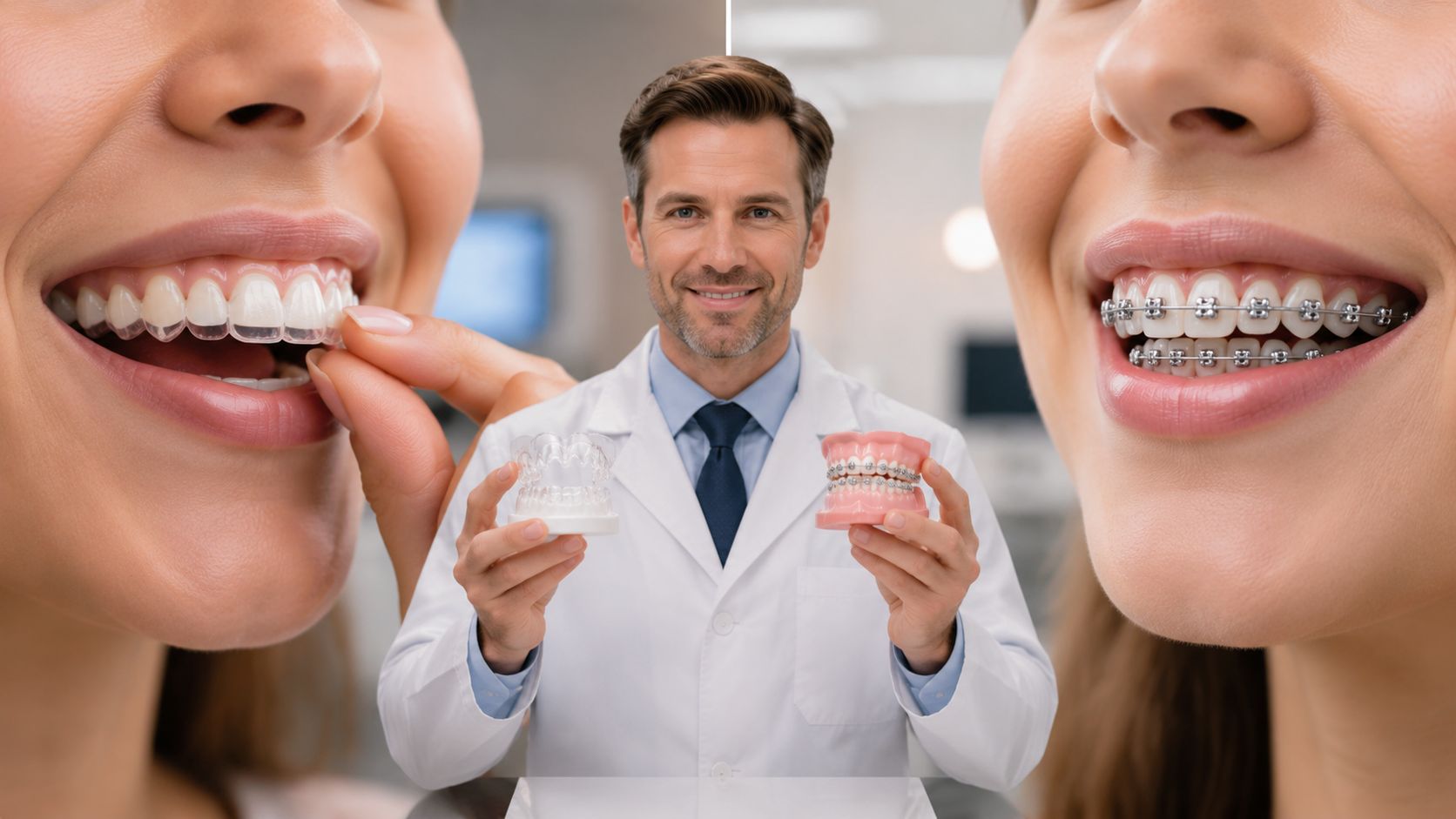
If you're comparing clear aligners and braces, you're probably already thinking beyond cosmetics. Maybe you notice your teeth in photos. Maybe your bite feels off when you chew. Maybe your teen is ready for orthodontic treatment and you're trying to choose something that fits school, sports, and daily life without adding stress.
Patients in Fair Lawn, Ridgewood, and Glen Rock often come in with the same question. They want a straighter smile, but they also want to know what will work for their case, how long treatment may take, and what day-to-day life will feel like. That matters. A treatment plan only works well when it fits both the teeth and the person.
A common situation looks like this. An adult has spent years smiling with lips closed in family photos, then finally decides it's time to fix crowding or spacing. Or a parent starts searching for a dentist near me or a cosmetic dentist near me because their child has crooked front teeth, a crossbite, or bite problems that seem to be getting more noticeable as they grow.

In communities like Fair Lawn, people want practical answers. Professionals often ask about Invisalign because they want something discreet for meetings, events, and everyday conversations. Parents may ask whether braces are still the better choice for teens who might forget to wear trays. Some patients are also balancing other needs, such as overdue cleaning and exams, dental x-rays, new patient exams, or cosmetic goals like teeth whitening after alignment is complete.
| Feature | Clear aligners | Traditional braces |
|---|---|---|
| Appearance | Nearly invisible | More noticeable |
| Removability | Yes | No |
| Best fit | Mild to moderate cases, selected bite issues | Simple to complex cases |
| Eating | Removed for meals | Food restrictions apply |
| Oral hygiene | Easier to brush and floss | More cleaning effort |
| Compliance | Requires disciplined wear | Works continuously |
| Popular options locally | Invisalign | Damon System, Six Month Smiles, metal braces |
The most useful way to think about clear aligners vs traditional braces isn't which one is better in general. It's who each option is best for and why.
What patients need most: a treatment plan that matches their bite, habits, schedule, and priorities.
In a family dental setting, that distinction matters. Someone looking for a dentist in Fair Lawn, NJ may also be planning other care, from restorative dentistry to replacing missing teeth with dental implants near me after orthodontic alignment creates the right space. Orthodontics isn't isolated from the rest of your oral health. It often works best as part of a bigger plan for function, comfort, and confidence.
Teeth move because the bone around them responds to steady pressure. That pressure has to be controlled. Too little force won't produce meaningful movement. Poorly directed force can create movements you didn't want. Good orthodontic treatment is about guiding teeth with precision, not just pushing them around.
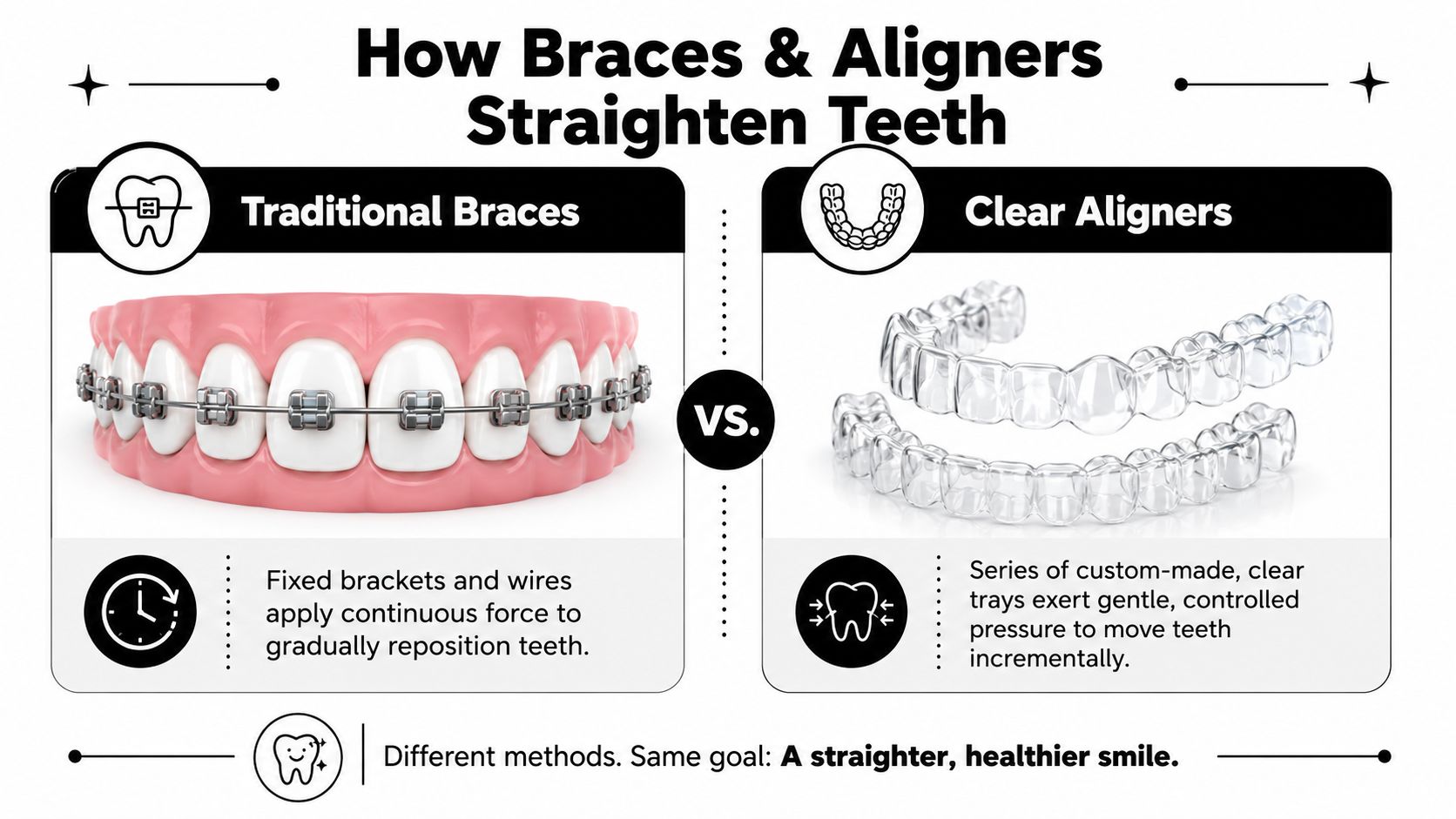
Traditional braces do this with brackets and wires attached to the teeth. The wire acts like a track. As it's adjusted, it directs teeth into better positions over time. Because braces are fixed in place, they work all day and all night without depending on memory or routine.
Clear aligners, including Invisalign, use a sequence of custom trays. Each tray is shaped to create small, planned movements. You wear one set, then move to the next set as treatment progresses. The trays are removable, which is why many adults and teens like them, but that same flexibility is also their biggest challenge. They only work when they're in your mouth.
Modern orthodontic care isn't limited to one appliance. The right office may offer several options depending on the case:
The iTero scanner changes the experience in a real way. Instead of biting into messy impression material, patients get a digital scan of their teeth. That scan helps build a more precise aligner plan and makes it easier to review how teeth fit together before treatment begins.
Not every crooked smile needs the same kind of force or the same level of control. Small spaces between teeth are different from deep bites, rotations, or crowded arches. A patient searching for an emergency dentist because of a broken tooth or a painful bite issue may eventually learn that orthodontics is part of the long-term fix, but the appliance choice has to match the problem.
Braces are attached. Aligners are removable. That one difference affects everything from control to convenience.
Some patients also discover that their orthodontic concerns overlap with cosmetic dentistry, tooth extraction, or restorative work. Straightening the teeth may create room for veneers, improve crown placement, or help distribute bite forces more evenly. That's why a full exam matters more than choosing a product name first.
A Fair Lawn parent often asks some version of the same question: which option will work faster for my teenager before school photos, or for me before a wedding, job change, or big family event in Ridgewood or Glen Rock? The honest answer is that speed depends less on the brand name and more on the kind of tooth movement the case requires, and how reliably the treatment can be carried out day after day.
For mild to moderate alignment problems, clear aligners can be very efficient. In the right case, they often finish sooner than braces. A clinical review in PubMed Central on aligner effectiveness found strong results for mild to moderate malocclusions, especially in nonextraction cases, while also noting a meaningful gap between the predicted digital setup and the final clinical result. In practice, that means some patients need refinement trays near the end, even when the case starts out looking straightforward on the scan.
That distinction matters. iTero scanning gives us an excellent digital starting point in our office, but a scan is still a plan, not a guarantee. Teeth do not always move on schedule, attachments can lose grip, and trays only work when they are worn as directed.
Braces still give us more control in cases with significant crowding, large rotations, root movement, torque changes, or bite correction that needs close finishing. For those patients, fixed treatment is often more predictable than removable treatment. That is especially true for teens and adults whose schedules make consistent aligner wear difficult.
The wear-time issue is where many treatment timelines change. Clear aligners generally need to be worn about 20 to 22 hours a day to stay on track, as noted earlier in the article. A patient who takes them out for coffee, snacks, sports, or long workdays can turn an efficient plan into a slow one. Braces keep applying force whether the day is busy or not.
From a family dentist's perspective, the better question is not “Which is better?” It is “Which is better for your case, your habits, and your deadline?”
I also discuss maintenance early because it affects results. Patients who choose aligners need a cleaning routine that is realistic enough to follow every day, and these effective methods for cleaning aligners can help prevent buildup that makes trays less pleasant to wear.
One more clinical point deserves mention. Earlier evidence cited in this article noted that aligners may be associated with less severe root resorption than conventional braces in some patients. That does not make aligners the automatic safer choice for everyone, but it can factor into treatment planning when a patient has a history that calls for a more cautious approach.
The best timeline is the one that leads to a stable finish, not the one that sounds shortest at the consultation.
A parent in Fair Lawn often asks the most practical question first. “What is this going to be like on a school day, at work, or during dinner?” That is usually where the choice becomes clearer.
Daily life with braces and daily life with aligners feel different in ways that matter. The right fit depends less on marketing and more on how a patient lives. In our area, I see that play out every day with students rushing between school and sports, adults commuting, and parents trying to keep one more health routine on track.
Clear aligners appeal to many adults and older teens because they are less noticeable in conversation, at work, and in photos. That matters to patients in client-facing jobs, teachers, and anyone who does not want metal showing when they smile. In our office, iTero scanning also helps patients see the plan before treatment starts, which makes the aligner process feel more concrete and easier to picture in real life.
Comfort is a little more nuanced. A study in PubMed Central found that clear aligners produced a 75% reduction in PAR after 12 months, compared with 80% for braces, while showing shorter average treatment duration of 14.5 months versus 16.2 months, higher patient satisfaction of 85% versus 65%, and lower discomfort scores at 2.3 out of 10 compared with 5.6 out of 10 for traditional braces.
That matches what many patients report. Braces tend to cause more rubbing on the cheeks and lips, especially after adjustments. Aligners usually feel smoother, but each new set of trays can create pressure for a day or two.

For many families, this is the deciding factor.
Braces stay on while you eat, which means certain foods can break brackets or bend wires. Popcorn, sticky candy, hard bagels, ice, and crunchy snacks create more problems than patients expect. Aligners come out for meals, so food choices are less restricted, but the patient has to remember to put the trays back in after eating.
Home care changes too. Brushing and flossing with braces takes more time because plaque and food collect around the brackets and wire. Aligners make brushing and flossing more familiar because the trays are removable, but the trays themselves need regular cleaning. Patients who want a simple routine can review these effective methods for cleaning aligners to help prevent odor, staining, and buildup.
Braces work well for patients who do better with a fixed appliance and fewer daily decisions. Younger teens who lose things, patients who snack often, and busy adults who know they will not want the responsibility of managing trays often do better with braces for that reason alone.
Aligners fit a different type of patient. They tend to work well for organized teens, adults with professional appearance concerns, and patients who want fewer food restrictions. They are also popular with people who want a treatment process that feels less intrusive at social events.
I tell patients in Fair Lawn, Ridgewood, and Glen Rock to be honest about routine. A disciplined high school student may do very well with aligners. Another may leave them in a lunch napkin twice in the first month. That is not a character issue. It is a treatment-planning issue.
Patients also ask about the financial side once they understand the day-to-day trade-offs. Our orthodontic financing options in Fair Lawn can help families plan for treatment in a way that fits real life, not just the ideal version of it.
A Fair Lawn parent usually asks this question after we review the treatment options. What is this going to cost my family, and is one choice really worth more than the other?
The honest answer is that fees overlap more than many patients expect. Braces are often a little less expensive at the starting point, while clear aligners can cost more if the case needs multiple refinement stages or longer monitoring. As noted earlier, published comparisons from East TN Orthodontics place both treatments in a similar broad range, with braces often coming in lower for more involved cases.
What changes the final number is not just the appliance. It is the difficulty of the tooth movement, the bite correction involved, the length of treatment, and how much follow-up care the case needs. A mild spacing case for an organized adult in Ridgewood is a very different investment from a teen in Glen Rock with crowding, a deeper bite, and limited tray wear compliance.
That is why I encourage families to look past the headline fee and ask a better question. Which option gives this patient the best chance of finishing on time and finishing well?
Orthodontic treatment is partly cosmetic, but it is also functional. Straighter teeth are often easier to clean well, which can make home care more manageable for patients who already struggle with crowding. In some cases, improving alignment also helps us plan future dentistry more predictably, whether that means bonding, veneers, crowns, or replacing a missing tooth later.
Time has value too. Earlier in this guide, we noted that aligners can be faster in selected mild to moderate cases, while braces often remain the steadier choice for more complex tooth movement. For a busy professional who wants fewer visible signs of treatment, that difference may matter. For a middle school student who is likely to forget trays, it may not.
Our local workflow matters here as well. With iTero scanning, we can evaluate tooth position digitally and show patients what we are seeing without messy impressions. That makes planning clearer for families in Fair Lawn, Ridgewood, and Glen Rock who want to compare options carefully before they commit.
Dental insurance can help, but orthodontic benefits vary widely. Many plans apply the same orthodontic benefit to braces or aligners, yet age limits, waiting periods, exclusions, and lifetime maximums can change the actual out-of-pocket cost.
A benefits check is often more useful than general assumptions. I have seen patients expect full aligner coverage and learn that their plan pays only a portion. I have also seen families assume aligners are excluded, only to find that the orthodontic benefit applies to either approach.
Monthly budgeting matters just as much as total cost. Patients who want to compare payments can review our orthodontic financing and payment options in Fair Lawn to see what fits their household budget.
A good financial discussion should leave you with two clear answers. What are you paying for, and which treatment is most likely to work for the person wearing it?
A parent in Fair Lawn may be asking about a middle schooler who loses everything that is not attached. An adult in Ridgewood may want straighter teeth without brackets showing in every work meeting. A college student coming home to Glen Rock may care most about finishing treatment without extra office visits. Those are different patients, and they are not choosing the same appliance for the same reasons.
Candidacy starts with two questions. What kind of tooth movement is needed, and how likely is the patient to follow the plan every day?
Clear aligners are often a good fit for adults and responsible teens with mild to moderate crowding or spacing, healthy gums, and the consistency to wear trays as prescribed. They also suit patients who want fewer visible signs of treatment or need the flexibility to remove the appliance for meals, sports, or special events. If that sounds like you, our Invisalign treatment in New Jersey may be worth a closer look.
Braces tend to make more sense when tooth movement is harder to control with removable trays, when the bite needs closer guidance, or when compliance is the weak point. I often recommend braces for younger patients who would struggle to keep track of aligners through school, activities, and meals. Fixed treatment removes one major variable. The appliance stays on the teeth and keeps working.

The first diagnosis shapes everything that follows. If a case is treated as a simple alignment problem when the underlying issue is bite function, treatment can stall, take longer than expected, or end with a change in plan.
That is one reason local evaluation matters. In our office, digital records and iTero scanning help us study the teeth from more than one angle and explain what is happening. Patients from Fair Lawn, Ridgewood, and Glen Rock usually feel more confident once they can see the crowding, spacing, or bite imbalance on a screen instead of trying to picture it from a verbal description alone.
The best choice is the one that fits the biology of the case and the daily routine of the person wearing the appliance.
A consultation should leave you more confident, not more confused. The goal is to understand what your teeth are doing, what kind of bite correction is needed, and whether aligners, braces, or another orthodontic option makes the most sense for your situation.
At a modern family dental practice, that visit usually starts with a conversation, photos, an exam, and digital records. If you've been searching for a dentist in Fair Lawn, NJ, a new patient exam, or even a cosmetic dentist near me, this first step often answers several concerns at once. It can clarify whether your issue is mainly cosmetic, mainly functional, or a combination of both.
The iTero digital scanner is one of the most helpful parts of the process. Instead of old-fashioned impression material, the scanner creates a comfortable digital model of your teeth. That helps with planning and makes it easier to explain what is happening with crowding, spacing, and bite fit.
Many patients also feel relief when they see that the conversation isn't only about straightening teeth. It may include related needs such as replacing a missing tooth later with dental implants near me, improving worn teeth with restorative dentistry, or addressing urgent problems first if you came in looking for an emergency dentist.
A good consultation isn't rushed. You should leave knowing what problem is being treated, why one option fits better than another, and what your daily responsibilities will be if you choose aligners or braces. If you want help preparing questions in advance, this guide on how to get your health concerns heard can help you organize what to ask and how to speak up during your visit.
Dr. Jody Bardash and the team serve families and adults from Fair Lawn, Ridgewood, and Glen Rock with a patient-focused approach that combines experience, advanced technology, and practical planning. For people who feel anxious about dental care, that calm and clear communication can make a major difference.
When treatment is chosen carefully, orthodontics doesn't just improve a smile. It can improve comfort, confidence, and the way the whole mouth functions over time.
If you're ready to compare braces, Invisalign, Six Month Smiles, or other orthodontic options with a team that understands family dental care in Fair Lawn, Ridgewood, and Glen Rock, schedule a consultation with Dental Professionals of Fair Lawn. You'll get a personalized evaluation, digital scanning, and a clear plan built around your smile, your bite, and your goals.