Your Fair Lawn Dentist's Guide To Cavities In Toddler Teeth
Concerned about cavities in toddler teeth? Our Fair Lawn dental experts explain causes, prevention, and gentle treatments to protect your child's smile.
Concerned about cavities in toddler teeth? Our Fair Lawn dental experts explain causes, prevention, and gentle treatments to protect your child's smile.
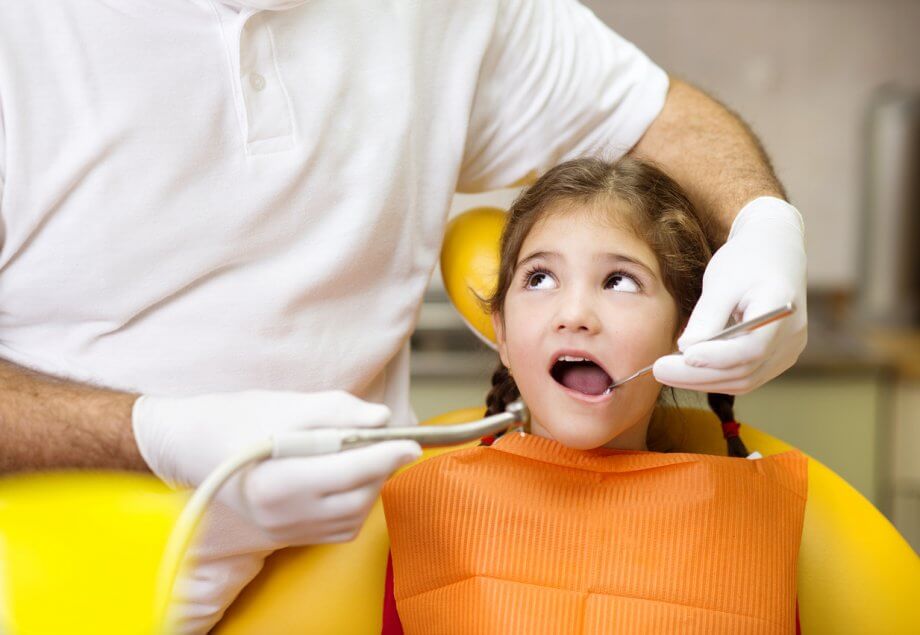
It’s a common moment for parents in Fair Lawn: you're brushing your toddler's teeth and notice a small, discolored spot you hadn't seen before. Your mind immediately jumps to cavities in toddler teeth, and it's easy to feel a surge of concern. First, take a breath. As your local dentist near you, we want to reassure you that while cavities are a real issue, they are also incredibly common and, most importantly, treatable with gentle, compassionate care right here in our office.
If you’re a parent in our local Fair Lawn, Ridgewood, or Glen Rock communities, please know you aren’t alone in this. We created this guide to answer your questions about toddler cavities—from what causes them to how we can work together to prevent and treat them. Consider this your go-to resource from our team here at Dental Professionals of Fair Lawn.
Dr. Jody Bardash and our entire staff are passionate about pediatric dental care. We’ve seen firsthand how catching these things early can pave the way for a lifetime of healthy, confident smiles.
A question we hear all the time at our Fair Lawn practice is, "Do cavities in baby teeth really matter if they're just going to fall out anyway?" The answer we always give is a resounding yes. Those little teeth have some big jobs to do before the adult teeth are ready to take over.
Letting decay go unchecked can lead to pain, infections, and more complex dental work down the road, like a tooth extraction. Our job is to give you the information and support you need to protect that little smile.
Here at Dental Professionals of Fair Lawn, we get it. Taking your toddler to the dentist, especially when you’re worried about a cavity, can be stressful for everyone. With over 30 years of experience, Dr. Bardash has built our practice around providing gentle, family-centered care in an environment that feels welcoming, not clinical.
From your child's very first new patient exam to routine dental cleanings and exams, we're here to guide you every step of the way. And while we're focused on great oral hygiene, we know your child's overall growth is just as important. For ideas on boosting development at home, you might find this guide to personalized story books for toddlers helpful.
We’re not just a dental office; we’re your partners in raising a happy, healthy child in the Fair Lawn, NJ community.
Let's break down what cavities in toddler teeth really are and why we take them so seriously, even in baby teeth. Think of the enamel on your child's teeth as a tiny, protective shield. But here’s the catch: the enamel on baby teeth is naturally thinner and softer than it will be on their permanent adult teeth, making it much more vulnerable.
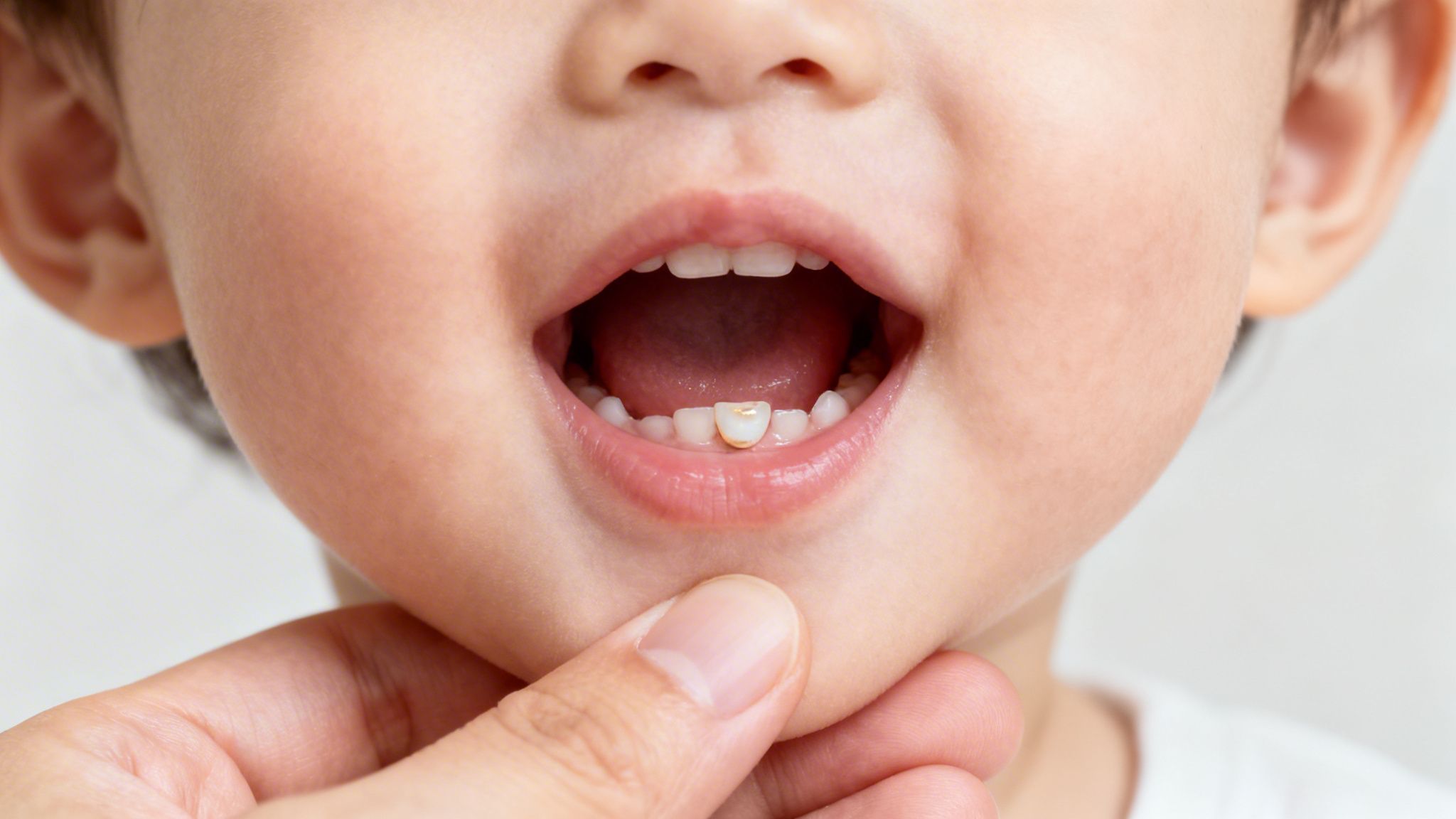
Every time your toddler eats or drinks—especially anything with sugar—the bacteria that live in all of our mouths get to work. They feed on these sugars and produce acid as a byproduct. This acid is the real culprit; it attacks that delicate enamel shield, slowly weakening it over time.
This entire process of decay in young children has a clinical name: Early Childhood Caries (ECC). It's a sneaky condition because it often starts without any pain or visible clues that a parent would notice.
The very first warning sign is a faint, chalky white spot on the tooth's surface, usually right along the gumline. This spot is a red flag that the enamel has begun losing essential minerals. The good news? At this early stage, our dentists can often stop or even reverse the damage with proactive dental care, like professional fluoride treatments here at our Fair Lawn office.
If these early signs are missed, the decay continues its march. The white spots may darken, turning a light brown or even black. Eventually, the weakened area of enamel gives way and collapses, creating the tiny hole we all know as a cavity.
Tooth decay isn't just a minor issue; it is the world's leading chronic childhood disease. Globally, it impacts an estimated 60-90% of children in industrialized nations, highlighting the critical need for early prevention and care.
Without a dentist's intervention, that hole will only grow larger and deeper, making treatment more complex. This is precisely why we urge parents in the Fair Lawn and Ridgewood areas to schedule their child's first new patient exam by their first birthday.
It’s a common misconception that baby teeth don't matter because they'll just fall out anyway. But the truth is, they play several critical roles in your child’s health and development.
This isn't a rare problem. A concerning 23% of U.S. children between the ages of 2 and 5 have had cavities in their baby teeth. The data also shows that about 1 in 10 toddlers in this age group have untreated decay, a number that unfortunately climbs as they get older. You can dig deeper into the national scope of dental caries with data from the NIDCR.
When left untreated, decay can cause significant pain, lead to serious infections, and set the stage for complicated dental issues in the future. Early detection and gentle care right here in our Fair Lawn dental office are the best ways to protect your child’s smile and their overall well-being.
When we think of cavities, candy is usually the first thing that comes to mind. But as dentists here in Fair Lawn, we know the real story is often more complex, especially with little ones. Many seemingly harmless daily habits can create the perfect environment for cavities in toddler teeth.
It’s not just about what they eat, but how often. Constant snacking, even on "healthy" things like crackers, pretzels, or dried fruit, means your child’s teeth are almost always being exposed to carbohydrates. Bacteria feed on these carbs and produce acid, which wears down precious enamel.
Think of it this way: their mouth never gets a break. When there isn't enough time between snacks for saliva to do its job of neutralizing acid and repairing the tooth surface, the decay process can begin.
Another major culprit we see is how a child drinks. Letting your toddler carry a sippy cup or bottle of milk, formula, or diluted juice for long stretches of time effectively bathes their teeth in sugar. This is a fast track to decay, especially for the front teeth.
The absolute riskiest habit is putting a toddler to bed with a bottle of anything other than water. During sleep, saliva production drops significantly. This creates a nightmare scenario where sugar pools around the teeth all night, leading to what's known as baby bottle tooth decay.
It's easy to feel like you're the only one dealing with this, but Early Childhood Caries is a massive global health issue. Studies show it affects nearly half of all preschoolers worldwide—a prevalence of 48% across 67 countries.
This isn't just a distant problem. For families in the Americas, the rate is also 48%. Data from the U.S. shows that 23% of children between ages 2 and 5 have had cavities. You can explore the global findings on childhood caries from this 2021 Wiley review to see just how common these risk factors are.
Here’s a fact that catches many parents off-guard: the bacteria that cause cavities are actually contagious. They can be passed from a parent or caregiver to a child through saliva.
This often happens through innocent, everyday actions like:
We share this not to cause alarm, but to empower you. Being mindful of these simple routines can make a huge difference in protecting your child's smile. Our goal at Dental Professionals of Fair Lawn is to give families in our community, including those in nearby Ridgewood and Glen Rock, practical, non-judgmental advice to keep those little teeth healthy.
Many of these risks are tied to everyday habits that are easy to overlook. The table below breaks down some of the most common ones we see in our practice.
| Risk Factor | Why It Increases Cavity Risk | Preventive Tip From Our Fair Lawn Dentists |
|---|---|---|
| Frequent Snacking | Keeps the mouth in an acidic state, preventing enamel from naturally repairing itself between meals. | Try to stick to set meal and snack times. If they are still hungry, offer water or tooth-friendly snacks like cheese or vegetables. |
| Sipping Sugary Drinks | Constantly bathes the teeth in sugar, providing a continuous food source for acid-producing bacteria. | Reserve milk and juice for mealtimes only. Offer water in a sippy cup for them to drink throughout the day. |
| Bedtime Bottle or Nursing | Sugar from milk or formula pools around the teeth all night when saliva flow is at its lowest. | Always put your child to bed with a clean mouth. If they need a drink, offer a bottle with plain water only. |
| Sharing Utensils/Pacifiers | Transfers cavity-causing bacteria directly from your mouth to your child's. | Use separate utensils for yourself and your child. Clean pacifiers with soap and water, not your own saliva. |
By recognizing these patterns, you can make small changes that have a big impact on your toddler's long-term dental health.
When it comes to cavities in toddler teeth, the best defense is a great offense. It's so much easier—and less stressful for everyone—to stop decay before it even has a chance to start. As your family’s dentist here in Fair Lawn, we want to give you a straightforward game plan to protect your little one's smile, focusing on simple habits you can start right now.
The first and most important step you can take is building a solid oral hygiene routine at home. It’s a foundation that will last a lifetime.
You should start brushing your child’s teeth twice a day the moment that first little tooth pokes through. All you need is a soft-bristled, child-sized toothbrush and a tiny smear of fluoride toothpaste—about the size of a grain of rice—until they turn three. Once they’re old enough to reliably spit out the excess, you can upgrade to a pea-sized amount.
The key is consistency. Make brushing a non-negotiable part of your morning and bedtime routines, and try to make it fun! To ensure you're cleaning effectively, it's also smart to keep their tools clean. You can learn the best way to sanitize toothbrushes to avoid reintroducing bacteria into their mouth.
As soon as you see two teeth touching side-by-side, it's time to start flossing. Those tight spaces are prime real estate for hidden cavities. Kid-friendly flossers make it easy to get into this habit early.
While brushing is essential, what your toddler eats and drinks is just as important. It’s less about banning treats entirely and more about managing how often their teeth are exposed to sugars and starchy carbs.
The daily habits we build with our kids can either protect their teeth or put them at risk.
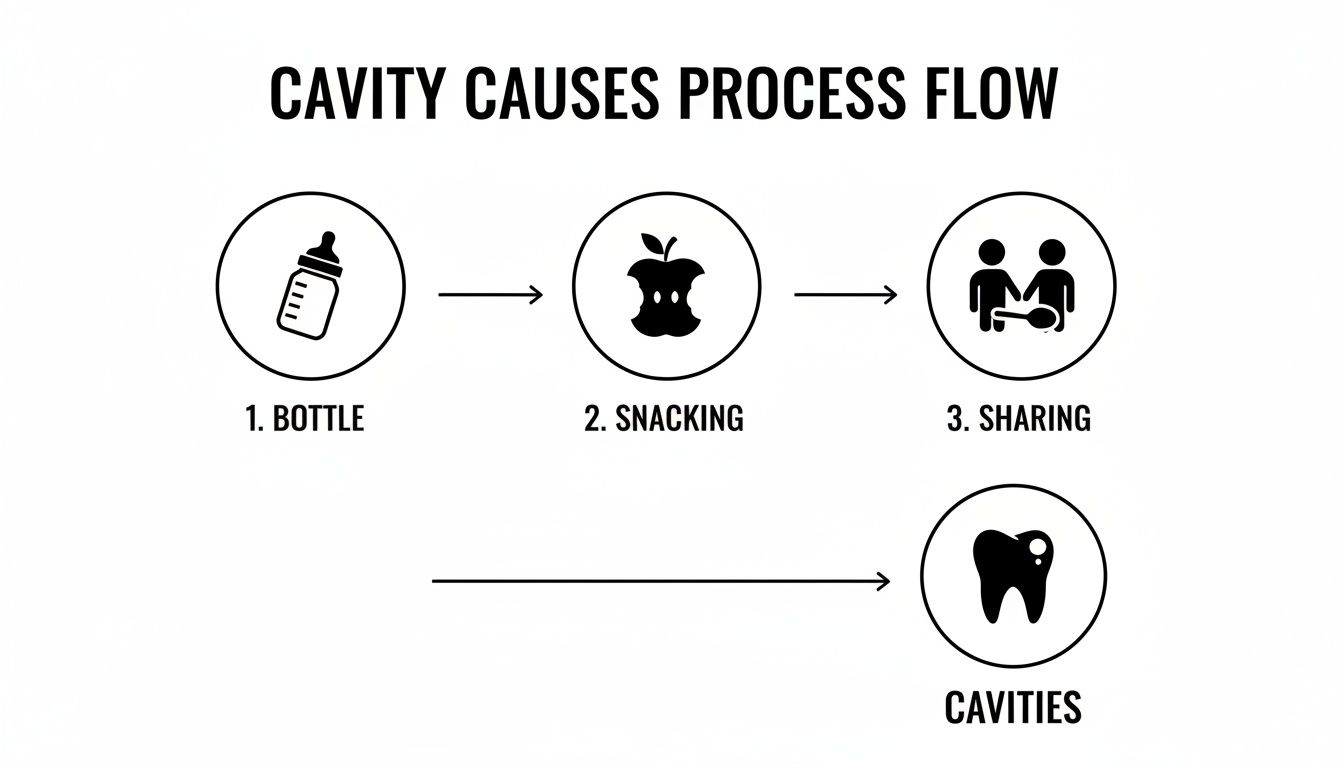
This graphic really shows how things like frequent bottle use, constant snacking, and even sharing spoons can create the perfect storm for tooth decay on a toddler’s delicate enamel.
Regular dental check-ups are the final piece of the puzzle. We can't stress this enough: bring your child for their first visit by their first birthday, even if only a few teeth are in. These early appointments are all about making the dentist a normal, friendly place, not a scary one.
At these check-ups in our Fair Lawn office, we can spot potential issues long before they become painful problems. We also have professional preventive tools that give your child’s teeth an extra shield of armor.
Fluoride varnish is a game-changer for strengthening young teeth. We simply paint a safe, highly concentrated fluoride treatment directly onto their teeth. This mineral fortifies the enamel, making it much tougher and more resistant to the acid attacks that lead to cavities.
Applying fluoride varnish is quick, completely painless, and a standard part of a preventive visit. For families in Fair Lawn, Ridgewood, and Glen Rock, these appointments are the best investment you can make in your child's long-term oral health. If you’re curious about how this works, you can learn more about our professional fluoride treatments and their protective benefits.
That sinking feeling when you hear your toddler has a cavity is completely understandable. But please know, this is one of the most common things we see in our practice, and the path forward is much less scary than you might imagine. Our entire team at Dental Professionals of Fair Lawn is here to make the experience calm, comfortable, and focused on getting your little one’s smile healthy again.
It all starts with a thorough but gentle new patient exam. Sometimes, we’ll need to take a few quick dental x-rays to see exactly what’s happening below the surface. This gives us the full picture so we can sit down with you, explain everything clearly, and decide on the best course of action together. No surprises, just clear communication.
Our primary goal is always to save the natural tooth and stop decay from spreading. We have several ways to do this, depending on how advanced the cavity has become.
For most smaller cavities, the best fix is a simple tooth-colored filling. We use a modern, completely safe composite material that bonds directly to the tooth, making it strong and durable. Best of all, it matches the natural shade of their teeth, so it’s virtually invisible.
If a cavity has grown larger and made the tooth weak, we might recommend a pediatric dental crown. Think of it as a custom-fit helmet that covers and protects the entire tooth, preventing it from breaking. This is a fantastic way to save a baby tooth so it can continue doing its important job—holding the spot for the permanent tooth that will eventually come in.
We know a dental office can seem like a strange and intimidating place for a toddler. That's why helping your child feel safe is at the heart of everything we do. Our team is specially trained to use a “tell-show-do” approach, explaining what we’re doing in simple, kid-friendly terms and turning the visit into a positive experience.
For kids who feel extra nervous or need a bit more work done, we also offer sedation dentistry. These are safe, well-established options that help your child completely relax, allowing us to perform the necessary treatment without any stress or fear. Your child's well-being is our top priority.
Occasionally, a tooth is too decayed to be saved, and the infection could risk the health of the permanent tooth growing underneath. In these rare situations, the healthiest option is a tooth extraction. If this becomes necessary, we will walk you through every step of the process and discuss options for maintaining the space for the adult tooth.
This isn’t just a local issue; it’s a global one. The World Health Organization estimates that over 530 million children have decay in their baby teeth. Here in the U.S., the CDC reports that more than 11% of children aged 2–5 have at least one untreated cavity, with that number rising to almost 18% for 6 to 8-year-olds. You can read more in the 2024 Oral Health Surveillance Report from the CDC.
While we fix the immediate problem, we also want to prevent new ones. We’ll often recommend adding an extra layer of protection to your child's other teeth. You can learn more about how dental sealants act as a shield against future decay. We are committed to being your partner in your child's oral health, every step of the way.
We get it. Bringing your toddler to the dentist for the first time, especially when you’re worried about something like cavities, can be a nerve-wracking experience. Here at Dental Professionals of Fair Lawn, our mission is to take that anxiety right off your plate. We’ve designed our entire practice around making that first visit positive, welcoming, and maybe even a little bit fun.
Think of us less as a sterile dental office and more as your partners in your child's health. With over 30 years of compassionate experience, Dr. Jody Bardash and our incredibly patient team know exactly how to make our youngest patients feel right at home. We're a local practice dedicated to serving families across Fair Lawn, Ridgewood, and Glen Rock, and we take that responsibility to heart.
A first dental visit isn't about diving into complex treatments. It's about building a positive relationship. We want your child to see our office as a friendly, curious place, not a scary one. We often start with something as simple as a ride in the dental chair or counting their teeth together with a tiny mirror.
For most toddlers, we use a technique called a "knee-to-knee" examination. It’s a wonderful, stress-free approach where your child sits on your lap facing you, and then gently leans back into Dr. Bardash’s lap. This keeps them feeling secure with you while allowing us to get a clear, quick look at their teeth and gums.
Our main goal during this first visit is to build trust. We talk your child (and you!) through everything we do in simple, cheerful language. This is your time to ask every question you have, share any worries about cavities in toddler teeth, and get comfortable with our team.
After the quick and gentle check-up, we’ll sit down with you to talk through what we saw. We’ll discuss your child’s oral development, point out any potential risk factors, and give you practical, personalized tips for your at-home routine. It’s a completely judgment-free conversation focused on creating a healthy plan that works for your family.
Honestly, the most important thing we can accomplish at a first visit is to set a happy, positive tone for the future. When a child's first dental experiences are gentle and reassuring, it makes all the difference in preventing dental anxiety later on. We build that foundation by making every visit feel like a win.
That’s why every appointment ends with a trip to our treasure box to pick out a prize. It’s a small thing, but it leaves your child with a great memory and something to look forward to. We're proud to be a part of the Fair Lawn community, and we’re committed to showing you that great dental care can be a supportive, stress-free part of raising a healthy, happy child.
It’s completely normal to have a long list of questions when it comes to your toddler's health. We hear from parents all the time in Fair Lawn and the surrounding communities, and to help put your mind at ease, we've put together answers to some of the most common concerns about cavities in toddler teeth.
Believe it or not, dental care starts before the first tooth even shows up. You can begin by gently wiping your baby’s gums with a soft, damp washcloth after feedings.
As soon as you see that first little tooth emerge, it’s time to start brushing. Use a soft, child-sized toothbrush with just a tiny smear of fluoride toothpaste (about the size of a grain of rice) twice a day. This simple routine is your single best tool for stopping cavities before they ever have a chance to form.
Yes, they are a very big deal and always need a dentist's attention. It's a common misconception that baby teeth don't matter because they'll just fall out anyway. But they play a critical role in your child's development, helping them chew their food, learn to speak clearly, and hold space for the adult teeth to come in correctly.
An untreated cavity in a baby tooth can lead to significant pain and serious infections that can affect your child's overall health. In some cases, infection can even damage the permanent tooth developing underneath the gums.
Here at Dental Professionals of Fair Lawn, our first priority is always to catch decay early and save those important baby teeth, setting the stage for a lifetime of healthy smiles.
Absolutely. Helping a nervous child feel safe and comfortable is at the heart of what we do. We've found that a calm, patient, and friendly approach makes all the difference. Our team uses a "tell-show-do" method, where we explain what we’re doing in simple terms, show them the tools, and then gently proceed. It’s all about building trust.
For little ones who need a bit more help relaxing, especially for longer treatments, we offer safe and effective sedation dentistry. These options allow your child to rest comfortably while we take care of the necessary dental work, all in our modern and welcoming Fair Lawn office.
The very first warning sign is often subtle: a chalky or dull white spot on the tooth's surface, usually right along the gumline. This indicates the tooth is losing minerals.
If that early decay progresses, you might start to see:
If you spot any of these signs, it's time to schedule a visit. The sooner we can take a look, the simpler and less invasive the treatment will likely be.
Protecting your toddler’s smile starts with a partnership between you and a dental team you can trust. If you have more questions or are ready to schedule your child’s first visit, Dental Professionals of Fair Lawn is here to help families in Fair Lawn, Ridgewood, and Glen Rock. Schedule your appointment today by visiting https://dentalprofessionalsoffairlawn.com.